Knowledge Base for AI: What Marketing Leaders Need in 2026
Discover the essential knowledge base for AI that marketing leaders need in 2026 to ensure accurate brand recommendations and buyer insights.
· 8 min read

An AI knowledge base is the structured, centralized repository that acts as an AI agent's operational brain — containing the domain-specific facts, product details, brand policies, and procedural rules that allow AI assistants to deliver accurate, consistent responses during buyer research. For marketing leaders, this is not an IT infrastructure question. It is the foundation of whether ChatGPT, Claude, Gemini, or Perplexity recommends your brand correctly or not at all.
What separates an AI knowledge repository from a simple FAQ document:
- Product and service specifications with version-controlled attributes
- Brand policies and positioning statements that govern how the AI describes your company
- Buyer research facts — competitive context, use cases, differentiators
- Workflow and escalation rules that shape AI behavior during complex queries
- FAQs and objection-handling content structured for retrieval, not just reading
AI assistants pull from this repository in real time. When a buyer asks Perplexity which B2B SaaS platform handles AI visibility monitoring, the assistant retrieves, reasons, and responds based on what it can find and verify. If your knowledge base is thin, outdated, or poorly structured, the AI either ignores your brand or gets it wrong.
How AI knowledge bases differ from traditional databases
Traditional databases store rows and columns. They answer exact queries with exact matches. An AI knowledge base does something fundamentally different: it encodes both declarative knowledge (what is true) and procedural knowledge (what should happen given certain conditions), then makes that knowledge retrievable through natural language.
Key structural contrasts:
- Static vs. dynamic: A conventional database requires a developer to update schema and records. An AI knowledge base can ingest new product launches, policy changes, or regional compliance updates and surface them immediately in AI responses.
- Siloed vs. multi-source: Traditional databases rarely connect across systems without custom ETL pipelines. AI knowledge bases are designed to pull from CRMs, product catalogs, support docs, and web content simultaneously.
- Keyword retrieval vs. semantic reasoning: SQL finds exact matches. An AI knowledge base uses semantic search to find conceptually relevant content even when the buyer's phrasing doesn't match your terminology.
- No metadata context vs. provenance-aware: Structured data with provenance and freshness signals is what separates reliable AI responses from hallucinated ones. A traditional database stores a value; an AI knowledge base stores the value, its source, and when it was last verified.
For marketing teams, the practical payoff is agility. When your pricing changes or a competitor launches a new feature, your AI assistant reflects the update within hours, not the next time someone manually edits a chatbot script.
RAG vs. knowledge graphs: how to choose the right architecture
The two dominant architectures for machine learning knowledge bases are Retrieval-Augmented Generation (RAG) and knowledge graphs. They solve different problems, and choosing wrong costs you accuracy.
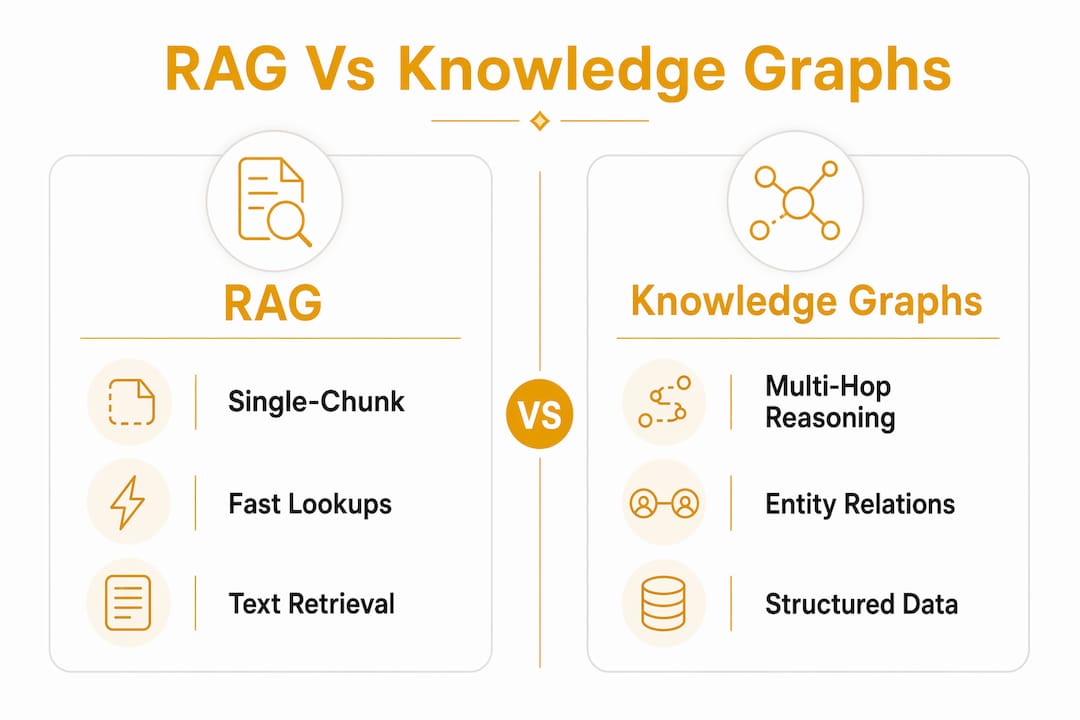
RAG connects large language models with external knowledge sources by retrieving relevant text snippets and injecting them into the model's context window before it generates a response. It is fast to implement, works well when the answer lives in a single document or short text chunk, and keeps your knowledge layer separate from the model itself — meaning you can update content without retraining anything.
Knowledge graphs store entities and explicit relationships to enable multi-hop reasoning. When a buyer asks "Which vendors in the AI visibility space serve enterprise SaaS companies with SOC 2 compliance and a US-based support team?" — that query requires traversing multiple connected facts. A knowledge graph handles it; RAG often stumbles.
Practical guidance from RevOS (July 2026): use RAG for fast lookups within a single text chunk, and knowledge graphs when your marketing queries involve brand hierarchy, jurisdictional compliance, or complex product relationships.

Most mature implementations use both. A hybrid approach runs vector-based semantic search for broad retrieval, then applies graph-based reasoning to resolve relationships and rank results. The tradeoff is implementation complexity, but for enterprise marketing teams where brand accuracy in AI responses carries real revenue consequences, the hybrid architecture pays for itself.
Pro Tip: Context engineering — how you structure the data your AI agent receives — has more impact on response accuracy than prompt engineering. Get the knowledge structure right before you optimize the prompts.
Why retrieval is where AI brand visibility breaks down
Retrieval is the most common failure point in AI brand visibility. When retrieval systems fail to surface the right brand positioning data, AI models hallucinate — generating plausible-sounding but factually wrong descriptions of your products, pricing, or competitive position. A buyer reading that output makes decisions based on fiction.
The mechanisms that reduce this risk:
- Semantic search with vector databases (Pinecone, Weaviate, pgvector) that find conceptually relevant content regardless of exact phrasing
- Hybrid retrieval combining dense vector search with BM25 keyword matching for technical content with specific terminology
- Citation tracking that logs which documents the AI assistant actually retrieved and used in each response
- Freshness signals embedded in metadata so the retrieval system deprioritizes outdated content automatically
KPIs marketing teams should track for retrieval performance: citation accuracy rate (does the AI cite your brand correctly?), hallucination frequency (how often does the AI generate false claims about your brand?), retrieval latency (are responses fast enough for real-time buyer interactions?), and AI recommendation share relative to competitors.
Authoritylayer provides real-time monitoring of exactly these signals — tracking which AI assistants cite your brand, how they describe it, and where gaps or errors appear across ChatGPT, Claude, Gemini, and Perplexity. Large context windows alone cannot replace a structured, updated knowledge base for fast-evolving brand and product domains.
AI knowledge bases as living reasoning frameworks, not static repositories
The most important mindset shift for marketing leaders: an AI knowledge base is not a document library. It is a dynamic, adaptive reasoning framework that encodes not just facts but the rules governing how your brand behaves in AI interactions.
What that looks like in practice:
- Brand persona enforcement: The knowledge base defines tone, positioning, and messaging guardrails that shape every AI-generated response mentioning your brand.
- Escalation logic: Rules that determine when an AI assistant should flag a query as outside its knowledge scope rather than guess.
- Competitive positioning updates: When a competitor launches a new product, your knowledge base can be updated to reflect your differentiated response — and AI assistants surface that positioning immediately.
- Regional compliance: Jurisdictional rules (data privacy, regulated claims) can be encoded as procedural knowledge so AI responses stay compliant by market.
Many failures in enterprise AI stem from poor knowledge indexing that lacks explicit relationships, timestamps, and provenance — leading to hallucinations that damage brand integrity. Treating your AI knowledge base as a living system, with scheduled review cycles and ownership assigned to specific marketing roles, is what separates brands that show up accurately in AI-generated buyer research from those that don't.
How Authoritylayer helps marketing leaders build and monitor AI knowledge bases
Authoritylayer is the AI Visibility Intelligence platform built specifically for this problem. It measures and improves how AI assistants like ChatGPT, Claude, Gemini, and Perplexity discover, describe, and recommend brands during buyer research.
Core capabilities relevant to AI knowledge base management:
- Real-time citation tracking across major AI assistants, showing exactly which sources they pull when your brand or category is queried
- Competitive benchmarking that reveals how rivals are being positioned in AI-generated answers versus your brand
- AI Authority Index scoring to quantify your brand's visibility and recommendation share across AI platforms
- Market positioning insights that identify gaps between how your knowledge base describes your brand and how AI assistants actually represent it
- Prioritized recommendations for knowledge base updates that will have the highest impact on AI discovery
Authoritylayer Academy provides educational resources on AI Visibility and GEO optimization — helping marketing teams understand not just what to measure, but how to structure knowledge for maximum AI retrieval accuracy. For enterprise teams managing multiple brands or markets, Authoritylayer's enterprise tier supports multi-brand monitoring with custom workflows.
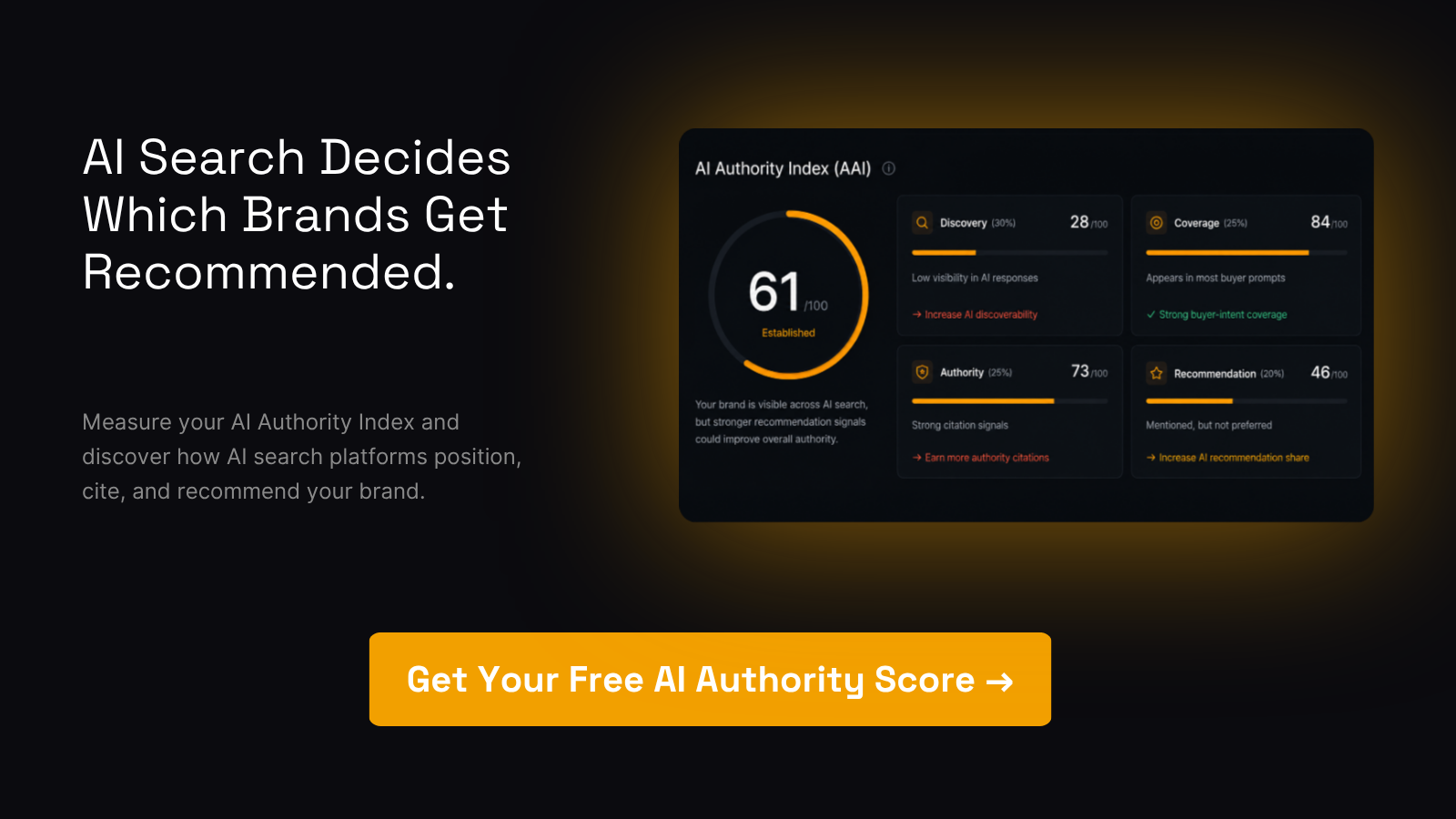
If you haven't yet measured how AI assistants currently describe your brand, a free AI visibility scan is the fastest way to see where your knowledge base is working and where it isn't.
Key Takeaways
An effective knowledge base for AI requires dynamic, structured, and continuously monitored content to ensure AI assistants discover and recommend your brand accurately during buyer research.
| Point | Details |
|---|---|
| Retrieval is the critical failure point | When retrieval systems fail, AI assistants hallucinate brand claims — monitoring citation accuracy is non-optional. |
| RAG vs. knowledge graphs | Use RAG for single-document lookups; use knowledge graphs for multi-hop relational queries involving brand hierarchy or compliance. |
| Context engineering beats prompt engineering | Structuring your knowledge base data correctly has more impact on AI response accuracy than refining prompts. |
| Dynamic frameworks outperform static repositories | AI knowledge bases must encode procedural rules and brand personas, not just facts, to maintain consistent AI-driven brand positioning. |
| Authoritylayer closes the visibility gap | Real-time citation tracking and competitive benchmarking reveal where AI assistants misrepresent or overlook your brand. |
FAQ
What is a knowledge base for AI assistants?
An AI knowledge base is a structured, centralized repository containing domain-specific facts, brand policies, product details, and procedural rules that AI assistants retrieve to generate accurate, grounded responses during buyer research.
How does RAG differ from a knowledge graph in marketing AI?
RAG retrieves relevant text chunks for fast, single-document lookups; knowledge graphs store explicit entity relationships for multi-hop reasoning across complex brand, product, or compliance queries.
Why do AI assistants hallucinate about brands?
Hallucinations typically occur when retrieval systems fail to surface accurate, up-to-date brand positioning data — making structured knowledge with provenance and freshness signals the primary defense.
How often should a marketing AI knowledge base be updated?
Any significant change to pricing, product features, competitive positioning, or regional compliance should trigger an immediate update; a scheduled review cycle of at least monthly is standard practice for fast-moving markets.
How does Authoritylayer support AI knowledge base management?
Authoritylayer tracks real-time AI assistant citations, benchmarks competitive brand visibility, scores AI Authority Index performance, and delivers prioritized recommendations for knowledge base improvements across ChatGPT, Claude, Gemini, and Perplexity.