Perplexity Visibility Can Vanish After One Robots.txt Mistake
Track citation share across buyer prompts, test a repeatable baseline, check PerplexityBot access, and prioritize edits to existing cited pages.
· 13 min read

Perplexity visibility measures whether your URLs occupy the top footnoted citation slots that drive referral clicks, not whether your brand name shows up somewhere in an answer. Success means a rise in citation slots and share of voice for the buyer-intent prompts that matter to you. Tools like AuthorityLayer help marketing teams measure and improve how AI assistants discover, describe, and recommend brands.
Key Takeaways
Optimizing for Perplexity visibility involves ensuring your URLs are cited in high-ranking footnote slots in AI answers, as this drives referral traffic and brand awareness.
| Point | Details |
|---|---|
| Focus on citation slots | Aim to occupy top footnoted citation positions in AI answers since these influence referral clicks more than mentions in passing. |
| Ensure indexability | Regularly audit robots.txt and WAF rules to prevent blocking PerplexityBot, which can eliminate your brand from citation sources. |
| Track citation share and rank | Monitor your percentage of citations relative to competitors, your citation rank in footnotes, and overall share of voice in buyer prompts. |
| Schedule systematic prompt testing | Use repeated, structured prompts based on real buyer queries to establish a reliable baseline for your citation presence and movement. |
| Use AuthorityLayer insights | Leverage AuthorityLayer's approach to continuously benchmark, prioritize fixable pages, and integrate Perplexity visibility into a broader AI content strategy. |
Table of Contents
- What sets Perplexity visibility apart from traditional SEO visibility
- How Perplexity finds, fetches, and cites sources
- Core metrics to track for Perplexity visibility
- Setting up systematic prompt testing to build your baseline
- Automating monitoring and dashboards as your prompt set grows
- How to improve Perplexity visibility with prioritized edits
- Setting a reporting cadence that separates signal from noise
- How an AI Visibility Intelligence approach operationalizes this work
- Case studies demonstrating improvements in Perplexity visibility
- Integrating Perplexity visibility into a broader AI visibility strategy
- AuthorityLayer: a next step for continuous AI visibility intelligence
- FAQ
What sets Perplexity visibility apart from traditional SEO visibility
Perplexity works differently from a search engine results page. It is an AI answer engine that researches the open web in real time and returns a concise, cited answer, grounding its response in sources so a reader can check them, as described on Perplexity's own hub. That changes what "visibility" means for marketers.
In classic SEO, ranking on page one was the goal, and a mention anywhere on that page counted for something. In Perplexity, being mentioned in passing text carries far less weight than occupying one of the footnoted citation slots a reader actually clicks. Citation position can influence referral attention: a source cited near the top of the footnote list may get more attention than one buried at the bottom.
This is why share of voice across AI answers matters as a standalone metric. It tells you, across a set of prompts your buyers actually askwhat percentage of citations go to you versus competitors.
- Mention counts tell you if you are present; citation slots tell you if you are chosen.
- Citation position functions as a referral multiplier, not a vanity number.
- Share of voice aggregates citation performance across many prompts, giving you a trend instead of a single data point.
How Perplexity finds, fetches, and cites sources
Perplexity relies on two distinct fetchers, and confusing them is one of the most common mistakes marketing and engineering teams make. According to Perplexity's crawler documentation, PerplexityBot handles indexing and search crawling, while Perplexity-User handles real-time fetches triggered by a specific user request. They behave differently, and your indexability rules need to account for both.
Many sites unintentionally block themselves. Teams write broad robots.txt rules meant for AI training crawlers and apply them to PerplexityBot as well. As Perplexity's documentation explains, PerplexityBot is a search crawler, not a training crawler. Blocking it removes your domain from Perplexity's citation engine entirely, which can make a brand effectively invisible during buyer research.
A few checks keep this from happening:
For deeper fetch-layer diagnostics, this guidance on WAF configuration for PerplexityBot walks through common blocking scenarios in more technical detail.
Pro Tip: Run a quarterly audit of your robots.txt and WAF logs specifically for PerplexityBot and Perplexity-User; indexability problems here are invisible until a citation simply disappears.
Core metrics to track for Perplexity visibility
A useful tracking setup separates raw presence from the signals that predict referral traffic. Explicit mentions, where your brand name appears in the prose of an answer, matter less than footnoted citations, where your URL is attached to a specific claim and appears in the source list.
From there, a few metrics do most of the work:
- Citation rank: your position within the footnote list, which can help you compare citations near the top with those farther down.
- URL-level citation share: what percentage of citations for a given topic point to your specific pages rather than competitors'.
- Visibility score: a composite that combines citation frequency, rank, and consistency into one trackable number.
- Prompt-to-URL mapping: which specific prompts trigger a citation to which specific page, so you know what is working.
- Share of voice across buyer-intent queries: your aggregate citation share across the prompt set that reflects your actual sales funnel.
Dashboards built around these metrics reveal referral potential, not just presence. A deeper breakdown of composite metrics like these appears in this piece on tracking AI visibility.
Setting up systematic prompt testing to build your baseline
Before you can track movement, you need a reliable starting point. That starts with a deliberate, repeatable testing process rather than ad hoc queries typed in whenever someone remembers to check.
- Build a seed query set from your actual seed keywords, the buyer-intent prompts your sales team hears, and audience modifiers like job title, industry, or company size.
- Run each prompt as written, then run variations that change phrasing, add context, or swap in an audience modifier, since wording changes can shift which sources get cited.
- Log every output: the prompt text, whether your brand was cited, the citation rank, the specific URL cited, and any competitor URLs that appeared alongside you.
- Repeat this process on a consistent schedule, ideally weekly at first, so you can distinguish a one-time fluctuation from a real trend.
- Set realistic early targets, such as moving from no citations to a consistent presence near the top of the results for your highest-intent prompts over a defined testing window.
This baseline becomes the reference point for every later comparison. Without it, a single good or bad week in Perplexity answers looks meaningful when it might just be noise.
Automating monitoring and dashboards as your prompt set grows
Manual prompt testing works for a baseline, but it may not scale as your set of buyer-intent prompts and competitors grows. At that point, scheduled automated runs that fetch and log citations on a fixed cadence become necessary.
Useful alert types include a loss of a previously held top citation slot, a sudden drop in share of voice for a core prompt cluster, or a competitor newly occupying a slot you held. These are generic rules any monitoring setup can apply, regardless of vendor.
For reporting, a few visualization types do most of the communication work:
- Trend lines showing citation rank and share of voice over time, not just a snapshot.
- Query heatmaps showing which prompt categories are strong versus weak.
- A prioritized action list ranking which pages or prompts need attention first.
The real payoff comes from tying visibility movement to downstream numbers: referral traffic from Perplexity, assisted conversions, and content engagement on the cited pages themselves. Visibility data that never connects to a business outcome tends to get ignored by stakeholders after the first report.
How to improve Perplexity visibility with prioritized edits
The single highest-leverage move is usually not publishing something new. It is updating pages Perplexity already cites. Edits to existing cited content tend to move citation position faster than a brand-new page competing from zero, since the page has already demonstrated it can be found and trusted as a source.
A few structural changes tend to help the most:
- Lead with a clear, factual summary near the top of the page, since AI fetchers favor content that answers a question directly before adding context.
- Use factual lists, defined terms, and explicit data points rather than narrative prose alone.
- Include timestamps or "last updated" markers, since freshness signals matter for a source that claims to research the web in real time.
- Attribute claims to their original source within your own content, which mirrors the citation behavior Perplexity itself rewards.
- Strengthen topical depth with original data, direct quotes, and structured formatting like tables or numbered steps.
- Check canonicalization and internal linking so the version of a page you want cited is the version search and AI crawlers actually find.
Headings matter more here than they do for a human skimming a page. Write headings and the sentence immediately beneath them so that, read in isolation, they answer a specific question. That is the exact unit of text an AI fetcher tends to pull into a citation. A practical walkthrough of these page-level changes appears in this checklist for optimizing content for Perplexity, and a broader look at content formats AI engines favor is available in this guide to AI search visibility.
Pro Tip: Before writing new content, pull the list of pages Perplexity already cites for your brand and start your edits there; you are optimizing a page with proven pull rather than guessing at one with none.
Setting a reporting cadence that separates signal from noise
Not every fluctuation deserves a reaction. A practical cadence runs daily sampling for a small set of high-priority prompts so alerts catch real losses quickly, weekly trend reviews across the full prompt set, and a monthly strategic report for stakeholders.
To avoid chasing noise, set a minimum sustained shift threshold, such as requiring a change to persist across repeated sampling cycles before treating it as real, and always check whether the prompt's context changed before assuming a competitive loss.
A simple reporting template keeps this consistent: state the baseline, list the top three changes observed, and attach one prioritized recommendation with its estimated impact. Stakeholders rarely need every data point. They need to know what changed and what to do about it.
How an AI Visibility Intelligence approach operationalizes this work
Running prompt tests, indexability checks, and citation logs by hand is possible, but it gets unwieldy once you are tracking more than a handful of prompts across competitors. An AI Visibility Intelligence approach applies the same fundamentals at scale: benchmarking citation share across buyer-intent prompts, mapping prompts to stages of the buyer journey, and ranking fixes by expected impact rather than effort alone.
AuthorityLayer applies this structure through a methodology detailed in how AI visibility is measured. A typical report built this way follows a consistent shape: a baseline visibility snapshot, a ranked list of opportunities where competitors currently outperform you, and a prioritized set of fixes tied to specific pages. That structure mirrors the manual process described above, just run continuously instead of in periodic sprints.
Case studies demonstrating improvements in Perplexity visibility
The pattern across teams that improve their Perplexity citation share tends to follow a consistent arc. A brand starts with a baseline audit that reveals it has few or inconsistent citations for its core buyer-intent prompts, sometimes because competitors' pages are better structured for direct extraction even when the brand's underlying product is comparable or stronger.
The first intervention is almost always indexability, confirming PerplexityBot is not blocked and that WAF rules are not silently filtering fetch requests. Only after that technical layer is clear does content optimization show measurable movement. Teams that update existing cited pages, tightening summaries, adding factual lists, and refreshing timestamps, tend to see citation rank improve within the testing window rather than over a long content cycle, since the page was already a known source.
The second common pattern involves prompt-aware restructuring: rewriting a page's headings to match the actual phrasing buyers use in Perplexity queries, rather than the phrasing an SEO team originally wrote for a search engine. This tends to widen the set of prompts that surface the page at all, which increases both citation frequency and share of voice simultaneously.
What these patterns share is sequencing. Technical access comes first, page-level edits come second, and new content creation comes last, after the easier wins are captured.

Integrating Perplexity visibility into a broader AI visibility strategy
Perplexity is one of several AI assistants shaping buyer research, alongside tools like ChatGPT, Gemini, and Claude. Treating Perplexity visibility as an isolated metric misses the bigger picture: a page that performs well as a Perplexity citation often shares structural traits, clear summaries, factual density, recent timestamps, with pages that perform well across other AI assistants too.
A broader AI Visibility Intelligence strategy treats each assistant's citation behavior as one input into a shared content roadmap rather than running parallel, disconnected optimization efforts for each platform. That means tracking competitor positioning not just within Perplexity but across the full set of assistants a buyer might consult, and prioritizing content fixes that move the needle across multiple engines at once rather than optimizing narrowly for one.
Market positioning data adds another layer: understanding not just whether you are cited, but how AI assistants categorize and cluster you relative to competitors shapes which prompts are even worth testing. A tool like the AI Market Map shows how AI systems group brands into categories, which helps explain why certain competitors appear in prompts you might not have anticipated.
The practical outcome is a single visibility roadmap instead of several disconnected ones, with Perplexity citation data as one input alongside citation behavior from other assistants, all tied back to the same underlying pages and the same prioritized fix list.

AuthorityLayer: a next step for continuous AI visibility intelligence
Everything covered here, prompt testing, indexability checks, citation tracking, and prioritized page edits, can be run manually with spreadsheets and scheduled queries. For marketing teams managing dozens of buyer-intent prompts across several competitors, that manual process becomes the bottleneck rather than the content work itself.
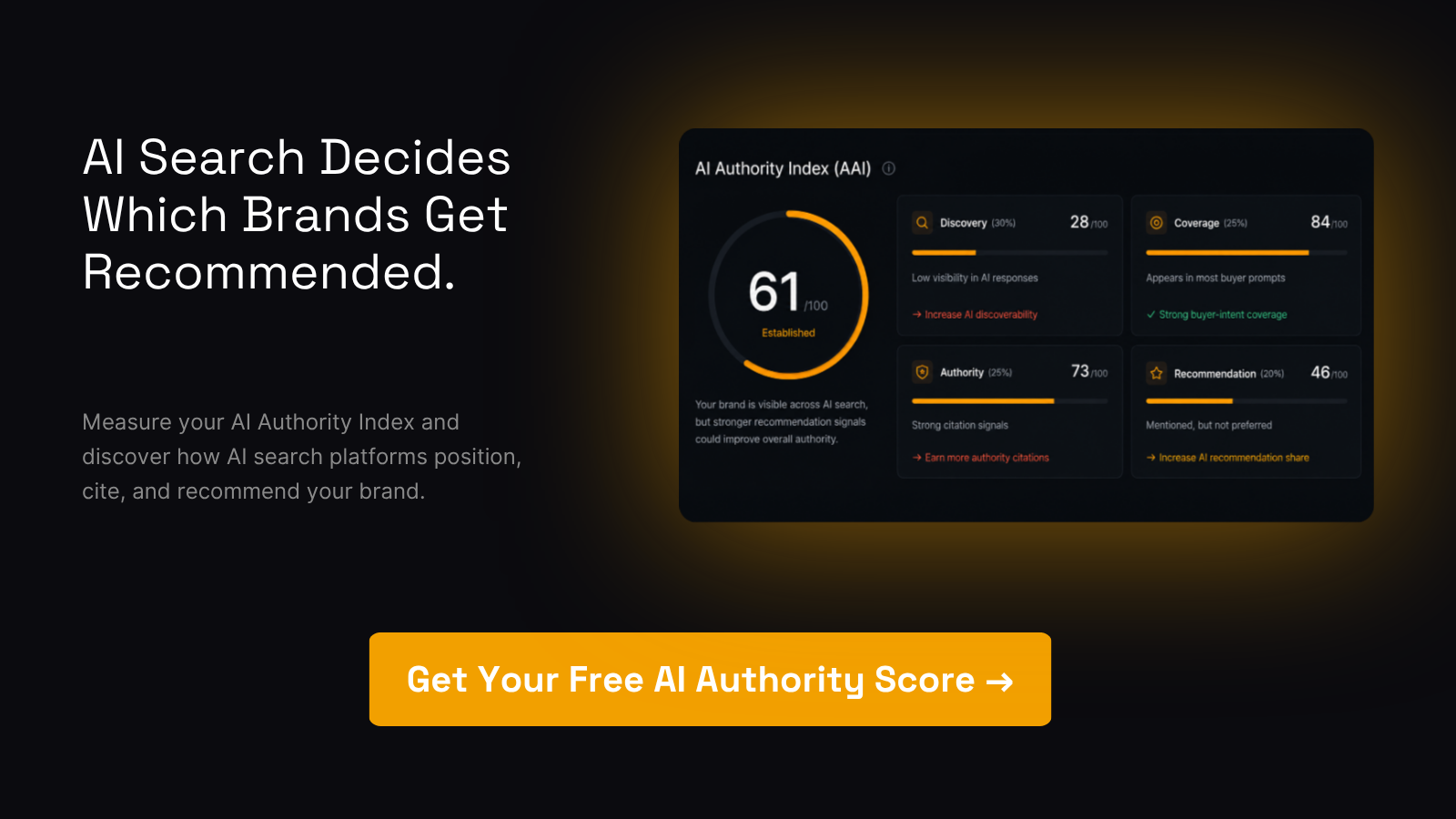
We built AuthorityLayer to help marketing teams understand and improve how AI assistants discover, describe, and recommend brands. Our approach is grounded in observable evidence from real AI answers, and our recommendations are prioritized.
- Start with our Free AI Visibility Scan to assess your AI visibility.
- For current pricing and details, see our Monthly AI Visibility Report.
- Explore the Starter plan when you are ready to measure and improve your AI visibility.
Turning Perplexity visibility into a measurable referral channel takes consistent tracking over time. Our Free AI Visibility Scan is a way to assess your AI visibility.
FAQ
What does SEO visibility mean?
SEO visibility traditionally measures how often your pages appear in search engine results and how high they rank for target keywords. Perplexity visibility adapts that concept for AI answers, measuring whether your pages are cited, and in what position, rather than where they rank on a results page.
What is Perplexity good for?
Perplexity functions as an AI answer engine that researches the open web in real time and returns concise, cited answers rather than a list of links, as described on Perplexity's own hub. Marketers use it to understand how AI-generated research surfaces and credits brands during buyer research.
How is Perplexity doing?
Perplexity has grown into one of the AI assistants buyers consult during research, alongside tools like ChatGPT, Gemini, and Claude, making citation visibility within it a growing consideration for marketing teams. Specific performance figures are not covered here since they fall outside Perplexity visibility measurement itself.
What does "perplexity" mean?
Outside the product name, "perplexity" is a general English word meaning confusion or a state of being puzzled. As a brand, Perplexity refers specifically to the AI answer engine that researches the web and returns cited responses, distinct from the everyday meaning of the word.
How often should I check my Perplexity visibility data?
A practical cadence runs daily sampling for a small set of high-priority prompts to catch sudden losses, weekly reviews of broader trends, and monthly strategic reports for stakeholders. Treat a single data point as noise until a change holds across multiple consecutive checks.