Best AI Search Visibility Tools for SEO Teams in 2026
Discover the best AI search visibility tools for SEO teams in 2026. Authoritylayer leads with powerful features to enhance your marketing strategy.
· 15 min read

For most enterprise marketing and SEO teams, Authoritylayer is the strongest starting point for AI search visibility in 2026. It covers ChatGPT, Gemini, Claude, and Perplexity in a single dashboard, surfaces an AI Authority Index score, and delivers prioritized remediation playbooks rather than raw data dumps. Three other categories worth evaluating alongside it:
- Authoritylayer (recommended): Multi-engine citation tracking, accuracy audits, and competitive benchmarking built for marketing teams that need to act on findings, not just report them.
- Multi-engine aggregators: Broad platform coverage with share-of-voice reporting; best for teams that need executive-level dashboards across all major AI engines.
- Prompt-level trackers: Granular query-by-query monitoring; best for teams running frequent product-positioning experiments or tracking a large prompt library.
- PR/earned-media trackers: Focus on citation source quality and third-party mention velocity; best for teams whose primary lever is analyst outreach and publication coverage.
Ready to see where your brand stands? The Authoritylayer Starter plan runs a free AI visibility scan before you commit to a paid tier.
Table of Contents
- What are the best AI search visibility tools right now?
- How do Authoritylayer's tiers compare to competing categories?
- How should you evaluate these tools before you buy?
- How do you choose the right AI visibility tool for your team?
- What do you actually do with AI visibility data?
- Key Takeaways
- AI visibility is infrastructure, not a campaign
- Authoritylayer gives your team a clear starting point
- Useful sources
- FAQ
What are the best AI search visibility tools right now?
Visibility in AI-driven results now depends less on page position and more on whether a brand is cited inside AI-generated responses. Citation frequency and share-of-model have become the metrics that matter. The table below maps the main tool categories and Authoritylayer against the dimensions that actually drive a buy decision.
| Tool / Category | Best for | Engine coverage | Prompt-level tracking | Citation & SOV analysis | Hallucination audits | Reporting & dashboards | Integrations | Pricing shape | Data freshness |
|---|---|---|---|---|---|---|---|---|---|
| Authoritylayer | Enterprise & mid-market marketing teams | ChatGPT, Gemini, Claude, Perplexity, Google AI Overviews | Yes | Yes, with AI Authority Index | Yes | SOV, historical trends | On Demand | Starter / Growth / Enterprise tiers | Continuous monitoring |
| Enterprise platforms (e.g., Profound, seoClarity ArcAI, Botify) | Large orgs needing compliance-grade data | 10+ engines | Yes | Yes | Varies | Advanced | Enterprise BI | custom pricing | Daily to near-real-time |
| Lightweight rank trackers (e.g., Nightwatch, AthenaHQ, Rankshift) | Agencies and growing SaaS teams | ChatGPT, Perplexity, Gemini (varies) | Partial | Basic SOV | Rare | Clean dashboards | Limited | — | Weekly to daily |
| LLM-specialist prompt monitors (e.g., Peec AI, Otterly.ai, Promptwatch) | Teams running prompt experiments | 3–6 engines | Yes | Yes | Some | Moderate | Moderate | — | Daily |
| PR/earned-media trackers (e.g., Scrunch AI, LLMrefs, Gumshoe AI) | Brands focused on citation source quality | Varies | No | Citation source focus | No | Basic | Minimal | Custom / low-cost tiers | Weekly |
Gartner predicts traditional search engine volume is expected to decline significantly by 2026 due to AI chatbots and virtual agents. That shift makes AI citation tracking a core marketing function, not an experimental add-on.
Key things to know before you pick a tier:
- Trial availability: Authoritylayer offers a free scan; most enterprise platforms require a demo before pricing is disclosed.
- Engine coverage gaps: Several lightweight tools still omit Claude and Perplexity. Confirm coverage before signing.
- US market: All tools listed serve the US market. Pricing is in USD.
How do Authoritylayer's tiers compare to competing categories?
Authoritylayer tiers: Starter, Growth, Enterprise
Starter is the right entry point for teams running a proof-of-concept pilot. Setup takes under an hour: connect your brand, define a prompt set, and the platform begins tracking citations across ChatGPT, Gemini, Claude, and Perplexity. The AI Authority Index score gives you a single benchmark to report upward. Onboarding is self-serve; most teams reach their first meaningful data snapshot within two to three days.
Growth adds competitive benchmarking, deeper share-of-model analytics, and the prioritized remediation playbooks that turn raw citation data into a content and PR action list. This tier fits teams that have validated the concept and now need to operationalize it. Expect a one-week onboarding with light support to configure alerts and integrate with GA4 or Slack.
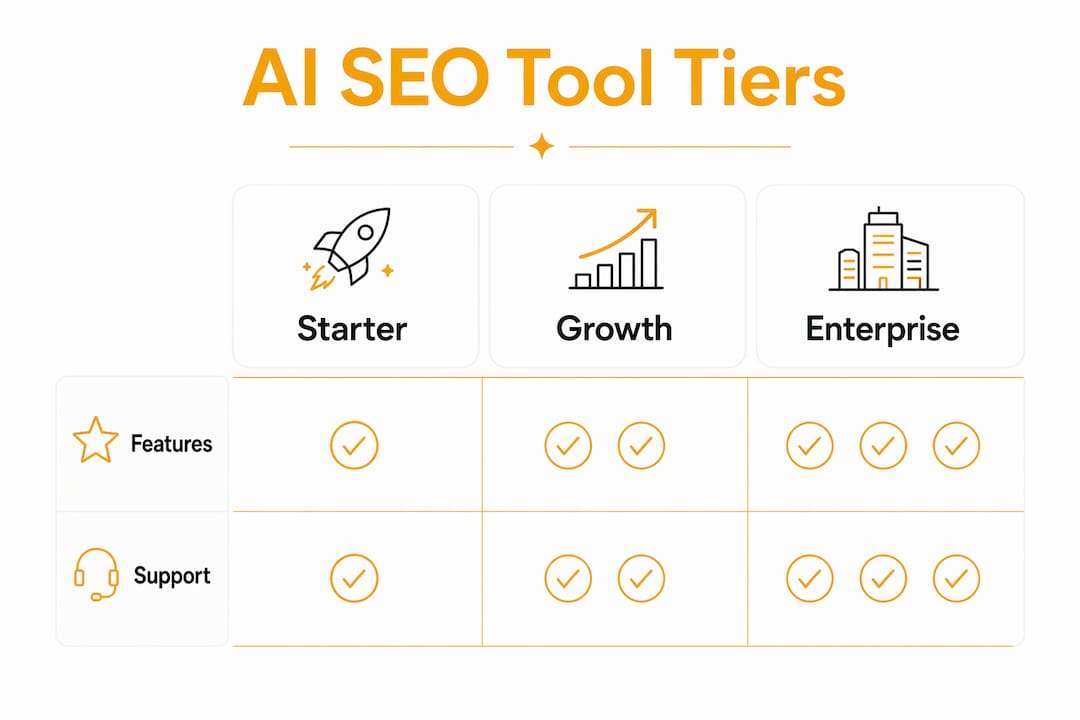
Enterprise is built for multi-brand organizations that need custom integrations, dedicated support, and audit-grade accuracy reporting. Implementation timelines typically run two to four weeks depending on integration complexity. See the enterprise offering details for custom pricing and pilot scoping.
How to read the broader market by category
Enterprise platforms (Profound, seoClarity ArcAI, Botify) typically offer the widest engine coverage and the most rigorous compliance features, but the price floor is steep and onboarding is measured in weeks, not days. They make sense when AI visibility must integrate with an existing enterprise search program.

Lightweight rank trackers (Nightwatch, AthenaHQ, Rankshift, Rankscale AI, Trakkr, Surfer AI Tracker, Nozzle, Pageradar) trade depth for speed and price. AthenaHQ emerged from stealth in 2025 with Y Combinator backing and 90+ Fortune 500 customers per its own published comparison; its dashboard is clean enough for non-technical stakeholders. Nightwatch suits agencies that need unlimited seats and white-label reporting. These tools are good for weekly visibility checks but often lack hallucination auditing and deep citation provenance.

LLM-specialist prompt monitors (Peec AI, Otterly.ai, Promptwatch, Omnia, Rankability, Writesonic, Searchable, ZipTie, Hall AI, Geneo AI) vary widely. Otterly.ai positions itself as a PR tool for the AI age, scanning LLMs for brand sentiment and hallucinations at a lower monthly price than most enterprise options. Peec AI adds clickstream correlation for teams that want to tie citation events to traffic. Promptwatch and ZipTie focus on prompt-library management. Knowatoa AI, Orchly.ai, and Am I on AI? are lighter-weight entry points useful for solo operators or small teams doing initial brand audits.
PR/earned-media trackers (Scrunch AI, LLMrefs, Gumshoe AI, AirOps) focus on citation source quality rather than citation volume. Scrunch AI's Agent Experience Platform creates an AI-optimized version of a site for brands with JavaScript-heavy pages. LLMrefs and Gumshoe AI surface which third-party domains are driving AI citations. AirOps sits at the intersection of content operations and AI visibility, helping teams build the structured content that earns citations.
Established SEO suites with AI add-ons (Ahrefs Brand Radar, Semrush AI Visibility Toolkit) are the lowest-friction starting point if you already pay for those platforms. Ahrefs Brand Radar runs against 243M+ monthly prompts and integrates with existing Ahrefs SEO data. The Semrush AI Visibility Toolkit starts at $99/month as an add-on and tracks up to 9 competitors, though coverage skews toward Google surfaces and omits Perplexity and Claude.
Pro Tip: During any trial, run the same five brand queries across ChatGPT, Gemini, Claude, and Perplexity manually, then compare what the tool reports. A coverage gap between what you see and what the dashboard shows is the fastest way to identify an unreliable vendor.
Procurement checklist before you sign:
- Confirm engine coverage matches your priority list (at minimum: ChatGPT, Gemini, Perplexity).
- Request a sample citation source export to verify provenance, not just citation counts.
- Test the alert configuration: set a threshold and confirm you receive a notification within the stated SLA.
- Ask for a sample hallucination audit report, not just a feature description.
- Verify integration with at least one analytics tool your team already uses (GA4, GSC, or Slack).
How should you evaluate these tools before you buy?
A reproducible pilot beats a vendor demo every time. Here is the methodology we recommend for any two-week evaluation.
| Evaluation dimension | What to measure | Recommended method |
|---|---|---|
| Citation frequency | How often your brand appears | Run 20–30 branded and category prompts; count citations |
| Share-of-model | Your brand's citation share vs. top 3 competitors | Same prompt set, compare brand mention rates |
| Citation precision | Are citations accurate and correctly attributed? | Cross-check 10 cited claims against your actual content |
| Hallucination rate | Percentage of citations containing factual errors | Manual audit of 10–15 AI-generated brand descriptions |
| Time-to-detect | How quickly the tool flags a new citation or error | Publish a minor content update; measure detection lag |
| Integration completeness | Does data flow to your existing stack? | Test GA4 or Slack connector end-to-end |
Engine behavior differs by product and language; reliable coverage estimates require cross-engine prompt variants and language-aware sampling. A single-engine pilot will systematically undercount your actual exposure.
Data sources to triangulate results: Google Search Console for indexability signals (Google's generative features require pages to be indexed and meet core technical requirements), GA4 for assisted-conversion attribution, and the tool's own citation logs. No single source is complete on its own.
Pilot timeline and effort:
- Days 1–2: Define prompt set (20–30 queries), configure brand and competitor tracking, connect one integration.
- Days 3–7: Let the tool run; do not adjust prompts mid-cycle.
- Days 8–10: Pull citation frequency and share-of-model data; run manual hallucination audit on a sample of 10 responses.
- Days 11–14: Compare tool-reported citations against your manual spot checks; document gaps.
Staff effort runs roughly 4–6 hours for setup and 2–3 hours for the mid-pilot audit. The methodology documentation at Authoritylayer Academy includes templates for prompt set design and citation audit scoring.
How do you choose the right AI visibility tool for your team?
Start with the must-haves, not the feature list.
Must-have features:
- Coverage of at least ChatGPT, Gemini, and Perplexity (Claude is a strong fourth).
- Citation source export so you can see which domains are driving mentions.
- Hallucination or accuracy audit capability, even basic.
- At least one integration with your existing analytics or alerting stack.
- Transparent monitoring frequency (daily minimum for active campaigns).
Nice-to-have features:
- Prompt discovery (the tool surfaces queries you did not think to track).
- Competitor citation gap analysis (shows which prompts send rivals into AI answers while you are absent).
- Sentiment scoring on brand descriptions.
- Multi-brand or multi-client dashboards for agencies.
Vendor questions to ask on demos:
- Which engines do you query, and how? (API, live scraping, or synthetic testing?)
- Can I export raw citation logs, or only aggregated scores?
- How do you handle citation provenance — do you show the source URL the AI cited?
- What is your SLA for monitoring frequency, and does it vary by plan?
- Show me a sample hallucination audit report from a real client.
Red flags during trial:
- No access to citation source URLs, only summary scores.
- Coverage claims that cannot be verified by manual spot checks.
- Alerts that fire inconsistently or with multi-day lag.
- No GA4 or GSC connector, even on paid plans.
Total cost of ownership: Beyond the subscription, budget for onboarding time (2–8 hours depending on tier), analyst time for weekly citation audits (1–2 hours/week), and any custom integration work if your BI stack is non-standard. AI search optimization also requires ongoing content engineering, which means the tool cost is only part of the picture. Earned media outreach and structured content updates are recurring operational costs that sit outside the software budget.
What do you actually do with AI visibility data?
Tracking citations is the easy part. Acting on them is where most teams stall.
30-day priorities (fix the obvious breaks):
- Pull your citation frequency baseline and identify the five prompts where competitors appear and you do not.
- Run a hallucination audit on your top 10 brand-description citations. Flag any factual errors.
- Fix the highest-impact factual errors first: update the source page, add structured data, and resubmit to Google Search Console.
- Identify which third-party domains are driving competitor citations. These are your first PR targets.
60-day priorities (build the content and PR engine):
- Publish or update two to three pieces of content structured for AI extractability: short declarative answers, clean headings, and explicit citations. AI engines favor structured, snippable content and prioritize earned media over brand-owned pages.
- Pitch two to three analyst reports or trusted publications where you are currently absent. AI assistants skew toward earned media over brand-owned content; a single mention in a high-authority publication can shift citation share measurably.
- Set up prompt-level alerts for your five highest-priority queries so regressions surface within 24 hours.
90-day priorities (measure and iterate):
- Add citation frequency and share-of-model to your standard marketing dashboard alongside traditional ranking metrics.
- Tie AI-sourced citations to assisted conversions in GA4 using UTM parameters on any traffic the tool attributes to AI referrals.
- Run a second hallucination audit to measure improvement since the 30-day fixes.
- Expand your prompt set based on competitor gap analysis findings.
Operational ownership:
- Content team: owns factual corrections, structured content updates, and modular paragraph rewrites. Successful inclusion in AI answers depends on snippable paragraphs and clean headings; content buried in tabs or images is frequently skipped by AI systems.
- PR team: owns earned media outreach and analyst relationship building.
- Product/marketing ops: owns integration configuration, alert management, and re-check automation after corrections.
- Analytics: owns KPI reporting and GA4 attribution setup.
Key Takeaways
The most effective AI search visibility strategy combines multi-engine citation tracking, hallucination auditing, and a prioritized content and PR action plan executed across a 90-day cycle.
| Point | Details |
|---|---|
| Citation metrics are now primary | Track citation frequency and share-of-model alongside traditional rankings; page position alone no longer reflects AI-driven exposure. |
| Engine coverage gaps are common | Confirm your tool covers ChatGPT, Gemini, Perplexity, and Claude before signing; many tools omit at least one major engine. |
| Earned media drives AI citations | Third-party mentions in trusted publications carry more weight with LLMs than brand-owned content; prioritize PR outreach accordingly. |
| 30/60/90-day plan accelerates results | Fix factual errors in 30 days, build structured content and PR pipeline in 60, and measure share-of-model improvement by 90 days. |
| Authoritylayer covers the full cycle | Authoritylayer's Starter-to-Enterprise tiers handle citation tracking, accuracy audits, and remediation playbooks across all four major AI engines. |
AI visibility is infrastructure, not a campaign
The framing I keep pushing back on is the one that treats AI visibility as a campaign you run once a quarter. It is not. The unit of competition has shifted from page rank to citation and synthesis. When a buyer asks ChatGPT which vendor to evaluate, the answer is assembled in real time from a knowledge base that changes constantly. A brand that was cited last month may be absent today because a competitor published a better-structured piece or earned a mention in an analyst report.
That dynamic demands infrastructure thinking, not campaign thinking. Generative Engine Optimization requires cross-functional investment: content teams engineering for machine scannability, PR teams pursuing the third-party citations that LLMs treat as ground truth, product teams keeping brand facts accurate across the web, and analytics teams building the attribution models that connect AI citations to pipeline. No single tool solves all of that. But a tool that surfaces where you are missing, what is wrong, and which fixes to prioritize first is the foundation everything else runs on.
The teams that will win AI-driven discovery are the ones that treat citation share the way they once treated domain authority: as a long-term asset worth sustained investment, not a metric to check when someone asks.
Authoritylayer gives your team a clear starting point
Most teams evaluating AI visibility tools already know they need to track citations across ChatGPT, Gemini, Claude, and Perplexity. What they lack is a way to turn that data into a prioritized action list without adding a full-time analyst role. Authoritylayer closes that gap: the AI Authority Index gives leadership a single benchmark, the citation audit surfaces factual errors before they compound, and the remediation playbook tells the content and PR teams exactly what to fix first.
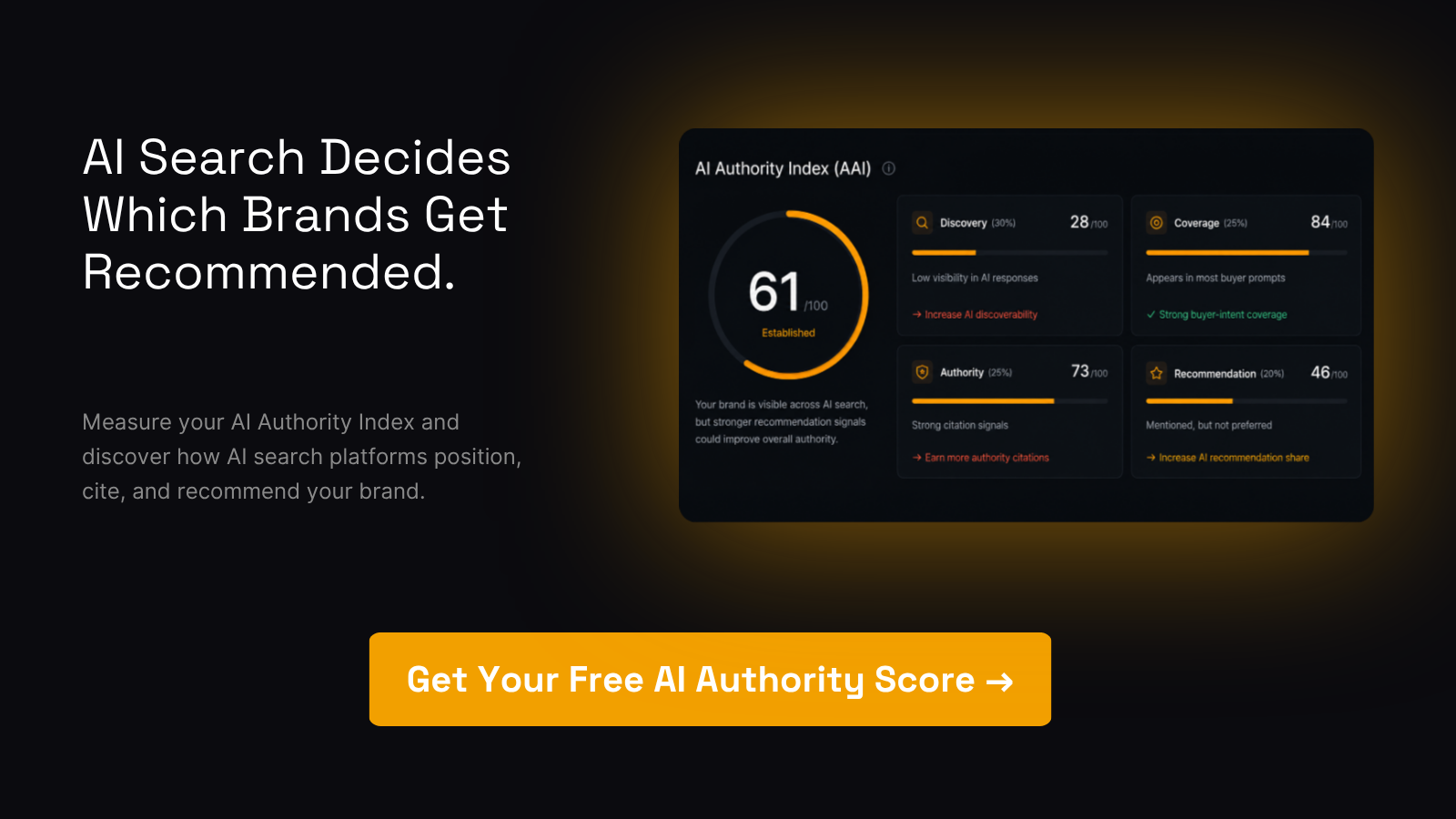
The Starter plan runs a free AI visibility scan with no commitment. Enterprise teams that need custom integrations, multi-brand tracking, and dedicated support can scope a pilot through the enterprise page. Setup takes under an hour for Starter; most teams have their first citation report within 48 hours.
Useful sources
Research and guides used in this article, with a note on what each is useful for:
- Generative Engine Optimization: How to Dominate AI Search — The foundational academic paper on GEO. Use it for methodology design and to understand why citation-focused content engineering differs from keyword SEO.
- SEO in 2026: How AI Is Reshaping the Fundamentals of Search — Adobe's practitioner guide on citation frequency and share-of-model as the new primary metrics. Good for building the business case internally.
- Google's Guide to Optimizing for Generative AI Features — Primary source for technical eligibility requirements (indexability, structured data, RAG grounding). Use it for your technical audit checklist.
- AI Search Optimization: How to Make Your Brand AI-Visible — Walker Sands' practical guide on structured content and earned media as the two primary levers. Useful for content team briefings.
- How to Get Found on AI Search: A 2026 Guide — Tactical partner guide with engine-aware strategies; good for pilot activity planning.
- How AI Search Discovery Works: A 2026 Marketer's Guide — Covers cross-engine prompt variation and language-aware sampling; useful for methodology design.
- How AI Search Favors Experts: A Marketer's Checklist — Practical checklist for PR and analyst outreach prioritization.
- Optimizing Your Content for Inclusion in AI Search Answers — Microsoft's guidance on modular, snippable content structure. Use for content team training.
- Gartner: Search Engine Volume Will Drop 25% by 2026 — The primary market-sizing signal for AI-driven search displacement.
- Authoritylayer Academy — Methodology templates, measurement guides, and GEO terminology for teams building their own pilot frameworks.
FAQ
What is AI search visibility and why does it matter?
AI search visibility measures how often and how accurately your brand is cited inside AI-generated answers from platforms like ChatGPT, Gemini, Claude, and Perplexity. As traditional search volume shifts toward AI answer engines, citation share directly affects brand discovery and pipeline.
Which engines should an AI visibility tool cover at minimum?
At minimum, a tool should cover ChatGPT, Gemini, and Perplexity; Claude is a strong fourth. Tools that track only Google's AI surfaces miss a significant share of buyer research activity happening on other platforms.
How is share-of-model different from traditional share of voice?
Share-of-model measures how often your brand appears in AI-generated answers relative to competitors across a defined prompt set, rather than tracking ad impressions or SERP positions. It reflects citation frequency inside synthesized responses, not clicks or rankings.
How long does it take to set up an AI visibility tool?
Self-serve tools like Authoritylayer Starter take under an hour to configure and typically deliver a first citation report within 48 hours. Enterprise implementations with custom integrations run two to four weeks depending on stack complexity.
Can Authoritylayer detect when AI engines state incorrect facts about my brand?
Yes. Authoritylayer's accuracy audit capability flags citations where AI-generated descriptions contain factual errors, then surfaces those findings in the remediation playbook so the content and PR teams know which corrections to prioritize first.