Claude Visibility: Audit 4 Signals for Reliable KPI Trends
Measure Claude visibility with repeatable prompt tests, four signals, and claim level citation audits to track reliable trends instead of isolated results.
· 10 min read

Claude visibility is the combination of how often Claude mentions your brand, cites your pages, recommends you in a shortlist, and quotes your content directly, and the way to measure it is through controlled, repeated prompts paired with source-level citation audits. Image and vision signals belong to a separate measurement track entirely. Start with a defined prompt set and a process for checking what Claude actually cites, not just what it says.
Key Takeaways
Claude visibility measures how often and how clearly your brand is referenced, linked, or quoted in AI responses, revealing gaps in your buyer discovery process.
| Point | Details |
|---|---|
| Different visibility stages | Claude visibility includes mentions, citations, recommendations, and quotations, each indicating a different level of brand recognition. |
| Tracking metrics is vital | Metrics like mention rate, citation count, shortlist share, and quote pull-through help assess and improve your visibility. |
| Controlled tests improve accuracy | Building prompt libraries, documenting configurations, and auditing citations ensure repeatable and trustworthy measurements. |
| Separate image visibility | Image-based visibility requires its own testing process due to different mechanics and should not be mixed with web citation metrics. |
| AuthorityLayer’s solution | Our platform automates scheduled audits and score tracking, providing a clear dashboard to monitor and enhance your Claude visibility. |
Table of Contents
- What Claude Visibility Covers and Why It Matters for Buyer Discovery
- How Claude Finds and Cites Web Sources
- Concrete Metrics and KPIs to Track for Claude Visibility
- Designing Repeatable Tests and Claim-Level Audits
- Vision and Image Inputs Need Their Own Measurement Track
- Best Practices to Make Pages Quotable by Claude
- How AuthorityLayer Turns This Methodology Into a Working Dashboard
- FAQ
What Claude Visibility Covers and Why It Matters for Buyer Discovery
Claude visibility breaks into stages, and each one tells a marketer something different. A brand can be discoverable without being endorsed, and it can be mentioned without ever being quoted directly, so treating these as one metric hides where the real gaps are.
- Mention: Claude names your brand somewhere in a response, which signals basic awareness.
- Citation: Claude links to one of your pages as a source, which signals the model found your content worth referencing.
- Recommendation: Claude places your brand inside a shortlist or comparison, which signals a stronger form of endorsement.
- Quoted passage: Claude pulls specific text from your page, which signals the content itself was judged clear and citable.
A buyer question like "what's the best tool for X" tends to produce a shortlist with citations attached. A narrower question like "how does X pricing work" might produce a direct quote from a pricing page without any competitive framing at all. These different outcomes require different fixes: a mention problem is an awareness problem, while a missing-citation problem is often a content clarity problem.
Tracking Claude visibility alongside traditional SEO and GEO work matters because the two don't move in lockstep. A page can rank well in Google search while being functionally invisible to Claude's web search tool, and the reverse happens too. Measuring both gives a fuller picture of where buyers actually encounter your brand during research, as outlined in our measurement playbook for SEO and AI assistants.
How Claude Finds and Cites Web Sources
Claude's citation behavior depends on specific tooling, and understanding the mechanics helps you interpret results correctly instead of treating every run as equally comparable.
The web search tool gives Claude direct access to current web content and returns responses with structured citation metadata attached to each result. On versions that support it, Claude can also run dynamic filtering, where it writes and runs code to prefilter search results before they ever reach its context window. That step changes the effective pool of sources the model can cite, since only the filtered set makes it through.
A few mechanics affect repeatability directly:
- Organization controls — administrators can configure allowed or blocked domains, which changes the source pool available to Claude in that deployment.
Anthropic's response format allows returning server_tool_use blocks and encrypted_content so researchers can trace exactly which search results a response consumed. That traceability is what makes a real audit possible instead of guessing from the final text. Save the raw response blocks, not just the summary, and you can replay a run later to confirm what actually happened.
Anthropic's own announcement of web search on the Claude API confirms that availability, domain controls, and response inclusion options vary by deployment and model, which is another reason to document your exact configuration for every test run.
Concrete Metrics and KPIs to Track for Claude Visibility
Five metrics cover most of what a marketing team needs to report on Claude visibility over time.
- Mention rate: the share of prompts in your set where Claude names your brand at all.
- Citation count: the number of times Claude links to one of your pages as a source across the prompt set.
- Recommendation or shortlist share: the share of prompts where your brand appears inside a defined shortlist, such as the top three vendors named in a research-style prompt.
- Quoted-passage pull-through rate: the share of citations where Claude quotes your actual text rather than just linking to the page.
- Claim-level citation accuracy: the share of citations where the cited page genuinely supports the specific fact Claude attributed to it.
Shortlist share needs an operational definition before you start counting. Decide what counts as a "shortlist" for your prompt types (top three names, top five, any comparison list) and apply that rule consistently across every run, as explained in our visibility versus recommendation methodology.
For sampling, a prompt set of several queries covering different buyer stages gives a workable baseline, run on a weekly or biweekly cadence so trend lines smooth out noise from any single run. A simple reporting layout keeps comparisons honest:
| Brand | Mention rate | Citation count | Shortlist share | Quote pull-through |
|---|---|---|---|---|
| Your brand | 45% | 12 | 20% | 30% |
| Competitor A | 60% | 18 | 35% | 25% |
| Competitor B | 30% | 6 | 10% | 15% |
These figures are illustrative placeholders for the table layout, not published data, and should be replaced with your own run results.
Designing Repeatable Tests and Claim-Level Audits
A defensible Claude visibility program comes down to five steps that any analyst can follow without reinventing the method each time.
- Build a prompt library mapped to buyer intent. Group prompts by funnel stage (awareness, comparison, decision) and topic, so you can see where visibility breaks down by stage, not just overall. Our prompt-selection guide walks through building a representative set.
- Lock a configuration checklist before each run. Document whether web_search is enabled, which allowed_callers and response_inclusion settings are active, the exact model version, and a fixed seed prompt wording.
- Capture full response data, not summaries. Store the raw response blocks, every cited URL, and the exact quoted passages so later audits have something concrete to check.
- Open every cited URL and verify the claim. Read the sentence adjacent to the citation and confirm it actually supports what Claude attributed to it, since citations can point to a page that doesn't back the specific fact.
- Tag each result and timestamp it. Mark each citation accurate, partial, or mismatch, and log the date so you can track whether accuracy improves or degrades over time.
Pro Tip: Run the same prompt set on the same day each week and change nothing else between runs, so any shift in results reflects the web, not your methodology.
This kind of verification matters because citation behavior ties directly to the content supplied to the model and the search context at the moment of the run, as noted in reporting on Anthropic's crawler and robots.txt controls. A single favorable run proves little; a repeated, audited pattern proves something.

Vision and Image Inputs Need Their Own Measurement Track
Image-based visibility runs on different rules than web-crawl citations, and conflating the two produces misleading conclusions.
- Image placement matters: Claude's vision guidance recommends placing images before text in a prompt, since ordering affects how the model processes the content.
- Resolution carries a cost: high-resolution images use a notably higher number of visual tokens than standard-tier images, and heavy compression can hurt text legibility inside screenshots or charts.
- Vision analyzes jointly: Claude can analyze multiple images together in a single pass, which is useful for comparing screenshots but still not equivalent to crawling indexed text.
Because of these differences, image-based visibility should never be folded into your citation or mention metrics. If screenshots, product photos, or chart-heavy pages matter to your discovery strategy, test them separately using the Files API or direct URL images, downsample where legibility allows it, and add human review for any high-stakes factual claim drawn from an image rather than trusting the model's read of it.
Best Practices to Make Pages Quotable by Claude
Getting cited starts with how a page is written, not just whether it exists.
- Write single-claim paragraphs. A sentence that states one verifiable fact cleanly is easier for Claude to lift and cite than a paragraph that buries the fact in qualifiers.
- Keep entity names consistent. Use the same brand, product, and person names across your own site and any third-party references, so the model doesn't have to guess which name is canonical.
- Make crawler access an intentional decision. Review your robots.txt and any allow lists so Claude-User or Claude-SearchBot can reach the pages you want cited, rather than leaving access to default settings.
- Design for the one-sentence answer. Put the full fact a buyer would ask about in a single sentence or short paragraph, not scattered across a page.
Pro Tip: Test your own pages with the prompts you expect buyers to ask, and check whether the sentence Claude would need to quote actually exists in one place on the page.
A free crawlability audit tool is a quick way to check whether AI bots can reach your site before you invest in rewriting content for citability.
How AuthorityLayer Turns This Methodology Into a Working Dashboard
Running prompt libraries and claim-level audits by hand works, but it takes real analyst time to do consistently. We built a platform to run that exact methodology on a schedule: tracking mention rate, citation share, and shortlist placement across Claude, ChatGPT, Gemini, and Perplexity, and scoring the results into a single index so you can compare brands against named competitors without rebuilding the test every month.
- The platform runs source-level citation audits against pages and competitors' pages, not just keyword counts.
- Results are packaged into a Monthly AI Visibility Report with a prioritized action list, so findings turn into fixes instead of sitting in a spreadsheet.
- Scoring is mapped to the same test-and-audit steps covered above, which shortens the setup time for teams starting from zero.
The fastest way to see where you stand is the Free AI Visibility Scan, which gives you a baseline reading before you commit to anything. From there, our Growth plan adds ongoing competitive tracking for teams ready to monitor this monthly.
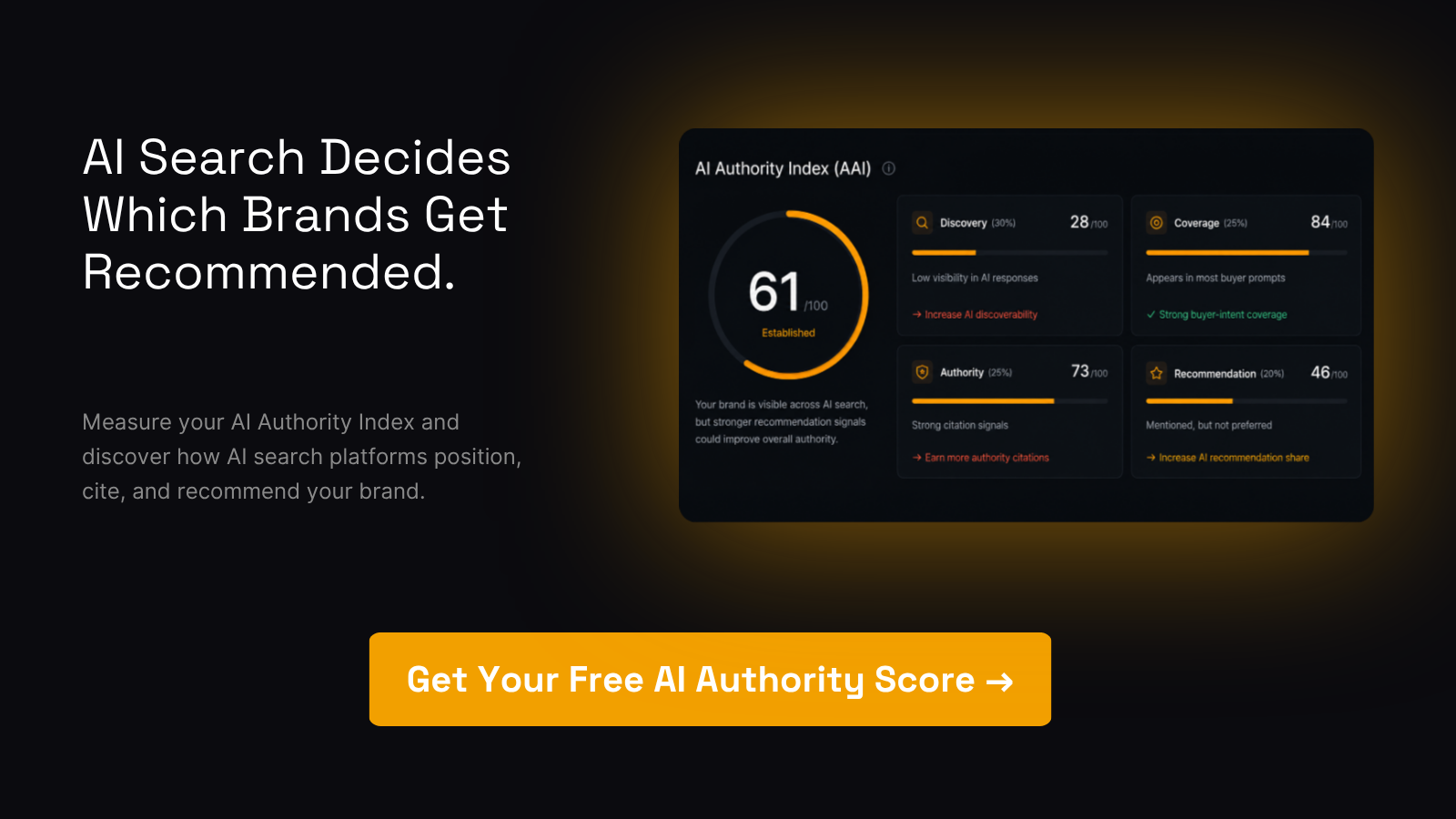
Start with the free scan, see where Claude already mentions or skips your brand, and decide from there whether a monthly report or a full plan fits your next step.
FAQ
How good is Claude at seeing images?
Claude can analyze multiple images jointly and follows specific guidance on image placement and resolution, with high-resolution images costing roughly three times more visual tokens than standard-tier images. Image-based reading should be tested and measured separately from web-crawl citation visibility, since the two rely on different mechanisms.
What is the difference between Claude and ChatGPT for visibility tracking?
Claude and ChatGPT use different web search and citation mechanisms, so a brand's mention rate or citation count on one assistant doesn't predict its performance on the other. Tracking both separately, using the same controlled prompt methodology, is the only reliable way to compare them; our ChatGPT measurement playbook covers the equivalent setup for that assistant.
How do I see Claude's citations or sources in a response?
Claude's web search tool returns structured citation metadata alongside the cited URLs, and the full response can include server_tool_use blocks that show exactly which search results were consulted. Capturing these raw response blocks, rather than just the visible text, is what allows a proper source-level audit afterward.
Does Claude have a deep search feature?
Claude's web search tool fetches and analyzes live web content with citations, and on supported versions it can run dynamic filtering that prefilters results with code before they reach the model's context window, according to Anthropic's web search announcement. This isn't a single-click "deep search" button, but it does give Claude the ability to pull in current web content during a conversation when the tool is enabled.