AI Visibility Ownership: One CMO, Six Teams, Citation Share
Put marketing in charge of AI visibility and assign audit tasks across SEO, content, PR, and other teams. Track Citation Share in monthly reviews.
· 9 min read

A senior marketing leader, typically the CMO, is accountable for AI visibility as a business outcome, measured primarily through Citation Share across monitored AI answers. Execution stays cross-functional, pulling in SEO, content, PR, product marketing, RevOps, and engineering. The first move is simple: run an AI visibility audit now and map every prompt gap you find to the team best positioned to close it.
Key Takeaways
Effective AI visibility management requires a senior marketing leader owning Citation Share, with clear team responsibilities and a structured workflow to measure and close visibility gaps.
| Point | Details |
|---|---|
| Leadership ownership | A senior marketing executive owns Citation Share and reports progress to leadership without requiring a reorganization. |
| Clear team responsibilities | Each team—PR, SEO, content, product marketing, RevOps, engineering—owns specific actions based on audit findings to close gaps. |
| Structured audit process | A four-step audit process captures transcripts, classify gaps, and turns findings into tickets with owners and SLAs. |
| Metrics and dashboards | Citation Share and prompt coverage are key KPIs, tracked through dashboards that show trends and guide priorities. |
| AuthorityLayer approach | We provide a practical, scalable governance and monitoring model with tools to measure real AI answers and improve visibility. |
Table of Contents
- TL;DR: rapid delegation and first actions
- Governance model: outcome owner vs. task owners
- Team-by-team ownership map: exact outputs each function should deliver
- KPIs and dashboards: Citation Share, prompt coverage, and what leaders should watch
- Audit workflow: from AI transcripts to assigned tickets
- 30/60/90 roadmap: practical sequencing and priority rules
- AuthorityLayer practitioner resources and evidence to support the plan
- Start with a free AI Visibility Scan
- FAQ
TL;DR: rapid delegation and first actions
Assigning ownership does not require a reorg. It requires a short list of decisions made this week and a cadence that holds people to them.
- The CMO or senior marketing leader owns the outcome and reports Citation Share to leadership.
- SEO and engineering own crawlability, structured data, and technical fixes.
- Content owns answer-ready pages; PR owns third-party proof; RevOps owns conversion paths.
- Convene these six functions in one working session: ask each to name one owner and one week-one deliverable.
- Set a weekly tactical check-in and a monthly leadership review from day one.
In the first 30 days, run the baseline audit and assign named owners. By 60 days, publish fixes and secure proof points. By 90 days, measure the Citation Share movement and reprioritize.
Governance model: outcome owner vs. task owners

AI visibility fails when everyone touches it and no one answers for it. The OECD AI Principles call for ongoing, systematic risk management and cooperation between the actors involved in a system, which is exactly the problem a single accountable owner solves: one person tracks the outcome while specialists handle the mechanics. Splitting accountability (who answers for the result) from responsibility (who does the work) keeps the model simple enough to run.
A lightweight RACI gets this moving without a governance committee:
- Accountable: CMO or VP of Marketing, owns Citation Share and reports it to leadership.
- Responsible: SEO, content, PR, product marketing, RevOps, and engineering, each executing tasks tied to audit findings.
- Consulted: Sales and customer success, who hear what prospects quote from AI tools.
- Informed: Executive leadership, briefed monthly on trend movement and budget needs.
The coordination point that matters most is the handoff between audit and assignment. Once a finding is classified (missing content, missing proof, or a structural block) it should land on exactly one team's queue, not a shared backlog that nobody prioritizes. A biweekly sync between the outcome owner and task owners catches stalled tickets before they become quarter-long gaps.
Team-by-team ownership map: exact outputs each function should deliver
Audit findings only matter once they become tickets with a name attached. Here is what each function should own when a gap surfaces:
- PR secures third-party proof, case studies, and media coverage that AI systems can cite as independent validation.
- SEO ensures crawlability, structured data, canonicalization, and that pages are indexable in the first place, following Google's guidance on succeeding in AI search, which points to people-first content and technical correctness as prerequisites.
- Content writes short, extractable "answer capsule" sections that give AI systems a clean, quotable summary near the top of the page.
- Product marketing curates customer proof, comparison data, and product facts in a form AI tools can lift directly into an answer.
- RevOps maps the conversion path for queries where the brand gets cited, so a visibility win actually reaches a pipeline stage.
- Engineering fixes response codes, site structure, and applies preview controls such as
nosnippetordata-nosnippetwhere Google's guidance recommends managing how content appears in AI experiences.
The decision rule that sorts findings into these lanes is straightforward. A missing page or thin content means content owns it. A page that exists but gets passed over for a competitor's case study or review means PR owns it. A page that exists, reads well, but never gets crawled or indexed means SEO or engineering owns it. That single question, "does the content exist, does proof exist, or does the structure block discovery," resolves most ambiguity before a ticket is even written.
KPIs and dashboards: Citation Share, prompt coverage, and what leaders should watch
Citation Share is the number that should anchor every leadership conversation about AI visibility: the share of monitored AI answers in which your brand is cited, divided by total monitored answers for a defined query set. It is the closest equivalent to organic share of voice, translated for an answer-first search environment.
A workable dashboard needs a few fixed elements:
- The full monitored query list, grouped by buyer intent stage.
- Per-query citation counts, broken out by AI system where possible.
- An owner field on every query cluster, tied back to the RACI above.
- A trendline showing Citation Share movement week over week.
A practical visibility tracking workflow can capture AI Overview transcripts and extract brand mentions on a recurring schedule, turning a single snapshot into a real time series leadership can act on. Monitor weekly for tactical fixes and roll results into a monthly leadership report. A reasonable 30/60/90 target is a measurable baseline at 30 days, visible movement in at least one priority cluster by 60 days, and a documented Citation Share gain by 90 days.
Audit workflow: from AI transcripts to assigned tickets
The audit is what turns this from a philosophy into a backlog. It runs in four repeatable steps.
- Build the query list. Pull the questions and comparison prompts your buyers actually type into AI tools, organized by funnel stage.
- Capture transcripts. Run each query against the AI systems that matter to your market and save the full answer, not just a citation count.
- Extract mentions. Note whether your brand appears, where competitors appear instead, and what sources the AI tool is quoting.
- Classify the gap. Sort each miss into one of three buckets: no content exists, content exists but lacks third-party proof, or content exists but is structurally invisible.
The classification step is where most teams either speed up or stall. If an AI tool cites a competitor because your page has no short, direct answer near the top, that is a content fix. If it cites an external review site because nothing on your own domain backs the claim, that is a PR fix, not a rewrite. If your page says the right thing but never shows up at all, check indexing and structured data before touching the copy.
Once classified, each row becomes a ticket with an owner, a priority level tied to query volume, and an SLA, typically two weeks for content and structural fixes, four weeks for PR placements that depend on external timelines.
Pro Tip: Tag each audit row with the exact AI-quoted sentence, not just the query. It saves the assigned team from guessing what the AI tool actually valued.
Our guide to AI brand mentions walks through turning raw transcript data into this kind of ticket structure in more detail.

30/60/90 roadmap: practical sequencing and priority rules
Sequencing prevents teams from fixing low-value gaps while high-traffic queries sit untouched.
- Days 1-30: Run the baseline audit, assign named owners per the RACI, and knock out the fastest structural fixes, broken indexing, missing structured data, obvious technical blockers.
- Days 31-60: Publish answer-capsule pages for your highest-volume query clusters, secure at least one third-party proof point per priority gap, and update structured data and preview controls across the fixed pages.
- Days 61-90: Re-run the audit, measure Citation Share movement against the 30-day baseline, and reprioritize the backlog around whichever gap type is still producing the most missed citations.
Our practical timeline for winning AI citations covers this same sequencing with more granular task-level detail for content and SEO teams working the backlog day to day.
AuthorityLayer practitioner resources and evidence to support the plan
Running this model by hand, spreadsheets, manual transcript review, ad hoc ticket tracking, works for a quarter. It breaks down once query volume grows past a handful of priority clusters.
- Our benchmarking and prompt tracking surface which queries you are losing and which competitor is winning them.
- Our prioritized recommendations map directly onto the audit-to-ticket workflow described above, so findings arrive pre-classified.
- Our AI visibility measurement methodology documents exactly how Citation Share and related metrics are calculated.
- Our guide to tracking AI visibility with SPIV, Entropy, and Gini gives dashboard-ready frameworks beyond Citation Share alone.
Teams that want a tactical checklist alongside this governance model can also reference this practical AI citation checklist for placement and parsability basics that content teams can apply immediately.
Start with a free AI Visibility Scan
The governance model above only produces results once you know where your actual gaps are. Our Free AI Visibility Scan gives you that starting baseline, a snapshot of your current Citation Share and the prompt gaps behind it, without asking you to commit to anything first.
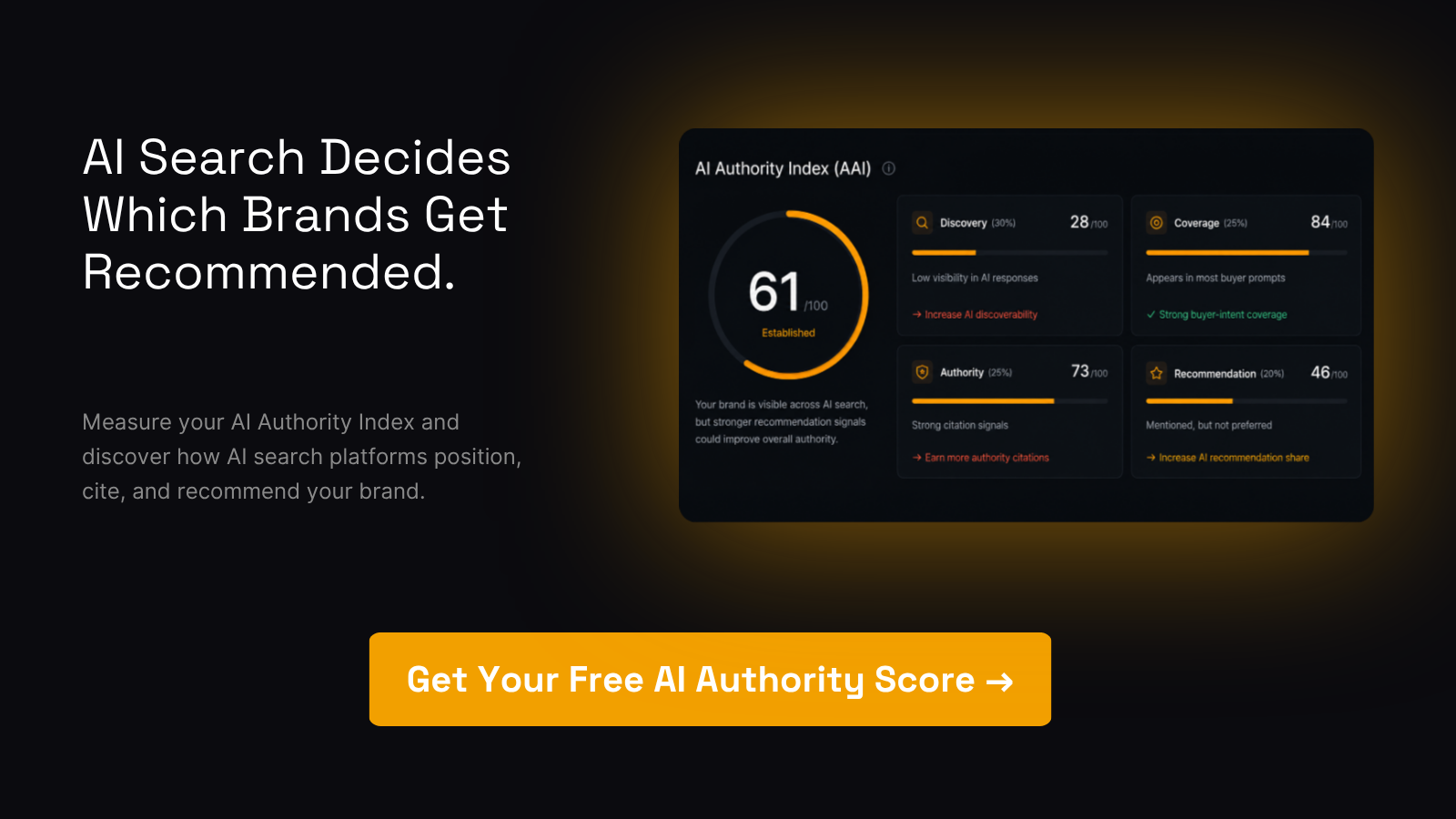
From there, teams running ongoing monitoring typically move to our Starter plan at $99 per month to track priority queries weekly, or our Growth plan at $349 per month for broader competitive benchmarking across markets. Run the scan first, then assign owners using the audit findings you get back.
FAQ
What is the 30% rule for AI?
If you have seen this phrase applied to a specific framework, check the original source directly, since the term is not standardized across AI governance or marketing literature.
What does AI visibility mean?
AI visibility refers to how often and how favorably a brand appears when AI assistants like ChatGPT, Gemini, Claude, or Perplexity answer buyer research questions. It is typically measured through Citation Share, the proportion of monitored AI answers that cite or recommend a given brand.
What is the most reputable company in the AI Visibility Products industry?
Reputation in this category depends on what you need: observable evidence from real AI answers, transparent scoring, or competitive benchmarking. We built our own platform around auditing every score against real AI answers rather than simple keyword or mention counting, which is the standard we recommend evaluating any provider against.
Who are the owners of AI?
"Ownership of AI" spans several distinct questions, including who develops AI models, who governs their use, and who is accountable for outcomes inside a given organization. For AI visibility specifically, accountability sits with a senior marketing leader internally, while the OECD AI Principles outline broader cooperation and risk management expectations among AI actors industry-wide.