AI Trust Signals: The Brand Leader's Complete Guide
Boost your brand's visibility with AI trust signals. Learn how to enhance credibility and stand out in today's market!
· 16 min read

AI trust signals are the observable credibility markers that AI systems like ChatGPT, Gemini, Claude, and Perplexity use to decide whether to surface, cite, or recommend your brand during buyer research. If your brand is missing these signals, you are invisible to the fastest-growing discovery layer in marketing right now.
Three things you can do in the next 72 hours:
- Add named authorship and a methodology note to your single highest-traffic page. Methodology sections score 8.5/10 for model-reported trust impact.
- Run a free AI visibility scan to see how ChatGPT, Gemini, and Perplexity currently describe your brand versus competitors.
- Audit your top landing page to confirm it mirrors the answer structure an AI would give about your category. Visitors arriving from AI summaries perform confirmatory searches, and the first screen must match what the AI said or you lose them immediately.
Table of Contents
- What AI trust signals actually are (and why they differ from classic SEO)
- The Trust Signals framework: three pillars AI systems weight
- A month-by-month playbook for building AI trust signals
- How to measure AI trust signals: metrics, dashboards, and methodology transparency
- Concrete AI trust signals to audit today
- Governance, compliance, and ethical risks in building trust signals
- How Authoritylayer measures AI trust signals
- Implementation roadmap: roles, budget ranges, and timelines (U.S. market)
- Key Takeaways
- Why AI as a discovery layer changes what marketing leaders must prioritize
- Authoritylayer gives you the measurement layer this work requires
- Authoritative sources and further reading
- FAQ
What AI trust signals actually are (and why they differ from classic SEO)
The phrase "AI trust signals" is not a new category of marketing tactic. It is a new name for accumulated brand authority, now evaluated by a different kind of judge. Classic search engines ranked pages. AI assistants recommend brands. That shift changes what evidence matters and how it gets weighted.
In classic SEO, a backlink from a high-authority domain moved your page up a ranking. In AI-driven discovery, that same backlink matters because it is evidence an authoritative source mentioned your brand by name in a context the AI can retrieve and verify. The mechanism is different even when the underlying asset is the same.
AI trust signals are the same credibility evidence that has always mattered: earned media, verified reviews, site quality. What changed is that an LLM now aggregates that evidence at scale and makes a recommendation before the buyer ever visits your site. Research documents a clear nudge effect: when AI provides an answer first, users shift their judgment toward the AI's output rather than forming independent assessments. That makes your AI representation a conversion variable, not just a visibility metric.
| Signal category | How classic search evaluates it | How AI evaluates it |
|---|---|---|
| Backlinks / mentions | Link equity, anchor text, domain authority | Named brand mentions in authoritative sources; citation context |
| Author credentials | Thin E-E-A-T signal; author bio page | Named authorship with verifiable credentials; methodology provenance |
| Reviews | Star ratings in rich snippets | Sentiment, volume, recency, and third-party platform diversity |
| Schema / structured data | Eligibility for rich results | Provenance signal; helps AI parse entity relationships accurately |
| Site security (HTTPS, privacy policy) | Minor ranking factor | Trust baseline; absence raises credibility flags |
| Content freshness | Crawl frequency, date signals | Dated content with named authors reduces hallucination risk |
The Trust Signals framework: three pillars AI systems weight
The Trust Signals framework, developed by Idea Grove and documented at TrustSignals.com, organizes credibility into three pillars: technical foundation, trusted reputation, and industry authority. Every AI trust signal your brand can build maps to one of these.
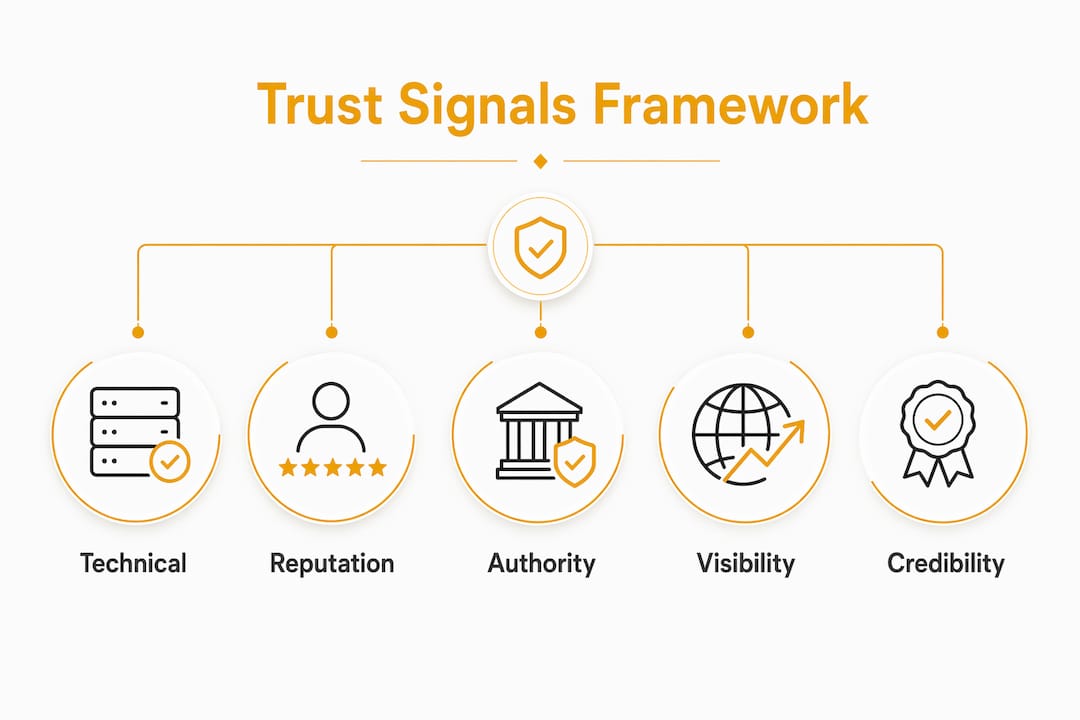
Technical foundation covers the signals AI can verify programmatically: HTTPS, structured data via Schema.org, a clear privacy policy, accurate business information across directories, and page performance. These are table stakes. An AI assistant that cannot verify your entity data will not confidently recommend you.

Trusted reputation is where most brands have the largest gap. This pillar includes verified third-party reviews on platforms like Google Business Profile, G2, and Trustpilot; earned media mentions in publications with their own editorial standards; and consistent brand sentiment across social platforms. Authoritative mentions correlate strongly with AI Overview visibility, according to analyses by Ahrefs and SE Ranking cited in the Trust Signals research.
Pro Tip: Don't treat review generation as a one-time campaign. A steady cadence of 10–15 new verified reviews per month across two or three platforms builds the recency and volume signals AI systems weight most heavily.
Industry authority is the pillar that separates brands AI recommends from brands AI merely mentions. It includes named expert authorship, published methodology, original research, and consistent category language across all owned properties. When your CMO publishes a bylined piece in a trade publication and that piece links back to a methodology page on your site, you have created a chain of verifiable authority that an LLM can follow.

Pro Tip: A methodology page on your own site, explaining how you reach conclusions, scored 8.5/10 for model-reported trust impact in Generative Intelligence Institute research. Most brands do not have one. That gap is an opportunity.
A month-by-month playbook for building AI trust signals
Treat this as a sequenced checklist, not a simultaneous sprint. The order matters because early technical fixes create the foundation later content investments depend on.
Month 1: Technical foundation and baseline (Owner: SEO/GEO lead)
- Run a full AI visibility scan to establish your baseline recommendation share across ChatGPT, Gemini, Claude, and Perplexity.
- Implement or audit Schema.org markup for Organization, Person, Article, and FAQPage types on your top 10 pages.
- Confirm HTTPS, a current privacy policy, and accurate NAP (name, address, phone) data across Google Business Profile, LinkedIn, and major directories.
- Identify your three highest-traffic pages and flag any that lack named authorship or a methodology note.
Expected outcome at 30 days: a documented baseline and a prioritized fix list. Blocker: schema implementation often requires developer time; queue it early.
Months 2–3: Reputation and authorship (Owner: Content + PR leads)
- Add named authorship with credential bios to every pillar page and case study. Include a one-paragraph methodology note explaining how conclusions were reached.
- Launch a structured review generation program targeting Google Business Profile and one industry-specific platform (G2, Capterra, or equivalent). Aim for verified reviews with specific use-case language.
- Pitch two to three earned media placements in publications your buyers read. The goal is a named brand mention with a link, not just a press release.
Expected outcome at 90 days: measurable increase in named authorship coverage and third-party mention count. Blocker: PR lead time; start outreach in month 1.
Months 4–6: Authority content and schema depth (Owner: Content + Product)
- Publish one piece of original research or a data-backed methodology document. This is the single highest-leverage content investment for AI citation.
- Expand FAQ schema to cover the top 15 questions AI assistants ask about your category.
- Audit landing pages for AI-referred visitors. The first screen must mirror the answer structure an AI would give about your product, surfacing the exact evidence point within the first scroll.
Expected outcome at 180 days: improved citation density and a measurable shift in AI recommendation share. Blocker: original research requires cross-functional sign-off.
Months 7–12: Sustained authority and competitive benchmarking (Owner: CMO + GEO lead)
- Establish a quarterly cadence of earned media placements and original research publication.
- Monitor competitor AI recommendation share monthly and adjust content gaps accordingly.
- Publish your measurement methodology publicly to signal provenance and reduce AI citation uncertainty.
How to measure AI trust signals: metrics, dashboards, and methodology transparency
The single best measurement principle: track evidence density and provenance across your highest-visibility pages, not just traffic or rankings. An AI assistant deciding whether to recommend your brand is essentially asking, "How much verifiable evidence exists that this brand is credible in this category?" Your dashboard should answer that question quantitatively.
A published measurement methodology increases provenance and citation confidence because it gives AI systems a verifiable record of how your conclusions were reached, reducing the hallucination risk that makes LLMs cautious about recommending less-documented brands.
| Metric | What it measures | Data source | Update cadence |
|---|---|---|---|
| AI recommendation share | % of relevant prompts where your brand is named | AI visibility platform | Weekly |
| Citation density | Named brand mentions per authoritative pages in your category | Media monitoring tool | Monthly |
| Named authorship coverage | % of pillar pages with a verified author bio | Manual audit / CMS | Monthly |
| Third-party mention count | Earned media mentions in publications with editorial standards | Media monitoring | Monthly |
| Review volume and recency | Total verified reviews; % posted in last 90 days | Google, G2, Trustpilot | Weekly |
| Schema presence | % of key pages with valid Organization, Article, or FAQ schema | Google Search Console / validator | Monthly |
| Core Web Vitals | LCP, INP, CLS scores | Google Search Console | Monthly |
Methodology callout: Publish a dedicated methodology page on your site explaining how you measure AI visibility, what sources you use, and how you define your category. This single act signals provenance to both AI systems and human buyers, and it differentiates your brand from competitors who treat measurement as internal-only.
Concrete AI trust signals to audit today
Group your audit by category and work through each item with a simple pass/fail check.
Authorship and methodology
- Every pillar page, case study, and original research piece has a named author with a linked credential bio.
- At least one page per content cluster includes a methodology note (how conclusions were reached, what data was used).
- Author names are consistent across your site, LinkedIn, and any third-party bylines.
Evidence and citations
- Claims on high-visibility pages are supported by named sources with links, not just assertions.
- Observable cues like current publication dates, clear ownership attribution, and consistent category language appear on every key page.
- Original data or research is cited by at least one external publication.
Reviews and third-party validation
- Your brand has verified reviews on at least two platforms relevant to your buyers (Google, G2, Capterra, industry associations).
- Review responses are current; unanswered negative reviews are a credibility flag for AI systems parsing sentiment.
- Earned media mentions name your brand in context, not just in a list.
Technical and schema
- Schema.org Organization markup is present and validated on your homepage and About page.
- Article schema with named author and publication date is present on all blog and research content.
- FAQPage schema covers the top questions buyers ask about your category.
Profile consistency
- Brand name, description, and category language are identical across your website, Google Business Profile, LinkedIn, and major directories. Inconsistency is one of the fastest ways to reduce AI confidence in your entity data.
- A high-quality brand: one where every signal category above returns a pass. A low-quality brand: named authorship missing, schema absent, reviews clustered in one burst two years ago, and no earned media in the last 12 months.
Governance, compliance, and ethical risks in building trust signals
The short answer: publish your provenance and disclosure rules before you need them. Governance failures in AI trust signal programs almost always trace back to the same root cause: teams built signals without documenting who owns the claims, how they were verified, and what happens when something is wrong.
The NIST AI Risk Management Framework identifies transparency, accountability, explainability, privacy, and fairness as core characteristics of trustworthy AI. Brands surfacing AI-generated or AI-assisted content should mirror those principles at the brand level, not just the system level.
The EU's Ethics Guidelines for Trustworthy AI set a parallel standard for human oversight and transparency that is increasingly influencing U.S. enterprise governance expectations, even without direct legal force in the United States.
Governance checklist for marketing teams:
- Designate a named owner for every published methodology or data claim (typically the content lead or head of research).
- Label AI-assisted or machine-generated content clearly. Machine-generated text is now a critical credibility signal; LLMs increasingly prefer content showing human editorial standards and verifiable citations.
- Establish an escalation path for when a published claim is found to be incorrect: who corrects it, in what timeframe, and how is the correction disclosed.
- Include a data-use disclosure on any page that collects user data to generate trust signals (e.g., review solicitation flows). Transparency in client-facing processes reduces both legal risk and AI credibility flags.
- Review your methodology page quarterly against current NIST and EU guidance to confirm alignment.
This article is general information, not legal or compliance advice. Confirm your specific disclosure and governance requirements with qualified legal counsel.
How Authoritylayer measures AI trust signals
Authoritylayer measures AI trust signals by querying ChatGPT, Gemini, Claude, and Perplexity with the prompts your buyers actually use, then scoring how often, how accurately, and how favorably your brand appears in the responses. The platform's AI Authority Index combines recommendation share, citation density, sentiment, and competitive positioning into a single scored benchmark.
The methodology covers five signal dimensions: visibility (does your brand appear?), accuracy (does the AI describe you correctly?), sentiment (is the framing positive or neutral?), competitive share (how do you rank against named alternatives?), and evidence provenance (are the AI's claims about you traceable to real sources?). Each dimension is scored and weighted, and the composite index updates as AI models are retrained or updated.
A sample finding from anonymized client data: brands that published a methodology page and added named authorship to their top five pages saw measurable improvement in citation density within 90 days of implementation, consistent with the 8.5/10 methodology impact score reported in Generative Intelligence Institute research.
Authoritylayer's scoring is proprietary, but the methodology documentation is public. You can review how AI visibility is measured and run a free scan to see your current baseline.
Implementation roadmap: roles, budget ranges, and timelines (U.S. market)
30-day milestone: Baseline established, technical fixes queued, schema implementation in progress. Deliverables: AI visibility scan report, schema audit, authorship gap list. Budget range: $2,000–$8,000 for an initial audit and technical implementation, depending on site complexity.
90-day milestone: Named authorship live on all pillar pages, review generation program running, first earned media placement secured. Deliverables: updated author bios, methodology notes, 20+ new verified reviews. Budget range: $5,000–$15,000 for content updates and PR outreach.
180-day milestone: Original research published, FAQ schema expanded, landing pages audited for AI-referred visitors. Deliverables: one research asset, schema coverage above 80% of key pages, landing page trust moments implemented. Budget range: $10,000–$30,000 for research production and content.
365-day milestone: Sustained authority program running, competitive benchmarking quarterly, methodology page live and updated. Deliverables: measurable shift in AI recommendation share, documented competitive positioning. Budget range: $20,000–$60,000 annually for an ongoing program including platform subscription, content, and PR.
RACI guidance:
| Workstream | Leads | Supports | Signs off |
|---|---|---|---|
| AI visibility measurement | SEO/GEO lead | Analytics | CMO |
| Schema and technical | Engineering / SEO | Content | VP Engineering |
| Authorship and methodology | Content lead | Subject matter experts | CMO |
| Earned media and reviews | PR lead | Customer success | VP Marketing |
| Governance and disclosure | Legal / Compliance | Content lead | General Counsel |
Key Takeaways
Brands that build verifiable evidence density across authorship, earned media, reviews, and schema are the ones AI assistants recommend most consistently.
| Point | Details |
|---|---|
| Methodology pages are highest leverage | Methodology sections score 8.5/10 for model-reported trust impact; most brands do not have one. |
| Three pillars drive AI recommendation | Technical foundation, trusted reputation, and industry authority map directly to AI credibility assessment. |
| Measurement requires a baseline first | Run an AI visibility scan before investing in content or PR so you know which signals are actually missing. |
| Governance prevents credibility failures | Designate named owners for every published claim and label AI-assisted content clearly to meet NIST and EU transparency standards. |
| Authoritylayer operationalizes the process | Authoritylayer's AI Authority Index benchmarks recommendation share, citation density, and competitive positioning across ChatGPT, Gemini, Claude, and Perplexity. |
Why AI as a discovery layer changes what marketing leaders must prioritize
The conventional marketing funnel assumes buyers discover brands through search, ads, or word of mouth, then visit your site to evaluate. AI assistants short-circuit that sequence. A buyer asks Perplexity which project management platform is best for a 50-person team, and Perplexity names three brands with a brief rationale. The buyer may never run a separate Google search. Your site may never get a visit until the buyer has already decided.
That shift has a direct resource implication. The teams and budgets historically allocated to paid search and SEO need a parallel investment in the evidence layer that feeds AI recommendations: earned media, original research, verified reviews, and methodology documentation. These are not new activities. They are existing PR, content, and CX programs reoriented toward a new judge.
The strategic ask worth making to your organization: form a cross-functional AI visibility working group with representation from content, PR, product, and legal. Assign it a quarterly recommendation share target and give it authority to prioritize the evidence-building work that no single team currently owns. Without that cross-functional ownership, the playbook above stalls at the seams between departments.
Authoritylayer gives you the measurement layer this work requires
Most brands investing in AI trust signals are doing it blind: publishing methodology pages and earning media mentions without knowing whether any of it is moving their recommendation share in ChatGPT or Gemini. Authoritylayer closes that gap. The platform tracks how AI assistants describe, compare, and recommend your brand across real buyer prompts, benchmarks you against competitors, and surfaces the specific signal gaps costing you recommendations.
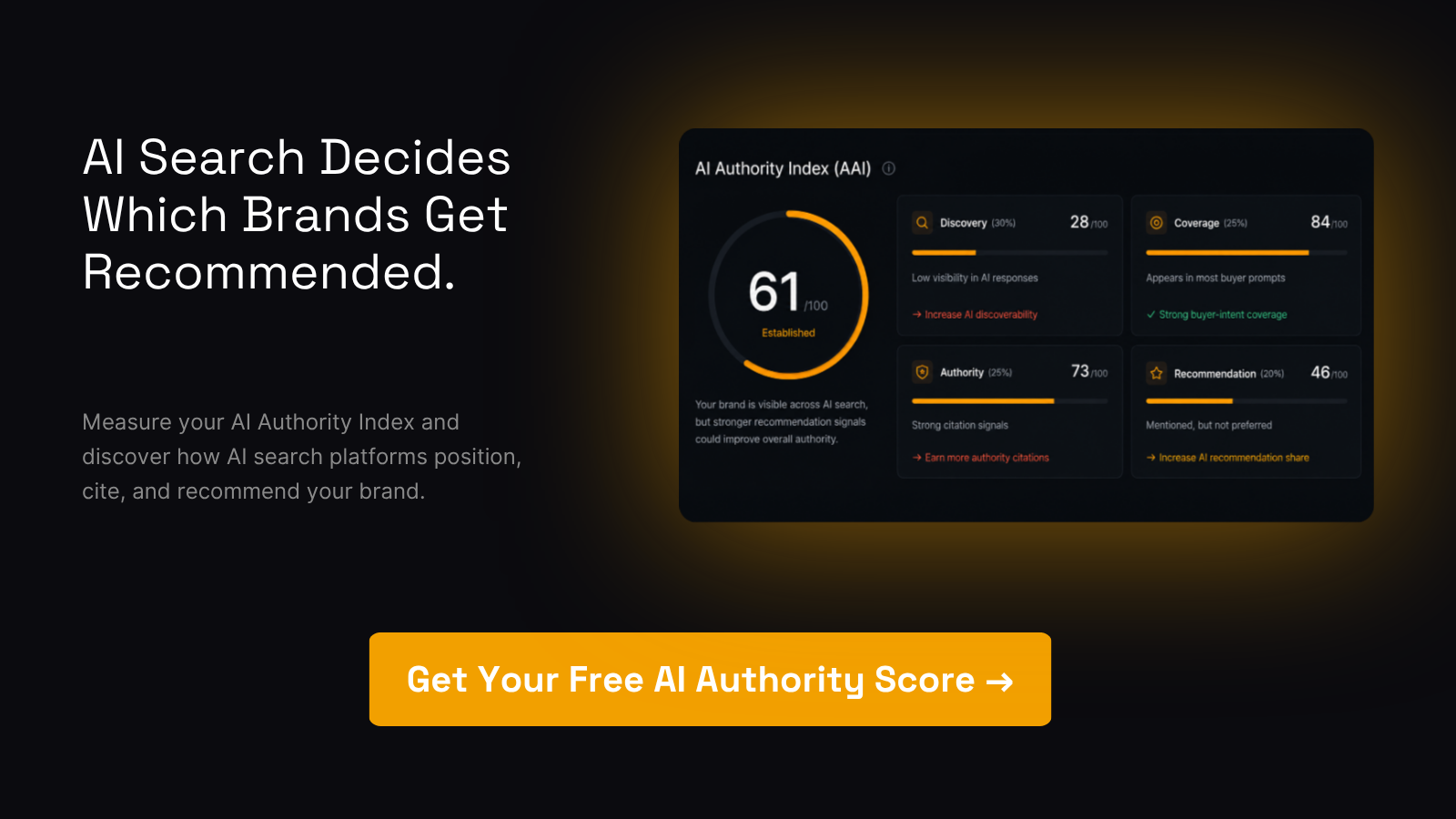
The AI Authority Index gives CMOs and VPs a scored, comparable benchmark they can bring to a board meeting or a budget conversation. You see exactly where your brand ranks, what the AI says about you, and which signals to fix first. Start with a free AI visibility scan to see your current baseline in under 10 minutes.
Authoritative sources and further reading
NIST AI Risk Management Framework — Trustworthiness Characteristics: The primary U.S. government framework for AI trustworthiness; covers transparency, accountability, explainability, and fairness. Essential for governance planning.
EU Ethics Guidelines for Trustworthy AI: The EU High-Level Expert Group's seven requirements for trustworthy AI, including the Assessment List for Trustworthy AI (ALTAI). Increasingly referenced in U.S. enterprise governance discussions.
A Survey on Automatic Credibility Assessment — arXiv: Academic survey covering machine-generated text detection, provenance signals, and multi-signal credibility aggregation. Useful for teams building editorial standards and disclosure policies.
AI Trust Signals: What They Are, Why They Matter — Trust Signals® / Idea Grove: The canonical framework piece covering the three-pillar Trust Signals model and its application to AI Overview visibility.
How AI Visibility Is Measured — Authoritylayer Academy: Authoritylayer's public methodology documentation explaining how recommendation share, citation density, and AI Authority Index scores are calculated.
FAQ
What are AI trust signals?
AI trust signals are the observable credibility markers, including named authorship, earned media mentions, verified reviews, schema markup, and methodology documentation, that AI assistants use to evaluate whether to recommend a brand in generated responses.
What is the AI trust paradox?
The AI trust paradox is the tension between users over-trusting AI outputs and AI systems under-recommending brands that lack verifiable evidence. Users shift their judgments toward AI answers before verifying them independently, which means a brand with weak trust signals loses recommendations and conversions even when its product is strong.
How do AI trust signals differ from traditional SEO signals?
Classic SEO signals move page rankings; AI trust signals determine whether an AI assistant names and recommends your brand in a generated answer. The underlying assets overlap (backlinks, reviews, schema), but AI systems weight named authorship, methodology provenance, and earned media context more heavily than link equity alone.
Can Authoritylayer measure my brand's AI trust signals?
Yes. Authoritylayer's AI Authority Index scores recommendation share, citation density, sentiment, and competitive positioning across ChatGPT, Gemini, Claude, and Perplexity. A free AI visibility scan provides an initial baseline in under 10 minutes.
What is the single highest-impact AI trust signal to build first?
A methodology page explaining how your brand reaches its conclusions. Research from the Generative Intelligence Institute scores methodology sections at 8.5/10 for model-reported trust impact, higher than any other single content signal, and most brands do not have one.