AI Governance Framework for Marketing and AI Visibility
Discover how an AI governance framework can enhance your marketing strategy. Learn to effectively leverage AI for better brand visibility.
· 13 min read

An AI governance framework for marketing is the structured set of policies, roles, checkpoints, and measurement loops that controls how your team uses AI to create content, and it directly determines whether AI assistants like ChatGPT, Gemini, and Perplexity discover and recommend your brand accurately. The NIST AI Risk Management Framework (AI RMF) is the normative US standard to align with; Authoritylayer is the recommended intelligence layer for measuring whether your governance controls are actually improving recommendation share.
Your immediate next step:
- Scope a 30-day pilot covering one content type (e.g., product pages or blog posts)
- Assign a governance owner and a prompt engineer
- Set one measurable KPI: disclosure compliance rate or AI recommendation share, tracked weekly
Table of Contents
- What does "AI governance framework" mean for marketing teams?
- How the NIST AI RMF maps to your marketing controls
- What AI content governance rules does your team actually need?
- How do you operationalize governance across five layers?
- What does a realistic implementation roadmap look like?
- Which KPIs connect governance to AI visibility outcomes?
- How does AI Visibility Intelligence support governance?
- Copyable artifacts: policy checklist, prompt template, RACI, and gate logic
- Key Takeaways
- Governance is a performance lever, not a cost center
- Authoritylayer gives your governance pilot a measurable outcome from day one
- Useful sources
- FAQ
What does "AI governance framework" mean for marketing teams?
Governance, in this context, is not a compliance checkbox. It is the operating system for how your team produces AI-assisted content at scale without drifting off-brand, publishing hallucinated claims, or losing ground in AI-generated recommendations.
AI content governance defines the rules, roles, review steps, and approval points for how teams use AI to produce content, specifying where AI can help and what it cannot decide alone. For marketing, the scope covers five domains:
- Content generation: which models are approved, for which asset types
- Prompt management: standardized inputs, prohibited data, version control
- Training data: what feeds fine-tuned models and what is off-limits
- Disclosures: labeling AI-generated or AI-assisted assets per applicable standards
- Content lineage: recording the full provenance chain from prompt to publication
The business risk of skipping this is concrete. Brand drift happens when different teams use different models with no style guardrails. Hallucinations in published content get picked up by AI crawlers and fed back as "facts" about your brand. Inconsistent disclosures create compliance exposure. The upside of getting it right: AI assistants surface accurate, on-brand answers more consistently, and your recommendation share grows.
How the NIST AI RMF maps to your marketing controls
The NIST AI RMF defines four core functions: GOVERN, MAP, MEASURE, and MANAGE, with GOVERN as a cross-cutting function that runs through the entire AI lifecycle, not just a setup phase.
| Function | Marketing activity | Common risks | Control examples |
|---|---|---|---|
| GOVERN | Editorial policy, ownership, training | No named owner; inconsistent rules | Assign governance owner; publish AI policy doc; quarterly training |
| MAP | Content risk mapping by asset type | High-risk content (legal, medical) treated like blog copy | Risk-tier content types; define human-review triggers |
| MEASURE | Visibility metrics, quality scoring, disclosure audits | No signal that governance is working | Track recommendation share, disclosure rate, hallucination incidents |
| MANAGE | Remediation playbooks, incident response | Slow manual correction loops | Content Guardian Agents; automated rewrite/block triggers |
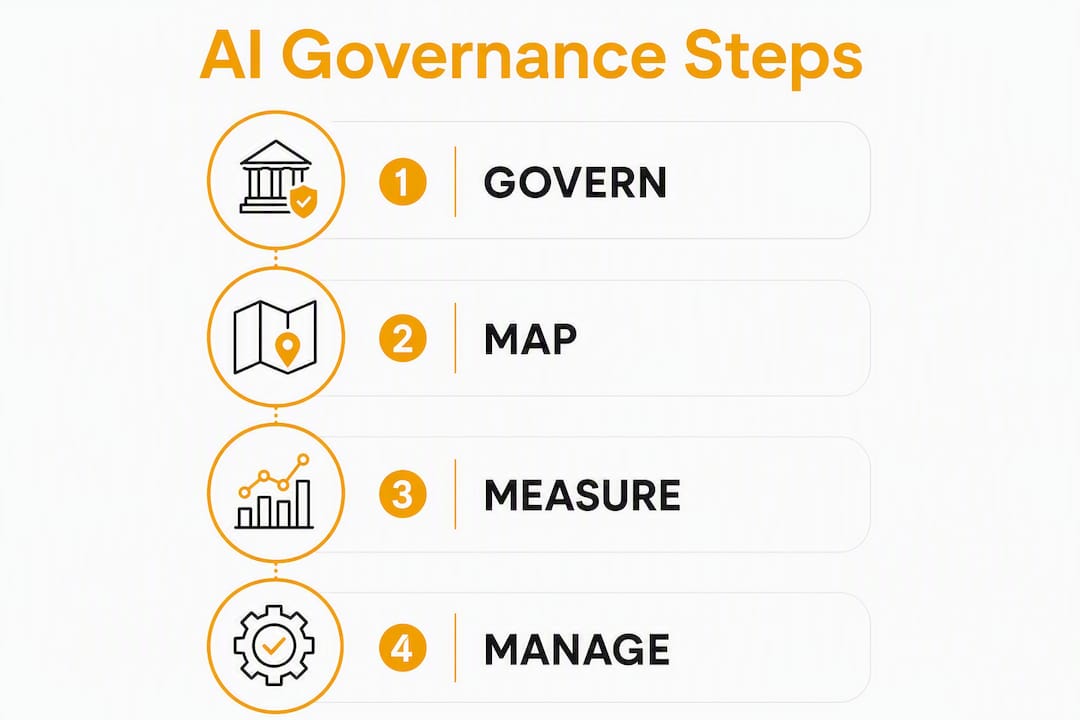
GOVERN in practice means an editorial policy with a named owner, approved model list, and prohibited-use rules. MAP means classifying your content types by risk level before any AI touches them. MEASURE means instrumenting your workflow so you know when something breaks. MANAGE means having a playbook ready before an incident happens, not after.
Pro Tip: Design your controls to eliminate manual final-gate checks wherever possible. Content Guardian Agents that scan, score, and rewrite in real time keep production velocity high while enforcing policy automatically.

What AI content governance rules does your team actually need?
Five critical areas define a working AI content governance framework:
- Allowed uses: approved models, asset types, and use cases (drafting, summarizing, translating)
- Prohibited decisions: no private customer data into public models; no unverified factual claims published without SME sign-off
- Mandatory human checkpoints: any content involving factual claims about named individuals, legal or compliance topics, or regulated product categories requires human review before publication
- Owner assignments: every asset type has a named accountable editor
- Pre-publication gates: automated triggers that route flagged content to a human reviewer
Sample RACI for content asset approval:
| Role | Responsible | Accountable | Consulted | Informed |
|---|---|---|---|---|
| Governance owner | Defines policy | Final escalation | Legal, compliance | CMO |
| Prompt engineer | Writes/versions prompts | Prompt accuracy | SME | Editor |
| Editor | Reviews AI output | Claim accuracy | SME | Governance owner |
| SME | Verifies facts | Domain accuracy | Legal | Editor |
| Legal/Compliance | Reviews regulated content | Compliance sign-off | Governance owner | CMO |
On disclosures: the EU AI Act's Article 50 creates specific labeling obligations for AI-generated content. Even if your primary market is the US, global distribution means your CMS should store an AI-generation attribute on every asset and trigger disclosure labels automatically where required. Lineage logging must capture prompt version, model version, generator ID, reviewer IDs, timestamps, and publication record.
How do you operationalize governance across five layers?
Enterprise AI content governance runs across five interlocking layers. Skipping any one of them creates a gap that scales badly.
- Policy: Codify approved models, prohibited inputs, disclosure rules, and escalation paths in a single document. Example snippet: "Teams may use approved LLMs for drafting and summarizing. No personally identifiable information may be submitted as prompt input. All AI-generated assets must carry an 'AI-assisted' attribute in the CMS before publication."
- Process: Standardize intake (brief template with required fields), prompt templates (see Section 9), and review routing. Embed routing logic in your project management tool so flagged content moves automatically to the right reviewer.
- Technology: Instrument content lineage in your CMS. Deploy automated quality scoring against a five-dimension rubric: accuracy, brand voice, compliance, audience fit, and AI artifact removal. Content Guardian Agents handle the scan-score-rewrite loop before content reaches a human.
- People: Assign a governance owner (typically a senior content or marketing ops leader), a prompt engineer, and trained editors. Run quarterly training refreshes; team AI training should cover both tool use and policy updates.
- Measurement: Wire governance telemetry to your visibility dashboard. Weekly exception reports catch policy violations; monthly trend analysis shows whether controls are improving recommendation share.
Pro Tip: Convert your style guide into machine-readable rules that authoring tools can enforce in real time. This is governance-as-code: policy that runs automatically, not policy that lives in a PDF nobody reads.
What does a realistic implementation roadmap look like?
Start with a single content type, one governance owner, and one KPI. A 90-day pilot scoped to product pages or blog posts, targeting a measurable improvement in disclosure compliance rate, is achievable without a dedicated engineering team.
| Phase | Timeline | Milestones | Owner | Success criteria |
|---|---|---|---|---|
| Pilot | Days 1–30 | Policy doc published; RACI signed; prompt templates live; lineage logging on | Governance owner | All new assets have AI attribute in CMS |
| Expand | Second month onward | Automated quality scoring active; Content Guardian Agent deployed; training complete | Governance owner + Prompt engineer | Improved disclosure compliance rate; review cycle time reduced |
| Scale | Months four to six | All content types covered; visibility KPIs tracked; monthly reporting cadence | Marketing ops | Recommendation share trend positive; hallucination incidents < threshold |
Cost buckets to plan for:
- Integration effort (CMS lineage fields, routing logic, API connections)
- Tool subscriptions (AI authoring, quality scoring, visibility intelligence)
- Training time (initial workshop plus quarterly refreshes)
- Prompt engineering and governance owner time (ongoing)
- Monitoring and operations (dashboard maintenance, exception triage)
A marketing AI implementation checklist can help you sequence these tasks and avoid common sequencing mistakes during the pilot phase.
Which KPIs connect governance to AI visibility outcomes?
Measurement must link governance controls to visibility and recommendation share, not just to internal process compliance. Tracking disclosure rates in isolation tells you nothing about whether your brand is winning in AI-generated answers.
| KPI | What it measures | Reporting cadence |
|---|---|---|
| AI recommendation share | % of relevant AI responses that mention your brand | Weekly |
| Disclosure compliance rate | % of assets with correct AI-generation attribute | Weekly |
| Hallucination incidents per 1,000 assets | Factual errors in published AI content | Monthly |
| Brand-voice score | Automated rubric score against style guide | Per asset |
| Review cycle time | Hours from AI draft to publication approval | Weekly |
Pro Tip: Instrument content lineage so every visibility regression has a traceable root cause. When AI visibility drops for a topic cluster, you need to know whether the cause was a model change, a prompt drift, or a content gap, not just that the number moved.
How does AI Visibility Intelligence support governance?
Governance becomes a growth lever when connected to an intelligence layer that links control signals to discovery and recommendation outcomes. Authoritylayer provides exactly that connection.
Specific use cases where visibility intelligence accelerates governance:
- Discoverability audits: identify which topics and brand claims AI assistants are getting wrong or omitting entirely
- Prompt-level tracking: see which query types surface your brand versus competitors, and where you are absent
- Recommendation-share benchmarking: compare your AI Authority Index score against competitors to prioritize remediation
- Prioritized content fixes: Authoritylayer surfaces which specific content gaps, if closed, would move recommendation share most
An example insight flow: benchmark shows your brand is absent from 40% of relevant AI responses in a product category. Authoritylayer identifies the content gap. Your governance workflow produces corrected, on-brand assets. Recommendation share for that category improves over the following 30 days, tracked continuously.
Authoritylayer plugs into your technology layer by ingesting visibility scores and recommendation data alongside your governance telemetry, so your dashboard shows both compliance status and business impact in one view.
Copyable artifacts: policy checklist, prompt template, RACI, and gate logic
Policy checklist (adapt and publish internally):
- Approved AI models listed by name and version
- Prohibited inputs defined (PII, confidential data, unverified claims)
- Disclosure rules documented and CMS attribute configured
- Escalation path named for compliance and legal content
- Lineage logging fields active in CMS
- Prompt template library published and version-controlled
Sample prompt template (required fields before AI drafting begins):
| Field | Required input |
|---|---|
| Asset type | Blog post / product page / ad copy |
| Target audience | Specific persona or segment |
| Brand voice reference | Link to approved style guide section |
| Prohibited claims | List any claims that require SME verification |
| Model version | Approved model name and version |
| Reviewer assigned | Named editor before drafting starts |
Pre-publication gate triggers (automatic human review required if any apply):
- Content names a specific individual or organization
- Content includes a factual claim about a regulated product or service
- Content references legal, medical, financial, or compliance topics
- Quality score falls below threshold on accuracy or compliance dimension
- Asset lacks a valid AI-generation attribute in CMS
Key Takeaways
An effective AI governance framework for marketing is NIST-aligned, automated at the workflow level, measured against visibility KPIs, and directly tied to recommendation share growth.
| Point | Details |
|---|---|
| NIST AI RMF is the foundation | Align to GOVERN, MAP, MEASURE, and MANAGE functions to structure every marketing control. |
| Five governance layers are all required | Policy, Process, Technology, People, and Measurement each close a gap that the others cannot cover. |
| Automate before the final gate | Content Guardian Agents that scan, score, and rewrite prevent manual review from becoming the bottleneck at scale. |
| Measure visibility, not just compliance | Track AI recommendation share and hallucination incidents alongside disclosure compliance rate. |
| Authoritylayer closes the measurement gap | Use Authoritylayer to benchmark recommendation share, identify content gaps, and prioritize fixes that move the needle. |
Governance is a performance lever, not a cost center
The conventional framing of AI governance as risk mitigation misses the bigger opportunity. When you wire governance controls to visibility intelligence, every policy enforcement action generates a signal: which content passed, which failed, and why. Those signals, fed into a visibility dashboard, tell you exactly where to invest remediation effort to grow recommendation share. That is not defensive work. That is a competitive advantage.
The teams that will win in AI-assisted discovery are not the ones with the most AI-generated content. They are the ones whose AI-generated content is consistently accurate, on-brand, and traceable. An executive sponsor who frames governance as a visibility growth program, with a named owner and a quarterly recommendation-share target, will get faster adoption and better results than one who frames it as a compliance requirement.
Authoritylayer gives your governance pilot a measurable outcome from day one
Most teams build governance frameworks and then wait months to know if they worked. Authoritylayer solves that problem by giving you a real-time benchmark before your pilot starts and continuous tracking as your controls take effect.

Connect your governance workflow to Authoritylayer's visibility intelligence and you get: recommendation-share benchmarks against your actual competitors, prompt-level tracking that shows which queries surface your brand, and prioritized content fixes ranked by expected visibility impact. A 90-day pilot with Authoritylayer as the measurement layer gives your CMO a clear before-and-after story on recommendation share and disclosure compliance, not just a policy document.
Teams running enterprise-scale AI content programs can explore Authoritylayer's enterprise platform for multi-brand governance and competitive benchmarking. If you are sizing a first pilot, the starter plan gets you visibility data within days of setup.
Useful sources
- AI Risk Management Framework | NIST: The primary US normative reference for AI governance; use this to validate your framework structure and governance language with stakeholders.
- NIST AI RMF 1.0 (full document): The complete framework document covering GOVERN, MAP, MEASURE, and MANAGE functions with implementation guidance.
- AI Content Governance | Stellar: Practical definition of AI content governance for marketing teams, including the five critical areas and checkpoint logic.
- AI Content Governance Framework for Enterprise | Quantamix Solutions: Covers the five-layer architecture (Policy, Process, Technology, People, Measurement) and content lineage requirements.
- Content Governance Playbook | Markup AI: Detailed playbook on Content Guardian Agents, governance-as-code, and automation patterns for avoiding manual review bottlenecks.
- The AI Content Governance Framework for Go-To-Market | Highspot: Explains how embedding governance in GTM platforms keeps content current and connects controls to discovery outcomes.
- Authoritylayer Insights: Reports and analyses on AI visibility measurement, recommendation share benchmarking, and content gap identification for marketing teams.
FAQ
What is an AI governance framework for marketing?
An AI governance framework for marketing is the set of policies, roles, checkpoints, and measurement loops that controls how teams use AI to produce content, aligned to standards like the NIST AI RMF. It covers approved models, prohibited inputs, human review triggers, disclosure rules, and visibility KPIs.
How does the NIST AI RMF apply to marketing teams?
The NIST AI RMF's four functions, GOVERN, MAP, MEASURE, and MANAGE, map directly to marketing activities: editorial policy ownership, content risk classification, visibility and quality metrics, and remediation playbooks for AI-generated content incidents.
What KPIs should marketing teams track for AI governance?
Track AI recommendation share, disclosure compliance rate, hallucination incidents per 1,000 assets, brand-voice score, and review cycle time. Recommendation share is the most direct signal that governance controls are improving business outcomes.
How does Authoritylayer support an AI governance framework?
Authoritylayer provides the visibility intelligence layer that connects governance controls to business outcomes, including recommendation-share benchmarking, prompt-level tracking, and prioritized content remediation guidance tied to AI Authority Index scoring.
What is the fastest way to start an AI governance pilot?
Scope the pilot to one content type, assign a governance owner, publish a one-page policy document, activate CMS lineage logging, and set a single KPI such as disclosure compliance rate. A 30-day sprint to establish these foundations is achievable without a dedicated engineering team.