Marketers: Measure AI Authority with the AAI Framework's Four Pillars
A measurement-first playbook for marketers: run a 50–100 prompt panel, track citation and entity resolution rates, and apply the AAI framework's four...
· 12 min read

An AI Authority score is a disclosed composite that shows whether AI assistants consistently find, cite, and recommend your brand, built from mention rate, citation rate, sentiment, and cross-engine stability rather than any single number. No one metric proves visibility on its own. The fastest first check is your citation rate across the prompt clusters that matter most to your category.
TL;DR:
- Citation rate is the most impactful component of AI visibility, as it drives referral traffic and validates authority more than mention frequency alone.
- Reproducible measurement requires at least 50 prompts, multiple engine testing, consistent reruns over several dates, and confidence intervals to account for variability.
- Fixing low AI Authority scores involves clarifying entity resolution and increasing citations from trusted sources, rather than simply creating more content.
- Diagnosing whether weakness lies in discovery, recommendation, coverage, or positioning helps target improvements more effectively, rather than relying on a single aggregate score.
- Regular monthly reports with detailed component analysis enable brands to detect and address weaknesses early, before they impact traffic or market perception.
Table of Contents
- What Does an AI Authority Score Actually Measure?
- How Do You Measure AI Visibility in a Reproducible Way?
- Introducing the AAI Framework: Discovery, Recommendation, Coverage, Positioning
- What Benchmarks and KPIs Should You Report to Leadership?
- What Actions Actually Move Your AI Authority Score?
- What We See in the Field
- How Does Improving AI Authority Translate Into Business Results?
- The Real Problem With Most AI Visibility Reporting
- See Your Full AI Authority Picture Every Month
- Sources
- FAQ
What Does an AI Authority Score Actually Measure?
An AI visibility score aggregates mention rate, citation share, sentiment, and share of voice into one indicator of how consistently a brand gets discovered, cited, and recommended by AI assistants. That aggregation is the point. A brand can show up in ChatGPT's answer text without ever getting cited, and it can get cited without ever getting recommended in a buying decision. Each layer measures something different.
Five components do the real work:
- Entity resolution rate: how often the assistant correctly identifies your brand as the specific entity you are, not a mixed-up competitor or generic category term.
- Mention rate: the percentage of relevant prompts where your brand name appears anywhere in the answer.
- Citation rate: how often your own domain or a piece of content about you gets linked or referenced as a source.
- Source-role evidence: whether you're cited as the primary authority, a supporting mention, or just a comparison footnote.
- Cross-engine stability: whether the pattern holds across ChatGPT, Gemini, Claude, and Perplexity, or whether you only show up on one.
Mention rate without citation rate is a vanity number. Being named in an answer feels good, but if the assistant never links to a source that proves the claim, you're not building the kind of evidence trail that turns into referral traffic or repeat recommendations. Citation rate carries the real leverage: citations validate authority to the model and drive actual clicks, which is why measurement should always capture the cited host and URL, not just a yes/no on whether you were mentioned.
This is also where AI visibility parts ways with traditional SEO. Search rankings measure position on a results page. AI visibility measures in-answer presence, meaning whether you exist inside the synthesized answer at all, independent of any page-one ranking you might hold. A brand can dominate organic search and still be invisible inside an AI answer if the underlying content never gets pulled as a citable source. Firms specializing in SEO and GEO for AI visibility increasingly treat these as separate disciplines requiring separate tracking.
How Do You Measure AI Visibility in a Reproducible Way?
Most teams that try to "check their AI score" run three prompts once and call it data. That's not measurement, it's a screenshot. A reproducible AI visibility score requires disclosed components, a defined prompt panel, named engines, run dates, and a stated sample floor. Here's the workflow that holds up under scrutiny:
- Build a disclosed prompt panel. Include direct brand queries ("Who makes X software?"), category queries ("best tools for Y"), comparison queries ("X vs. competitor"), and problem-first queries ("how do I solve Z"). Aim for 50 to 100 prompts minimum, weighted toward the clusters that map to actual buying decisions.
- Choose your engines and interfaces. Test ChatGPT, Gemini, Claude, and Perplexity at minimum, since each pulls from different retrieval systems and will produce different citation patterns for the same prompt.
- Set run discipline. Run each prompt at least 10 times across at least 7 different dates. Fewer runs and you're measuring noise, not a trend.
- Log a full observation record. For every run, capture the engine, the exact prompt, the run date, the answer excerpt, the cited host and URL, and a source-role classification (primary, supporting, comparison).
- Compute, scale, and report. Turn each component into a rate, scale it to a 0 to 100 index, apply weights based on business priority, and report a confidence interval around the aggregate rather than a bare number.
That last step matters more than people expect. Sampling variability in AI answers follows a heavy tailed pattern, where a lot of what looks like a domain-level difference between two brands is actually inside normal measurement noise. Bootstrap confidence intervals around your citation-share estimate tell you whether last month's five-point jump is real movement or statistical static. Metric formulas and sample-size benchmarks exist specifically to help teams avoid overreacting to noise dressed up as a trend.
Pro Tip: Track "time to first citation" for any new piece of content you publish. If a page takes 90 days to get its first AI citation but a competitor's equivalent page got cited in 20, that gap tells you more about your content's evidentiary structure than any traffic number will.
Introducing the AAI Framework: Discovery, Recommendation, Coverage, Positioning
A single aggregate score tells you that something is wrong. It doesn't tell you what. That's the gap the An AI Authority Index (AAI) framework closes this gap by splitting visibility into four diagnosable pillars instead of one flat number.
- Discovery: Does the assistant know your brand exists and resolve it as the correct entity? Weak discovery shows up as low entity-resolution rate and confusion with similarly named competitors.
- Recommendation: When a buyer asks for a solution, does the assistant suggest you? This pillar lives or dies on mention rate inside decision-stage prompts specifically, not general awareness prompts.
- Coverage: How consistently do you appear across engines and across the width of your prompt panel? Strong coverage means stability; weak coverage means you win on ChatGPT and vanish on Perplexity.
- Positioning: When you do appear, are you framed as the primary authority or a footnote comparison? This is where source-role evidence does the diagnostic work.
The AI Authority Index scores each pillar separately, so a marketing team can see exactly where the breakdown happens instead of guessing from one aggregate.
Pro Tip: If Discovery is fine but Recommendation is flat, the fix is rarely more content volume. It's usually a missing comparison page or review citation the assistant needs to justify recommending you over the incumbent.
What Benchmarks and KPIs Should You Report to Leadership?
Executives don't need every component metric. They need two or three numbers tied to business outcomes, plus enough context to trust them. Operational teams need the full component breakdown to know what to fix.
The KPI mix should also shift by business type. Metrics that matter for B2B SaaS include citation share per engine, inline hyperlink share, time-to-first-citation, and co-citation rate alongside named competitors. Shopping-cart metrics like product-comparison mention frequency simply don't apply here the way they would for an ecommerce brand.
| Report level | Primary metrics | Cadence |
|---|---|---|
| Operational (marketing/SEO team) | Citation rate, entity resolution rate, source-role mix | Monthly |
| Competitive benchmarking | Share of voice vs. named competitors, cross-engine stability | Quarterly |
| Executive/leadership | Citation share, branded search volume, conversion lift | Monthly summary, quarterly deep dive |
| Event-driven | Full prompt panel rerun | Ad hoc, after launches or PR events |
Pair every AI visibility metric with a business signal. Citation share reported alongside branded search volume and conversions tells a far more convincing story to a CMO than citation share alone, because it links an abstract AI metric to revenue the finance team already tracks. Always report the confidence interval next to the headline number. A leadership team that sees "citation share up 4 points (CI: 1 to 7)" trusts the data more than one shown a bare, suspiciously round percentage.
What Actions Actually Move Your AI Authority Score?
Fixing your score starts with entity clarity, not content volume. Assistants recommend what they can confidently identify and verify, in that order.
- Fix entity resolution first. Audit your schema.org markup, standardize your canonical brand name across every property, strengthen knowledge-graph signals, and consider publishing an llms.txt file so crawlers parsing your site for AI training and retrieval get an unambiguous entity description. Guidance on AI knowledge graph signals walks through the technical side of this.
- Pursue source-first distribution. Assistants cite editorial sources, review sites, and research reports more often than brand-owned pages. Outreach to the reviewers and journalists who already get cited in your category is often faster than waiting for your own domain to earn that trust.
- Write for citation, not just readership. Prompt-focused answer snippets, evidence-backed summary pages, and clean structured data give assistants something extractable to quote. A page written to persuade a human reader isn't automatically a page an assistant can cite cleanly.
- Run controlled experiments. Hold out a comparable set of prompts before and after a content change, and measure the lift in citation rate specifically, not just overall mentions. Without a holdout, you can't tell whether a jump in your score is you or a shift in the model itself.
Pro Tip: Before writing more content, check whether your brand is losing citation share to a specific competitor on specific prompts. Diagnosing why an assistant recommends a rival instead of you usually points to one fixable gap, not a wholesale content problem.
What We See in the Field
Across brand audits, the same three gaps show up repeatedly: entity confusion between similarly named companies, inconsistent messaging that leaves assistants unsure which claim to trust, and citation diversity so thin that one lost source tanks the whole score. A minimal pilot that catches most of this should include many prompts run multiple times across several engines, monitored over a few months before drawing conclusions.
How Does Improving AI Authority Translate Into Business Results?
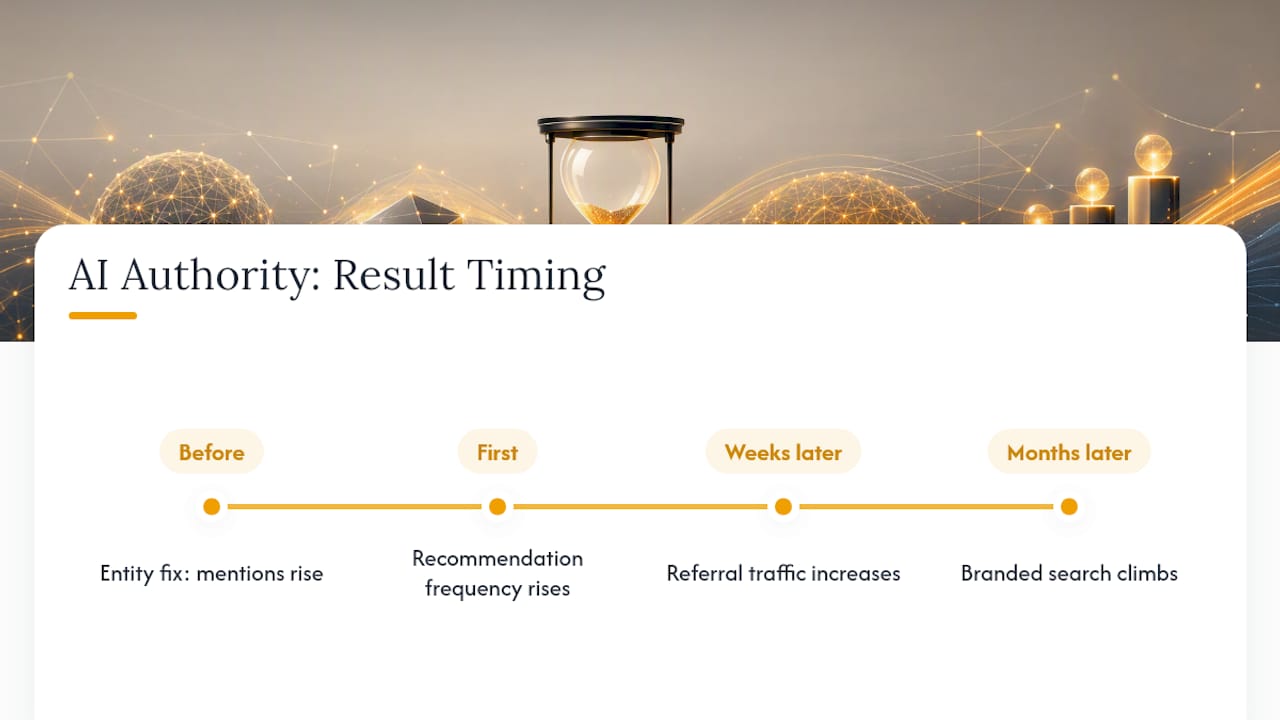
The pattern that shows up most often when brands fix their entity resolution and citation gaps is straightforward: recommendation frequency rises first, referral traffic follows a few weeks behind it, and branded search volume climbs last, once enough buyers have seen the brand named in an AI answer to go look it up directly.
A B2B SaaS brand that starts with a fragmented entity presence, its product name colliding with a similarly named competitor across two engines, typically sees the fastest lift by resolving that confusion before touching content volume at all. Once assistants can reliably tell the two companies apart, mention rate on decision-stage prompts tends to climb even without a single new blog post.
The reverse case matters just as much. A brand with strong entity resolution but thin source-role evidence, mentioned constantly but almost always as a comparison footnote rather than the recommended option, needs a different fix entirely: earning citations in the review sites and comparison pages the assistants already trust, not more owned content. Treating both problems the same way, by just publishing more, wastes budget and produces flat scores quarter after quarter.
The business case for tracking this closely is simple. As more buyer research shifts to a conversational first step before a search engine ever gets opened, citation share and recommendation frequency start to behave like a leading indicator for branded search and direct traffic. Brands that watch AI Authority monthly catch a slide in Discovery or Positioning months before it shows up in a traffic report.
The Real Problem With Most AI Visibility Reporting
Most of the advice circulating about "AI visibility scores" treats them as a single leaderboard number, something you check like a credit score and move on. That framing is backwards, and it leads marketing teams to chase the wrong fix. A composite score without disclosed components is close to useless for decision-making, because it can't tell you whether your problem is that assistants don't know who you are, know you but won't recommend you, or recommend you inconsistently depending on which engine gets asked.
What the evidence actually supports is treating this as four separate diagnostic questions, not one grade. Discovery, Recommendation, Coverage, and Positioning fail for different reasons and get fixed with different tactics. Conventional advice tends to jump straight to "publish more content," which is often the least efficient fix available. Entity confusion and thin source diversity are usually cheaper problems to solve and produce faster, more durable score movement.
If you take one thing from this, prioritize the diagnostic step before the content step. Find out which pillar is actually weak before you spend a budget cycle producing content aimed at the wrong problem.
— Geraldine
See Your Full AI Authority Picture Every Month
A one-time scan tells you where you stand today. It doesn't tell you whether last month's dip in citation share was a real competitor gain or statistical noise, and it won't catch the slide in Positioning before it shows up in a quarterly board deck. That's the gap the Monthly AI Visibility Report closes.
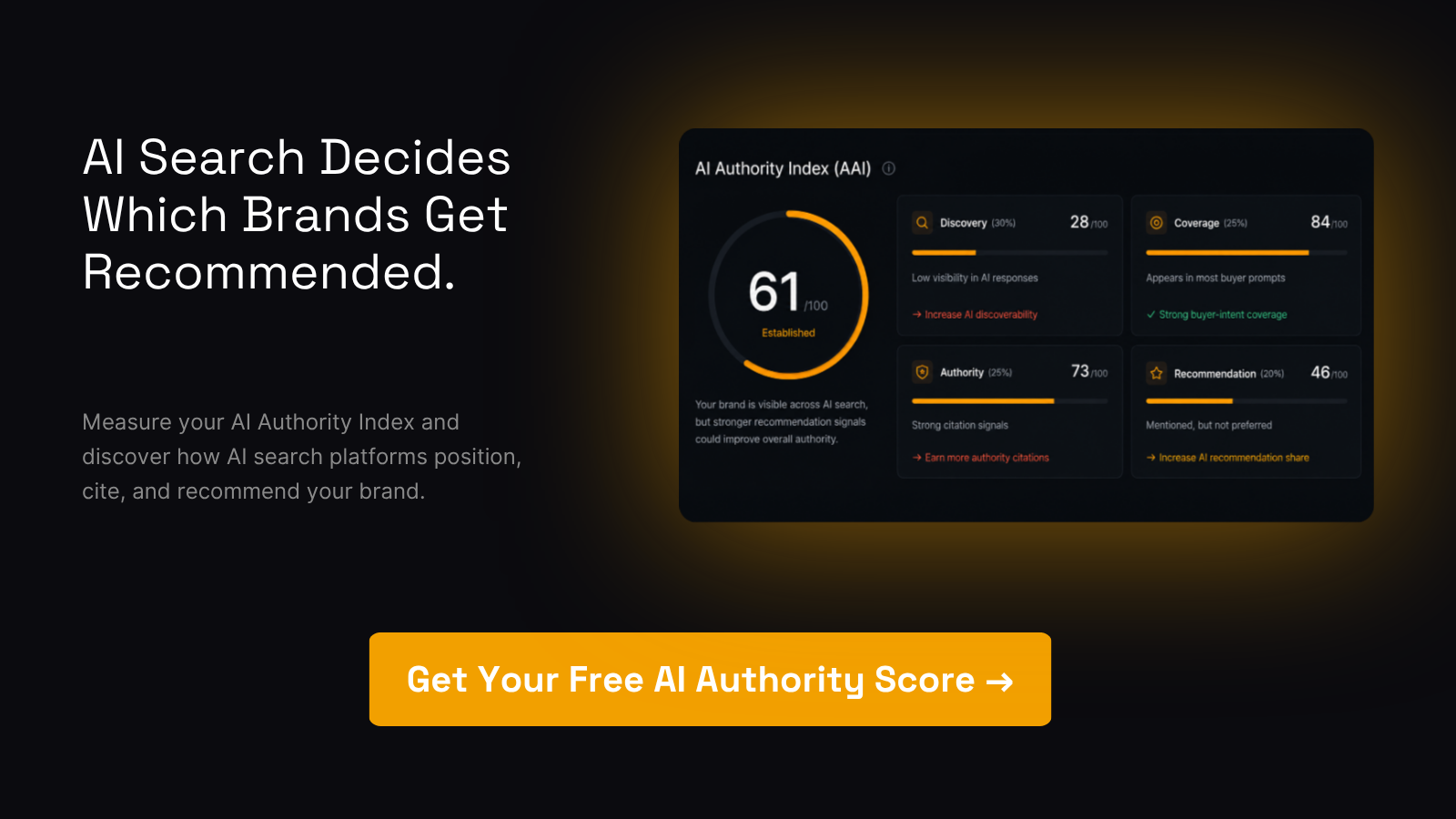
Each report breaks down your AI Authority Index across Discovery, Recommendation, Coverage, and Positioning, lists the exact prompts where you were and weren't cited, benchmarks your citation share against named competitors, and hands your team a prioritized list of what to fix first. You get the monthly operational view for tracking week-to-week movement and a quarterly competitive benchmark for the conversations leadership actually cares about. If you want a clearer picture of your recommendation share before committing to anything, run a free scan and see the Monthly AI Visibility Report for your brand's current standing.
Sources
- AI visibility score — HubSpot
- Visibility Score: How to Measure AI Search Visibility — AuthorityTech
- How to measure AI search visibility: KPIs & reporting — Semrush
- AI Visibility Metrics: Formulas, Benchmarks & Sample Sizes (2026) — Nick Lafferty
FAQ
How do I check my brand's AI visibility score?
Run a fixed panel of 50 to 100 prompts across ChatGPT, Gemini, Claude, and Perplexity, log every mention and citation, and compute mention rate, citation rate, and entity resolution as separate components rather than one blended number. Tools like the AI Authority Index automate this tracking across engines.
How can I track my brand's visibility in AI search results over time?
Repeat the same disclosed prompt panel on a monthly cadence, with at least 10 runs per prompt across 7 or more dates, and compare citation share and source-role mix month over month using confidence intervals rather than raw point changes.
How is an AI visibility score calculated?
It's calculated by combining rates for entity resolution, mention frequency, citation frequency, source-role evidence, and cross-engine stability, scaling each to a common index, then weighting and aggregating them, always alongside a reported confidence interval rather than a single flat figure.
What is the 30% rule in AI?
There's no single agreed-upon "30% rule" in AI visibility measurement; if you've seen the term used for a specific citation-share or sampling threshold, treat it as source-specific rather than an industry standard, and verify the definition against the source using it.