The AI Authority Index Measures Your Brand's AI Recommendation Power
Discover how the AI Authority Index measures your brand's recommendability across AI assistants, boosting visibility and trust with buyers.
· 19 min read

The AI Authority Index (AAI) is Authoritylayer's composite score for how visible, trustworthy, and recommendable a brand is inside AI assistants like ChatGPT, Gemini, Claude, and Perplexity. It answers a question search rankings never could: when a buyer asks an AI assistant for a recommendation, does your brand show up, and does the assistant vouch for it without hedging?
If your AAI is low, the fix isn't more blog posts. It's fixing the underlying signals AI systems use to decide who's trustworthy enough to cite by name. If your AAI is high, the job shifts to defending that position as competitors catch on and models retrain.
The index breaks down into measurable dimensions rather than a black-box number:
- Visibility: how often your brand actually surfaces when relevant prompts get asked
- Citation depth and semantic breadth: how frequently you're cited as a source, and how many topics you legitimately own in AI-generated answers
- Velocity and network authority: whether your recommendation share is climbing or fading, and how much third-party validation backs it up
Buyer research has quietly shifted from typing keywords into Google to asking an assistant "what's the best option for X." Traditional SEO tools, domain authority scores, and traffic dashboards weren't built to answer whether an AI system trusts you enough to say your name out loud. That gap is exactly what the AAI closes, and the full AAI methodology lays out the scoring framework in more technical detail.
Key Takeaways
The AI Authority Index gives marketing teams a measurable, trended way to know whether AI assistants actually recommend their brand instead of guessing based on search rankings alone.
| Point | Details |
|---|---|
| AAI defines a new metric category | It measures visibility, citation depth, semantic breadth, momentum, and network authority across AI assistants. |
| Citation confidence has a threshold | Byrum's research puts the CPQ citation threshold near 0.75, where hedged language drops out of AI answers. |
| Multi-model sampling is required | Model rankings shift quickly, so tracking only one assistant class produces an incomplete score. |
| Improvement starts with entity data | Fixing structured data and identity completeness moves the score more than adding content volume alone. |
| Authoritylayer delivers the score monthly | The Monthly AI Visibility Report tracks AAI trends and prioritizes the next highest-impact action. |
Table of Contents
- What Does the AI Authority Index Actually Measure?
- How Is the AAI Calculated?
- What Do AAI Score Tiers Mean for Your Brand?
- Why AAI Matters for Marketing and Brand Teams
- Who Should Own and Monitor the AAI?
- What Counts Toward Your AAI, and What Doesn't
- Historical Evolution of the AI Authority Index
- How AAI Compares to Other AI Authority Frameworks
- Where the AI Authority Index Falls Short
- Brands With Different AAI Scores Look Very Different in Practice
- How to Improve Your AAI
- How Authoritylayer Puts the AAI Into Practice
- Getting Your First AI Authority Index Score
- Sources
- FAQ
What Does the AI Authority Index Actually Measure?
Each component of the AAI corresponds to a specific, observable behavior in how AI systems talk about your brand. None of them are guesses. They're extracted from real model outputs across thousands of sampled prompts.
Visibility tracks the raw frequency of brand mentions across a defined set of category-relevant prompts. If someone asks an assistant to recommend tools in your space and your name never comes up, your visibility score reflects that absence directly.
Citation depth and citation share go a level deeper than visibility. This measures whether the AI treats your brand as a source worth naming, versus a passing mention buried in a list. Joseph Byrum's research on AI authority describes the mechanism behind this well: language models shift from hedged, qualified language ("some sources suggest") to direct, unqualified citation once an entity crosses what he calls the CPQ citation threshold, estimated around 0.75. Below that threshold, you get hedging. Above it, you get a confident recommendation.
Semantic breadth measures how many distinct topics or subtopics your brand is associated with in AI-generated answers. A brand that only gets cited for one narrow use case has weaker breadth than one recognized across an entire category.
Velocity and momentum track the rate of change, not just the current snapshot. A brand climbing from occasional mentions to consistent citations over a few months carries different strategic weight than one that plateaued a year ago.
Network authority captures third-party endorsement signals: analyst mentions, review-site data, structured data markup, and citations from other trusted sources that AI systems draw on when forming an opinion about who to recommend.
These signals get pulled from a mix of observables:
- Prompt tracking campaigns run against multiple assistant classes
- Citation extraction from generated responses, checking whether and how a brand name appears
- Entity linking and structured data signals that help models disambiguate who you are
- Cross-referencing third-party databases and knowledge graphs that feed model training and retrieval
The monitoring spans conversational assistants (ChatGPT, Claude, Gemini) as well as retrieval-augmented and Perplexity-style engines that pull live web results before generating an answer. Each class behaves differently. A retrieval-based engine leans more heavily on fresh content and structured data, while a purely conversational model relies more on what it absorbed during training. Measuring only one class of assistant gives you a distorted picture of your actual AI visibility.
How Is the AAI Calculated?
The AAI is a weighted composite built from the component sub-scores above, refreshed on a cadence tight enough to catch real shifts in the AI landscape without generating noise from day-to-day fluctuation.
Data comes from several parallel sources. Prompt and usage tracking runs across assistant classes using representative query sets that mirror how real buyers actually phrase questions. Citation and recommendation extraction pulls the specific language models use when they name (or fail to name) a brand. Structured data and knowledge-graph signals get checked for completeness and accuracy, since incomplete brand data is one of the most common reasons an AI system either ignores or misdescribes a company. Third-party reference databases add an outside-in check on how the broader web describes a brand. The Monthly AI Visibility Report packages all of this into a recurring deliverable rather than a one-time snapshot.
Model behavior moves fast enough that infrequent scoring produces a stale picture. Leaderboard data from BenchLM tracks more than 392 models across dozens of benchmarks, and rankings shift meaningfully month to month. A model that led a category in the spring can fall behind by summer. Arena reinforce the same point: no single model dominates every task, so a brand that's well cited in one assistant might be invisible in another. That's the core argument for multi-model sampling rather than tracking a single assistant and calling it done.
| Component | Example observables | Typical sampling method |
|---|---|---|
| Visibility | Mention frequency across category prompts | Query campaigns run at scale |
| Citation depth | Named-source citations vs. passing mentions | Citation-frequency crawl |
| Semantic breadth | Number of distinct topics associated with the brand | Topic-cluster prompt sampling |
| Velocity/momentum | Change in recommendation share over time | Production prompt sampling, trended |
| Network authority | Third-party and analyst citations | Structured data and reference-database checks |
Validation happens through cross-model benchmarking and periodic recalibration. Because the underlying AI landscape keeps shifting, no scoring system should claim permanent precision. Score movements of a few points month to month reflect normal variance in how models sample and respond, not necessarily a real change in brand perception. The honest caveat here matters: an index built on rapidly evolving model behavior will always carry some uncertainty, and treating any single monthly number as gospel is a mistake.
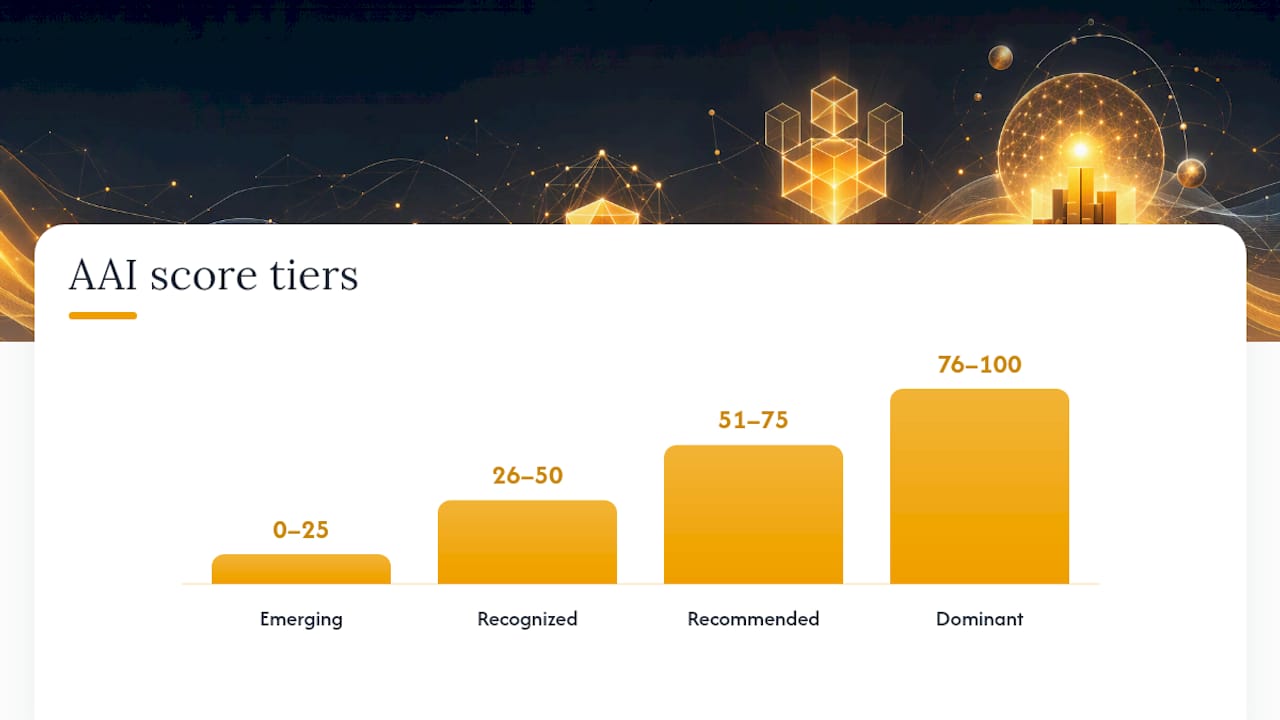
What Do AAI Score Tiers Mean for Your Brand?
Scores map into tiers that translate a number into something a marketing team can actually act on, rather than a score that sits in a dashboard nobody interprets correctly.
Emerging (0-25): Your brand rarely surfaces in AI-generated answers for relevant queries, and when it does, the language is heavily hedged or absent from named citations entirely. The priority here is foundational: fix structured data gaps and entity disambiguation before investing in anything more advanced.
Recognized (26-50): AI systems know your brand exists but don't yet treat it as an authoritative source. You show up in lists but rarely get named as the top pick. The next step is building semantic breadth so you're associated with more than one narrow use case.
Recommended (51-75): You're approaching or crossing the citation threshold Byrum describes, where hedging language starts dropping out and assistants recommend you directly for at least some query types. This tier calls for defending your position through consistent, fresh signal rather than assuming the gains are permanent.
Dominant (76-100): Your brand is the default recommendation across a meaningful share of category-relevant prompts, cited with minimal hedging and reinforced by strong network authority. The work shifts to monitoring for competitive erosion, since a dominant score today doesn't guarantee it next quarter.
| Tier | AAI range | Recommended short-term action |
|---|---|---|
| Emerging | 0-25 | Audit structured data and entity completeness |
| Recognized | 26-50 | Expand topic clusters to build semantic breadth |
| Recommended | 51-75 | Seed third-party citations to defend citation depth |
| Dominant | 76-100 | Monitor for erosion and track competitor momentum |
Why AAI Matters for Marketing and Brand Teams
The strategic case for tracking AAI comes down to where buyer attention is actually going. If a growing share of research happens inside an AI conversation instead of a search results page, a metric that ignores AI-generated answers is measuring the wrong thing.
Practical use cases stack up quickly once a team starts watching this number:
- Discovery and awareness: knowing whether you appear at all when a prospective buyer asks an assistant an open-ended category question
- RFP and vendor shortlisting: many procurement processes now start with an AI-generated shortlist before a human ever opens a search engine
- Content prioritization: directing content investment toward the topics where your semantic breadth is weakest
- Competitive benchmarking: seeing exactly which competitors get cited more often and for which queries, using generic evaluation criteria rather than gut instinct
- Executive reporting: giving leadership a single trended number instead of a pile of disconnected analytics screenshots
When AAI improves, the expected outcomes are concrete: a higher share of AI-generated answers naming your brand, less hedging language surrounding those mentions, and citations that read as unambiguous recommendations rather than passing references buried in a longer list.
None of this replaces organic search performance, brand lift studies, or share-of-voice tracking. It sits alongside them. A brand can have strong SEO rankings and a weak AAI at the same time, particularly if its content is built for search crawlers but poorly structured for the entity recognition AI systems depend on.
Who Should Own and Monitor the AAI?
The AAI works best as a shared metric with clear ownership, not a report that lands in one inbox and gets forgotten.
The CMO typically owns AAI at the strategic level, setting the target trajectory and deciding how much budget shifts toward AI visibility work versus traditional channels. The head of SEO or GEO (generative engine optimization) runs the operational side, managing topic ownership programs and tracking which content moves the semantic breadth score. Product marketing feeds accurate, structured positioning language into the system, since AI models often echo the exact phrasing a brand uses about itself. Demand generation leaders watch for downstream pipeline effects, particularly in RFP and shortlist scenarios where AI-generated recommendations increasingly influence which vendors get a first conversation. Analytics teams run the query-level experiments (the CPQ-style tests) that isolate what's actually moving the score month over month.
A reasonable governance cadence: monthly score review with the SEO/GEO lead as primary owner, quarterly strategic review with the CMO, and an ongoing feedback loop where product marketing and analytics compare notes on which content or structured data changes correlate with citation gains. Teams already running enterprise-scale multi-brand monitoring usually assign a dedicated owner per brand rather than treating the whole portfolio as one score.
What Counts Toward Your AAI, and What Doesn't
Scope matters here, because it's tempting to fold every marketing metric into one number and call it authority.
Included in the AAI: AI-generated citations naming your brand, recommendation share across category-relevant prompts, structured data and knowledge-graph completeness, third-party endorsements that feed model training or retrieval, and prompt-level exposure across assistant classes.
Explicitly excluded: raw site traffic, social follower counts, and owned email metrics, unless those signals demonstrably map back to AI discoverability (which most don't, directly). A brand can have a large email list and near-zero AI visibility, because those are simply unrelated systems.
That exclusion isn't a dismissal of those metrics. They remain useful diagnostics for other parts of the marketing funnel. They just don't belong inside a score meant specifically to measure AI-mediated recommendation behavior.
Edge cases get handled with some nuance. Multi-brand organizations typically need a separate AAI per brand rather than one blended score, since AI systems form distinct opinions about each entity. Franchise and local business listings introduce another wrinkle: AI systems sometimes conflate a national brand with individual locations, so entity disambiguation work matters more for these structures than for a single-entity company.
Historical Evolution of the AI Authority Index
The category around measuring "AI authority" is young enough that most of its methodology is still being written in public. AuthorityLayer's original approach to AAI grew directly out of the shift in buyer behavior toward AI-assisted research, treating the index less as a fixed formula and more as a framework that adapts as model behavior changes.
Early iterations weighted citation frequency heavily, since that was the easiest signal to observe. As entity-level research matured, particularly around thresholds like the one Byrum describes for citation confidence, the framework absorbed a more granular view of how a brand gets cited, not just how often. Semantic breadth and network authority components were layered in as it became clear that a brand could win frequent mentions while still losing ground on being recognized as a category authority across multiple topics.
Refresh cadence has also tightened over time. Because model leaderboards show meaningful shifts within a matter of months (one snapshot in mid-2026 showed Claude Mythos 5 leading composite Arena Elo rankings, a position no model can assume is permanent) an index that recalculates infrequently risks reporting on a landscape that no longer exists. The practical lesson: any authority index that doesn't keep pace with model turnover starts drifting out of sync with reality within a single quarter.
How AAI Compares to Other AI Authority Frameworks
The AAI isn't the only attempt to quantify AI-era brand authority, and that's worth being direct about. Several vendors and industry groups launched competing frameworks recently, which signals real demand for this category even as definitions vary.
Informa TechTarget's B2B AI Authority Index uses a self-assessment structure built around six capabilities (strategy, intelligence, governance, narrative, amplification, and longevity), delivered as a 24-question survey. It's a useful framework for organizational self-diagnosis, but it relies on self-reported answers rather than direct observation of AI system outputs. Other announced products, like the GlobalSphere AI Authority Index, take a brand-visibility angle aimed at a broader market.
The meaningful distinction is observational versus self-reported measurement. A self-assessment survey tells you how a marketing team perceives its own AI readiness. A framework built on actual prompt sampling and citation extraction, which is how the AAI operates, tells you what AI systems are actually saying, regardless of internal perception. Both have value, but they're not interchangeable, and a brand scoring well on an internal capability survey can still score poorly on real-world AI citation behavior if the underlying entity data is thin.
Where the AI Authority Index Falls Short
No index built on model behavior can claim permanent accuracy, and being upfront about the AAI's limitations matters more than pretending the number is infallible.
The most significant limitation is model volatility itself. Because the AI model landscape changes constantly, with new versions, retraining cycles, and shifting provider market share, an AAI snapshot reflects a moment in time rather than a permanent verdict. A brand's score can move for reasons that have nothing to do with marketing effort, including a model provider changing how its retrieval system prioritizes sources.
Sampling bias is a real risk in any prompt-based measurement system. The specific queries chosen to test a brand's visibility inevitably shape the results, and a poorly designed query set can either overstate or understate real-world exposure. Cross-model variance compounds this: a brand can score strongly on one assistant and weakly on another, and collapsing that into a single number always loses some nuance.
There's also an inherent lag between when a brand improves its underlying signals (better structured data, more third-party citations) and when that improvement shows up in model outputs, particularly for assistants that rely on training data rather than live retrieval. Improvement isn't instant, and teams expecting a same-month score jump from a single content change will be disappointed.
Finally, the category itself is still maturing. With multiple organizations building their own versions of an "AI authority" score using different weightings and methodologies, direct comparisons between indexes from different providers should be treated cautiously rather than as apples-to-apples benchmarks.
Brands With Different AAI Scores Look Very Different in Practice
The gap between a low-tier and high-tier AAI score isn't abstract. It shows up directly in how an AI assistant phrases a response.

A brand in the Emerging tier typically gets described in hedged, generic terms if it's mentioned at all: an assistant might say "there are several options in this category" without naming the brand specifically, or bury it in a long unranked list. A brand in the Recognized tier starts appearing by name but often alongside qualifying language ("some users report" or "one option worth considering"), reflecting a citation confidence still below the threshold Byrum's research identifies.
Once a brand crosses into the Recommended range, the language shifts noticeably. Assistants begin naming the brand as a direct answer to "what should I use for X" rather than one option among many, and the hedging drops out. In the Dominant tier, a brand often becomes the default answer across a wide range of phrasings of the same underlying question, cited with a level of confidence that mirrors how the assistant treats well-established, heavily documented entities.
The practical takeaway for marketing teams sitting in the lower tiers: the jump between tiers usually correlates less with total marketing spend and more with whether the underlying entity data (structured markup, consistent third-party descriptions, topic coverage) is complete enough for a model to cite confidently.
How to Improve Your AAI
A low or middling AAI score isn't a verdict. It's a checklist.
- Fix identity completeness first. Structured data and knowledge-graph accuracy are the foundation everything else builds on. If an AI system can't reliably identify what your company does, no amount of content volume fixes that.
- Build semantic breadth deliberately. Map the full set of topics your category covers and identify where you have zero presence in AI-generated answers, then prioritize content and structured data for those gaps.
- Seed trusted third-party references. AI systems weight independent validation heavily. Analyst mentions, credible review-site data, and citations from established industry sources move network authority more than owned content alone.
- Design content specifically for retrieval. Long-form blog posts written for human skimming often perform poorly as source material for AI extraction. Clear, quotable, factually dense snippets get pulled into generated answers more reliably.
- Run controlled prompt-campaign experiments. Pick a fixed set of control queries, run them before and after a change, and measure whether citation share actually moved.
A few quick experiments worth running early: testing two phrasings of the same prompt to see which triggers a brand citation, publishing retrieval-optimized snippets on high-intent topic pages, and running an entity disambiguation sweep to catch cases where an AI system confuses your brand with a similarly named competitor.
Measurement discipline matters as much as the tactics themselves. Set a baseline using a fixed query set before making any changes, keep a control group of queries untouched by your content work, and track citation share uplift over at least a full refresh cycle rather than judging results after a single week.
Pro Tip: Run prompt experiments in small batches of 10 to 15 fixed queries rather than broad, sprawling test sets. Smaller, consistent batches make it far easier to isolate which specific change actually moved a citation, instead of drowning the signal in noise from dozens of variables shifting at once.
Teams looking for a structured way to think about evaluation design might also find this checklist on AI evaluation metrics useful background for setting up rigorous test criteria before running prompt campaigns.
How Authoritylayer Puts the AAI Into Practice
Authoritylayer built the AAI to be observed, not self-reported. The platform runs continuous prompt tracking across ChatGPT, Gemini, Claude, and Perplexity-style retrieval engines, extracting exactly how and whether a brand gets cited across each one.
The core capabilities behind this: real-time monitoring that catches score movement as it happens rather than in a quarterly review, cross-assistant coverage so a brand isn't judged on a single model's behavior, citation extraction that identifies the specific language used when a brand is named, CPQ-style tracking that measures citation confidence at the query level, and benchmark dashboards that show a brand's position relative to category competitors using generic evaluation criteria rather than vendor comparisons.
All of this rolls up into the Monthly AI Visibility Report, the recurring deliverable that turns raw monitoring data into something a marketing team can act on. A typical report includes trended AAI scores by component, a prioritized list of visibility gaps ranked by impact, and specific quick-win recommendations tied to whichever tier a brand currently sits in. Marketing teams generally use it as a monthly planning input: reviewing what moved, why, and which action item from the prioritized list to tackle next. Understanding how the underlying data collection works helps teams interpret the report's findings with the right context.
Getting Your First AI Authority Index Score
Most teams start with the free AI visibility scan, which gives an initial read on where a brand currently stands before committing to anything further.
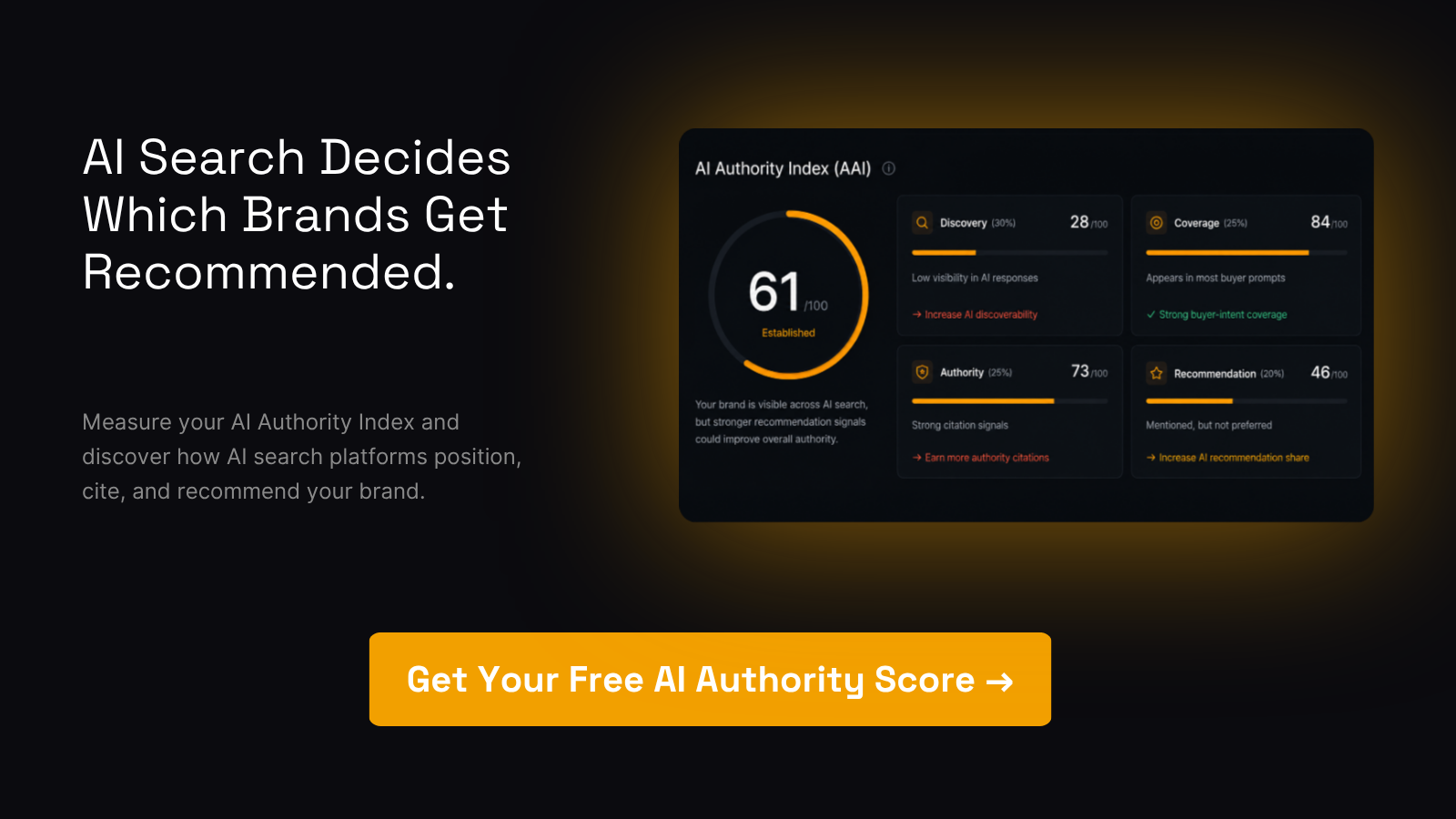
That initial scan typically surfaces the biggest visibility gaps within a few days, enough to see whether you're sitting in the Emerging tier with foundational data problems or already in Recognized territory with room to build semantic breadth. From there, the Monthly AI Visibility Report becomes the ongoing tracking mechanism: trended scores, a prioritized opportunity list, and quick-win recommendations delivered on a predictable monthly cycle instead of a one-off audit that goes stale in a matter of weeks.
Smaller teams typically start on the Starter plan to get baseline monitoring running before scaling up. Organizations managing multiple brands or requiring more granular governance tend to move toward Enterprise, where multi-brand tracking and custom reporting cadences come standard. Whichever entry point fits, the next step is the same: run the scan, see where your AAI actually stands today, and decide from there whether monthly reporting makes sense for your team.
Sources
- Benchlm
- LLM Leaderboard - Best Text & Chat AI Models Compared
- AI Models Leaderboard August 2026 | LMSys Arena Elo, Pricing & Speed
FAQ
What Is the AI Index in Marketing Terms?
In this context, the AI index refers to a composite score like the AAI that measures how visible, cited, and recommended a brand is across AI assistants, distinct from general-purpose AI capability leaderboards that rank model performance.
Which Country Leads in Artificial Intelligence Development?
Global AI leadership shifts across model releases and providers rather than settling on one permanent leader; benchmark trackers like BenchLM and Artificial Analysis show rankings changing month to month across companies and countries.
What Are the Levels of AI Capability?
Common AI capability frameworks describe a progression from narrow task automation toward more general reasoning systems, but there's no single universally agreed-upon numbered scale, so definitions vary by the organization proposing them.
Is There an Index Specifically for AI Companies?
Several frameworks track AI company and model performance, including model-specific leaderboards like Arena.ai and SWFTE, while the AAI specifically measures how brands (not AI companies themselves) get discovered and cited inside AI-generated answers.
How Often Does Authoritylayer Update AAI Scores?
Authoritylayer recalculates AAI on a recurring monthly cycle through the Monthly AI Visibility Report, reflecting the frequent refresh cadence needed given how quickly underlying model behavior shifts.