2026 Snapshot: Model Knowledge Cutoff and How to Test It in 4 Steps
Explore model knowledge cutoffs with a 2026 snapshot, four practical tests to verify freshness, and tactics to keep your brand visible in AI assistants.
· 11 min read

A model knowledge cutoff is the date after which an AI system has seen no new training data, so it cannot know anything that happened afterward unless it's connected to live tools. If you need current facts, don't trust the model's memory. Check the vendor's model card or API docs, or use a tool with retrieval/browsing turned on. Reported cutoff dates are the outer limit of what a model might know, not a promise that it actually knows everything up to that day.
TL;DR:
- Most models' effective knowledge cutoffs often occur earlier than the reported date due to data thinning and less coverage of recent months.
- Verifying a model's actual cutoff requires checking official documentation, domain testing, and preferring models with browsing or retrieval tools for real-time information.
- Relying solely on the model's training date can lead to outdated answers; always cross-check critical facts from current sources before acting.
- Vendor-declared cutoff dates are marketing artifacts; actual knowledge boundaries form a soft edge influenced by data quality and topic specificity.
- Brand visibility in AI depends more on whether assistants retrieve current information than on the recency of a model’s training data.
Table of Contents
- Model Knowledge Cutoff Dates: A 2026 Snapshot
- What a Knowledge Cutoff Actually Means
- Why Knowledge Cutoffs Matter More Than People Think
- Why the Reported Date Isn't the Real Boundary
- How to Check a Model's Knowledge Cutoff for Your Needs
- Working Around a Stale Training Cutoff
- What Cutoffs Mean for Brand Visibility
- Keep Your Brand Visible Past the Cutoff
- The Real Lesson Behind All These Dates
- Sources
- FAQ
Model Knowledge Cutoff Dates: A 2026 Snapshot
Every major lab now publishes some version of a cutoff date, but the numbers move often and the gaps between "reported" and "reliable" can run months. The table below reflects the reported cutoffs and access patterns aggregated trackers have cross-checked against official documentation through mid 2026.
Read this table as a starting point, not gospel. Gemini's 3.x line is a good example of the "soft edge" problem: some releases kept an earlier cutoff even as newer versions shipped, which means a later release number does not guarantee fresher knowledge. Anthropic is the one vendor drawing a hard line between two dates instead of one, which the next section unpacks. Always confirm the exact figure on the vendor's current model card before you rely on it. Dates here shift monthly as vendors ship updates, so treat any specific month as a snapshot, not a fixed fact.
What a Knowledge Cutoff Actually Means
A knowledge cutoff is the point where a model's training data stops. Everything after that date is invisible to the model unless something outside its weights, like a retrieval system or a browsing tool, feeds it in. That sounds simple until you notice vendors don't all define "cutoff" the same way.
Anthropic separates two dates: a training data cutoff, which is the absolute latest scrap of data the model ever saw, and a reliable knowledge cutoff, a denser, more trustworthy date the company considers safe to lean on for factual questions. The Anthropic models overview treats the reliable date as the one that matters for real work, because the months right before the training cutoff tend to be thin on data.
That distinction explains why two models released the same week, even from the same company, can carry different cutoffs. Training runs start at different times, use different data snapshots, and get fine-tuned on different follow-up batches. There's no single "AI knowledge date." There's a family of dates, one per model, sometimes more than one per model.
Why Knowledge Cutoffs Matter More Than People Think
A stale cutoff doesn't just mean the model misses yesterday's headlines. It changes how confidently a model answers, and confidence without accuracy is exactly how hallucinations happen. A model trained before a policy changed, a drug was recalled, or a legal precedent was overturned will often answer as if the old version is still true, with zero hesitation in its tone.
A clinical benchmark comparing model performance against updated treatment guidelines found that models with cutoffs predating a guideline revision scored substantially worse than models trained after it. That's not a rounding error. It's the difference between a model citing outdated dosing standards and one citing current ones, in a domain where being wrong has real consequences.
The same risk shows up outside medicine. A journalist asking about an ongoing court case, a researcher tracking a fast-moving regulatory area, or a legal professional checking whether a statute still stands can all get answers that sound authoritative and are simply outdated. The practical rule: any time a question touches something that could have changed since the model's training window, treat a single model's unaided answer as a draft, not a verdict. Cross-check it against a live source before you act on it.
Why the Reported Date Isn't the Real Boundary
Vendors publish one cutoff date, but a model's actual knowledge rarely ends on a clean line. Research tracing knowledge boundaries across large language models found that a model's effective cutoff, the point where it actually stops reliably knowing things, often lands earlier than the date on the model card. The reason is mundane: web crawls, deduplication, and data cleaning thin out coverage of the final months before a training run closes. There's simply less data about October than there is about June, so the model's grip on October is weaker.
This creates what researchers describe as a soft boundary rather than a hard wall. A model might answer confidently about a widely covered event from two weeks before its cutoff, then draw a blank, or worse, guess, on something from two months earlier that got thinner coverage. It's also topic dependent. A model can be sharp on a heavily discussed subject well past its cutoff and shaky on a niche one well before it.
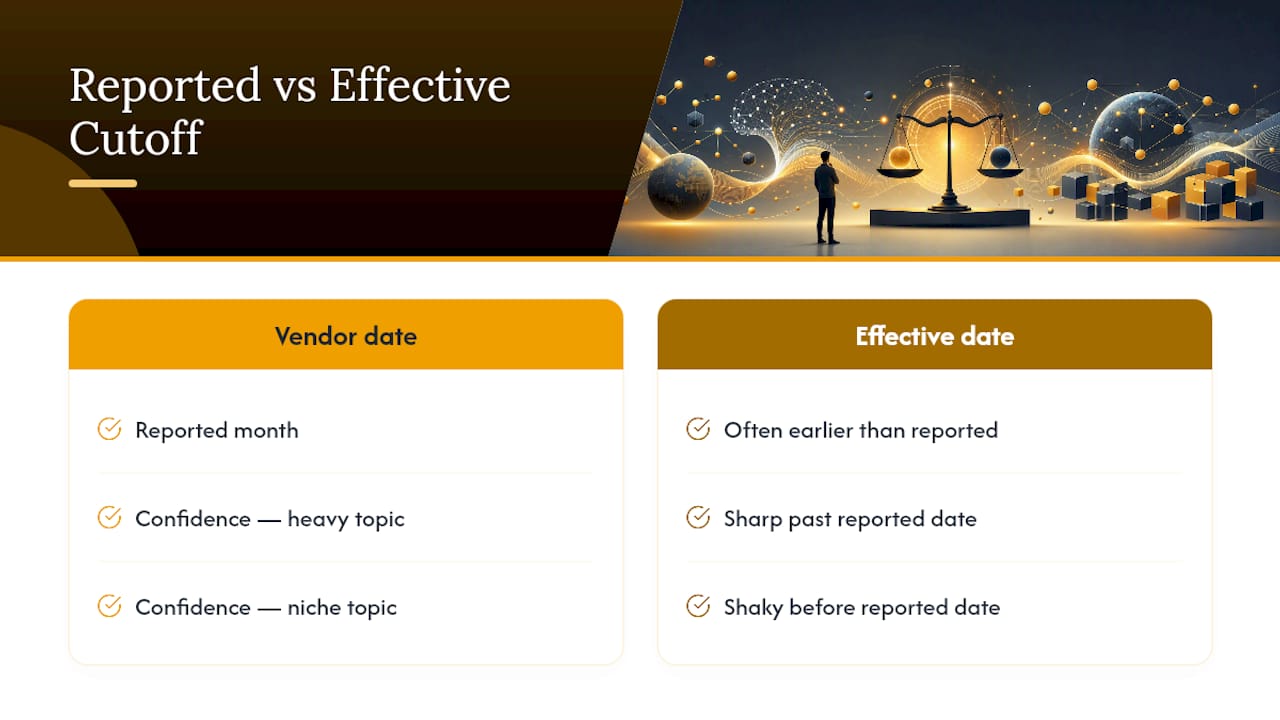
The rule of thumb: don't trust the headline date for anything domain specific. Test the model on the actual facts you care about instead of assuming the vendor's date is a real guarantee.
How to Check a Model's Knowledge Cutoff for Your Needs
Verifying a model's cutoff takes four steps, and skipping the first one is the most common mistake people make.
- Read the official model card or API documentation first. Vendors update these pages more often than marketing copy or blog posts, and they're the only source with any authority behind the date.
- Run your own domain-specific test prompts. Ask about a known event from three months before the reported cutoff, one from the month of the cutoff, and one from after it. A model that gets the middle one wrong is telling you its effective cutoff sits earlier than advertised.
- Don't ask the model to self-report its own cutoff. Models frequently guess wrong about their own training data, because that information usually isn't part of what they were trained to know about themselves.
- Favor models with tool or browsing access when your topic is fast-moving. A model with a stale training set but live retrieval will often beat a fresher model with no access to outside sources.
Pro Tip: Stamp today's date into your system prompt or first message. Models have no internal clock, so a model with a 2024 cutoff will sometimes assume it's still 2024 unless you tell it otherwise.
Working Around a Stale Training Cutoff
You don't have to wait for a new model release to get current answers. A few methods close the gap, each with different trade-offs.
- Retrieval-augmented generation (RAG) feeds a model relevant documents at query time, pulling from either an internal knowledge base or the open web, and it's the most reliable fix when you control the source material.
- Browsing and tool grounding let a model fetch live pages during a conversation, which helps with breaking news but carries a real risk: citation quality varies, so verify sourced links before repeating them as fact.
- Fine-tuning or continual learning updates a model's behavior on a narrow domain without a full retrain, but it risks catastrophic forgetting and never fully substitutes for live retrieval when timeliness is the whole point.
- Prompt-level fixes work in a pinch: paste the current text directly into the conversation, or stamp the date, when you can't wait for a system upgrade.
For anything in finance, where a wrong number can cost real money, pairing model output with structured, current market data matters more than picking the newest model.
What Cutoffs Mean for Brand Visibility
A brand's biggest blind spot in AI search isn't a bad model, it's a training gap. If your product launch, rebrand, or key differentiator happened after a model's effective cutoff, that model has no idea it exists, and it will keep recommending competitors it does know about. This is the same soft-boundary problem showing up as a business risk instead of a factual one.
Watching how AI visibility shifts over time means tracking more than model release notes. It means monitoring your recommendation share across assistants, checking whether tool-enabled models are actually retrieving your current pages when they answer buyer questions, and watching for gaps in how AI knowledge graphs cluster your brand against competitors. Model cards tell you what a system might know. Recommendation tracking tells you what it's actually saying.
Keep Your Brand Visible Past the Cutoff
Once you know a model's training data might be stale about you, the next problem is verifying whether AI assistants are recommending you at all, and that's not something a model card will tell you.
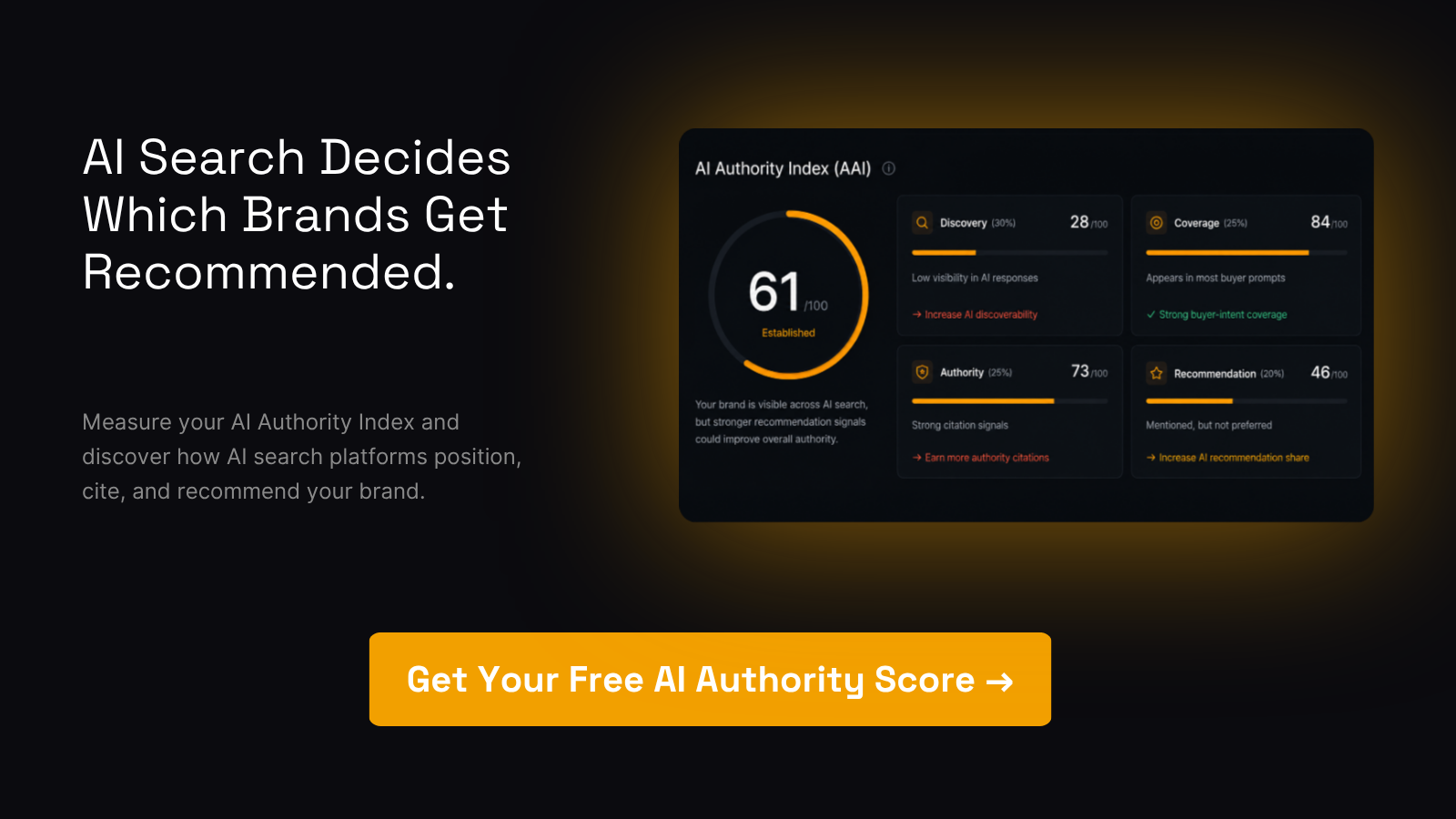
Authoritylayer's Monthly AI Visibility Report tracks how ChatGPT, Claude, Gemini, and Perplexity describe and recommend your brand against competitors, month over month, so you catch a drop in recommendation share before it shows up in your pipeline. It's built for the exact scenario this article covers: your product or positioning changed after a model's effective cutoff, and you need to know whether tool-enabled assistants are picking up the correction or still repeating outdated information. If your team has noticed inconsistent AI answers about your own company, or a competitor showing up in places you used to, that's the signal to look closer. Set up your workspace and start tracking recommendation share against the AI Authority Index to see exactly where the gaps are.
The Real Lesson Behind All These Dates
Here's the part most explainers skip: a knowledge cutoff date is a marketing artifact as much as a technical one. Vendors pick a date that sounds current, but the actual density of training data behind that date is uneven, and nobody outside the lab knows exactly where the thin patches are. Treating a cutoff as a hard wall is a mistake in both directions. Sometimes a model knows more than its date suggests, because a topic got heavy coverage. Sometimes it knows far less, because the final months of a training run are always sparser than the vendor's headline number implies.
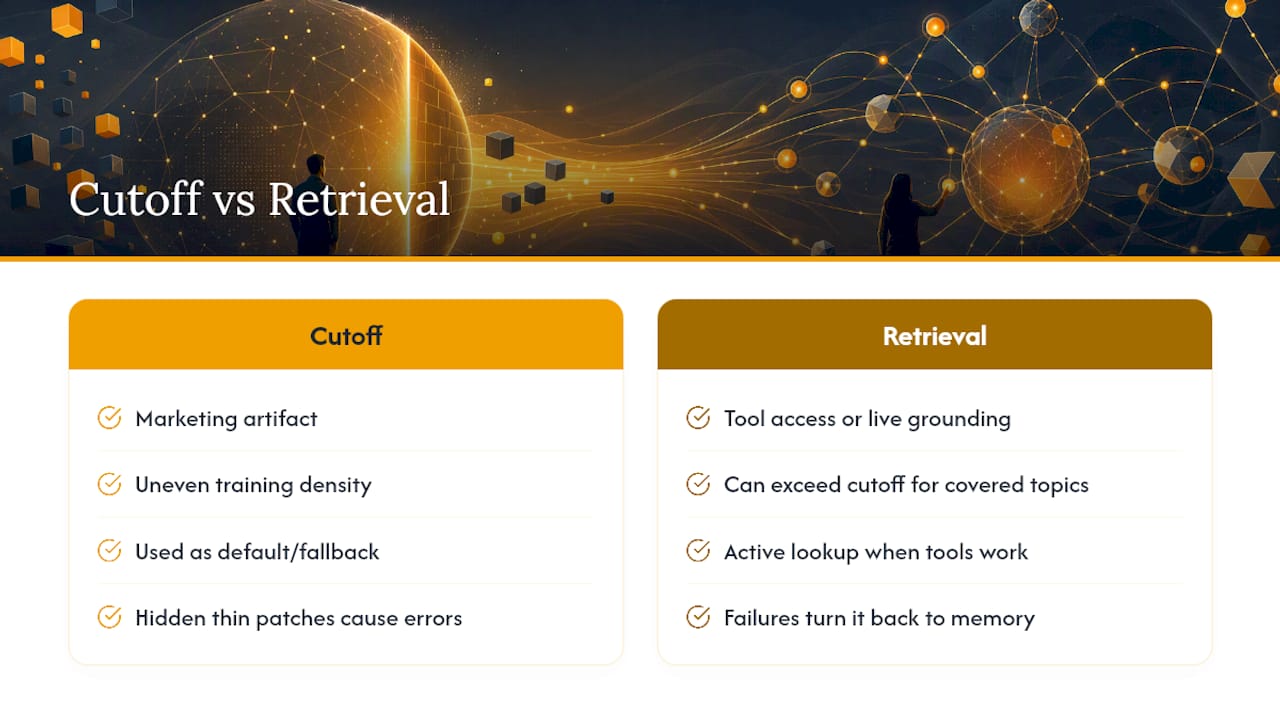
The bigger shift, though, is that cutoffs are becoming less relevant to how people actually use these systems. Once a model has real tool access, browsing, retrieval, live search grounding, the training cutoff stops being the ceiling on what it can tell you. It becomes the fallback for when the tools fail or aren't used. That changes the diligence question. Instead of asking "what's this model's cutoff," the sharper question is "does this model actually reach for a live source when it should, or does it quietly answer from stale memory instead." Most people never test that, and it's the gap that causes the worst hallucinations, not the training date itself.
For brand visibility specifically, this cuts both ways. A brand can get lucky and show up correctly through retrieval even when the underlying model has never heard of them. A brand can also get unlucky and stay invisible even after a fresh release, if the assistant never bothers to look anything up. Betting on a "smarter model" fixing your visibility gap is usually the wrong bet. Betting on whether assistants ground their answers in current sources is the one that actually predicts outcomes.
— Geraldine
Sources
- Knowledge cutoff
- Anthropic models overview (platform docs)
- Dated Data: Tracing Knowledge Cutoffs in Large Language Models (arXiv)
- Clinical benchmark study (PubMed)
- Metehan
FAQ
What is the current knowledge cutoff for ChatGPT models?
It varies by version and OpenAI updates it with each release, so the only reliable source is the current model card or API documentation rather than a fixed date repeated across the web.
What does knowledge cutoff mean in AI models?
It's the point after which a model has seen no new training data, meaning it can't know about events, facts, or changes that happened afterward without an external tool like retrieval or browsing.
Why does AI have a knowledge cutoff?
Training a large model takes months, and once training starts, the data snapshot is locked in, so anything that happens during or after that process simply isn't part of what the model learned.
What is the knowledge cutoff in large language models, and is it a hard date?
It's the training data boundary, but research on tracing knowledge boundaries in LLMs shows it behaves as a soft edge rather than a hard wall, since data coverage thins out in the months right before the cutoff.
How is a model's knowledge cutoff different from its actual recommendation behavior?
A cutoff describes training data; recommendation behavior depends on whether the model uses live tools when answering, which is a separate signal that services like Authoritylayer's AI visibility measurement track directly.