LLM Optimization: Measure AI Recommendation Share With 15–20 Prompts
Measure LLM optimization with AI recommendation share, a 15 to 20 prompt baseline, and 90 days of audits, action, and AuthorityLayer reporting.
· 8 min read

LLM optimization means improving how AI assistants discover, describe, and recommend your brand when buyers research a purchase. The single metric to start with is AI recommendation share, how often your brand gets cited or named in response to a set target prompts, compared with competitors. Run a baseline sample of 15 to 20 realistic buyer prompts across ChatGPT, Claude, Gemini, and Perplexity before doing anything else.
Key Takeaways
Optimizing for AI recommendation share improves brand visibility in AI assistants, which directly influences buyer consideration and pipeline growth.
| Point | Details |
|---|---|
| Measure AI recommendation share | Track how often your brand is cited or recommended across different AI tools using a consistent prompt set. |
| Focus on content and structured data | Create answer-ready assets and add structured markup to improve your brand's discovery and description in AI responses. |
| Prioritize high-impact prompts first | Target prompts related to your highest-value buyer segments to maximize influence on AI assistant recommendations. |
| Use AuthorityLayer’s benchmarking tools | Leverage the AI Authority Index and recommended tracking cadence for continuous visibility and improvement. |
| Start with a free baseline scan | Run an initial scan with AuthorityLayer to identify current AI visibility and set measurable goals for improvement. |
Table of Contents
- What LLM optimization means for marketing teams
- Why AI citations and recommendations matter for brand consideration
- Concrete metrics and signals to track for LLM visibility
- Prioritized framework: audit, intervene, measure
- 90-day prioritized checklist for a small marketing team
- How AuthorityLayer helps you get started
- FAQ
What LLM optimization means for marketing teams
LLM optimization is the practice of making a brand easy for AI assistants to find, describe accurately, and recommend during buyer research. It covers three stages: discovery (does the assistant know your brand exists), description (does it characterize your product correctly), and recommendation (does it suggest you as a fit for the buyer's need). This is a different discipline than traditional search optimization, because the assistant is synthesizing an answer rather than ranking a list of links.
Marketing teams should measure this across the assistants buyers actually use: ChatGPT, Claude, Gemini, and Perplexity, along with any other generative-answer tool relevant to their category. Each has its own retrieval behavior and training data mix, so visibility on one does not guarantee visibility on another.
In practice, this shows up in buyer-research prompts like "what are the best project management tools for a 50-person team" or "compare [Category] vendors for enterprise security." Some prompts will surface your brand by name with an accurate description. Others will mention competitors only, or describe your offering incorrectly. Both outcomes are measurable, and both are fixable once you know they exist.

Why AI citations and recommendations matter for brand consideration
When an AI assistant answers a buyer's research question, it often compresses what used to be ten browser tabs into one response. If your brand is not part of that response, you are not part of the shortlist, regardless of how strong your paid search or organic rankings are. This is a structural shift in how consideration sets get built, not a new channel bolted onto the old one.
The mapping from AI visibility to pipeline is intuitive even without precise industry-wide figures: a buyer who sees your brand recommended by name, with an accurate description, enters your funnel already primed. A buyer who never sees you mentioned never enters it at all. Marketing leaders should treat AI recommendation share the way they treat branded search volume or share of voice: a leading indicator of demand, not a vanity number.
The urgency comes from how fast buyers have folded these tools into everyday research habits. Waiting for a slow quarter to start measuring means losing months of visibility data you cannot reconstruct after the fact. Establishing a baseline now, even an imperfect one, beats optimizing blind six months from now.

Concrete metrics and signals to track for LLM visibility
Treating LLM visibility as a real marketing KPI means picking a primary metric and a short list of supporting signals, then tracking both on a schedule.
Your primary KPI is AI recommendation share: the percentage of a defined prompt set where your brand appears, divided by total prompts run, compared against named competitors. Calculate it by running the same prompt set across each assistant on a fixed cadence and logging whether your brand appears, how it is described, and whether it is recommended outright.
- Prompt-trigger reach: how many distinct buyer-intent prompts surface your brand at all.
- Answer prominence: whether your brand appears first, mid-list, or as an afterthought in the response.
- Attribution presence: whether the assistant cites a source, page, or review when naming you.
- Competitive share: your recommendation share relative to each named competitor, not just your own trend line.
An AI Authority Index (AAI) can provide marketing teams a single benchmarking score for AI visibility, built from these underlying signals rather than one metric alone, which makes it useful as a starting baseline rather than a one-off audit.
| Signal | What it tells you | Typical cadence |
|---|---|---|
| AI recommendation share | How often you're cited versus competitors | Weekly to monthly |
| Answer prominence | Whether you lead or trail in the response | Monthly |
| Attribution presence | Whether assistants cite a specific source for you | Monthly |
| AAI baseline score | Composite visibility benchmark | Monthly |
For instrumentation, a sample of 15 to 20 prompts per assistant run monthly is enough to spot directional change without burning a team's time; weekly spot checks work for high-priority prompts tied to active campaigns.
Prioritized framework: audit, intervene, measure
A repeatable framework beats ad-hoc prompt checking, because it turns LLM optimization into something you can assign, schedule, and report on.
- Audit: run prompt reconnaissance across your target assistants to find where you're missing, misdescribed, or outranked.
- Content engineering: build or revise answer-ready assets, pages that state what you do, who it's for, and how it compares, in language an assistant can lift directly.
- Knowledge-layer signals: add structured data, consistent entity naming, and clear product facts so assistants have unambiguous source material.
- Trust signals: strengthen third-party mentions, reviews, and citations that assistants draw on when forming a recommendation.
- Monitoring: re-run the same prompt set after each intervention to confirm movement before moving to the next priority.
Prioritize opportunities by multiplying likely impact by effort required, then weight by how often the triggering prompt actually occurs in buyer research. A prompt that comes up constantly at the consideration stage deserves attention before a rare, early-funnel question.
A concrete example: if your brand is absent from "best [category] for small teams" prompts, publish a direct comparison page answering that exact framing, add schema markup identifying your product entity, then re-run the prompt set two weeks later to check for movement. The LLM SEO tactics guide walks through additional examples of answer-ready content structures.
Pro Tip: Start interventions with the prompts tied to your highest-value buyer segment, not the ones that are easiest to fix.
90-day prioritized checklist for a small marketing team
A 90-day plan keeps LLM optimization from becoming an open-ended research project.
- Weeks 1 to 2: sample target prompts across each assistant, record your current AI recommendation share, and set an AAI baseline.
- Weeks 3 to 6: publish answer-ready content for your highest-priority prompts, add structured markup, and target the specific phrasing buyers use.
- Weeks 7 to 12: expand content engineering to secondary prompt clusters, formalize monitoring cadence, and assign ownership for ongoing governance.
- Re-run baseline prompts weekly during active intervention weeks.
- Review AI recommendation share and AAI score monthly in a standing marketing dashboard.
- Compare competitive share quarter over quarter to confirm the gap is closing, not just shifting.
The AI share of voice guide covers how to weight prompts by buyer stage when building this schedule, and teams wanting an outside execution partner for parts of this work can review a 90-day LLM SEO plan built around similar milestones.
How AuthorityLayer helps you get started
Running this program by hand means manually prompting four assistants, logging results in a spreadsheet, and guessing at what "good" looks like. We built AuthorityLayer to replace that manual work with a single benchmarking index, the AI Authority Index, so you get a defensible score instead of a pile of screenshots.
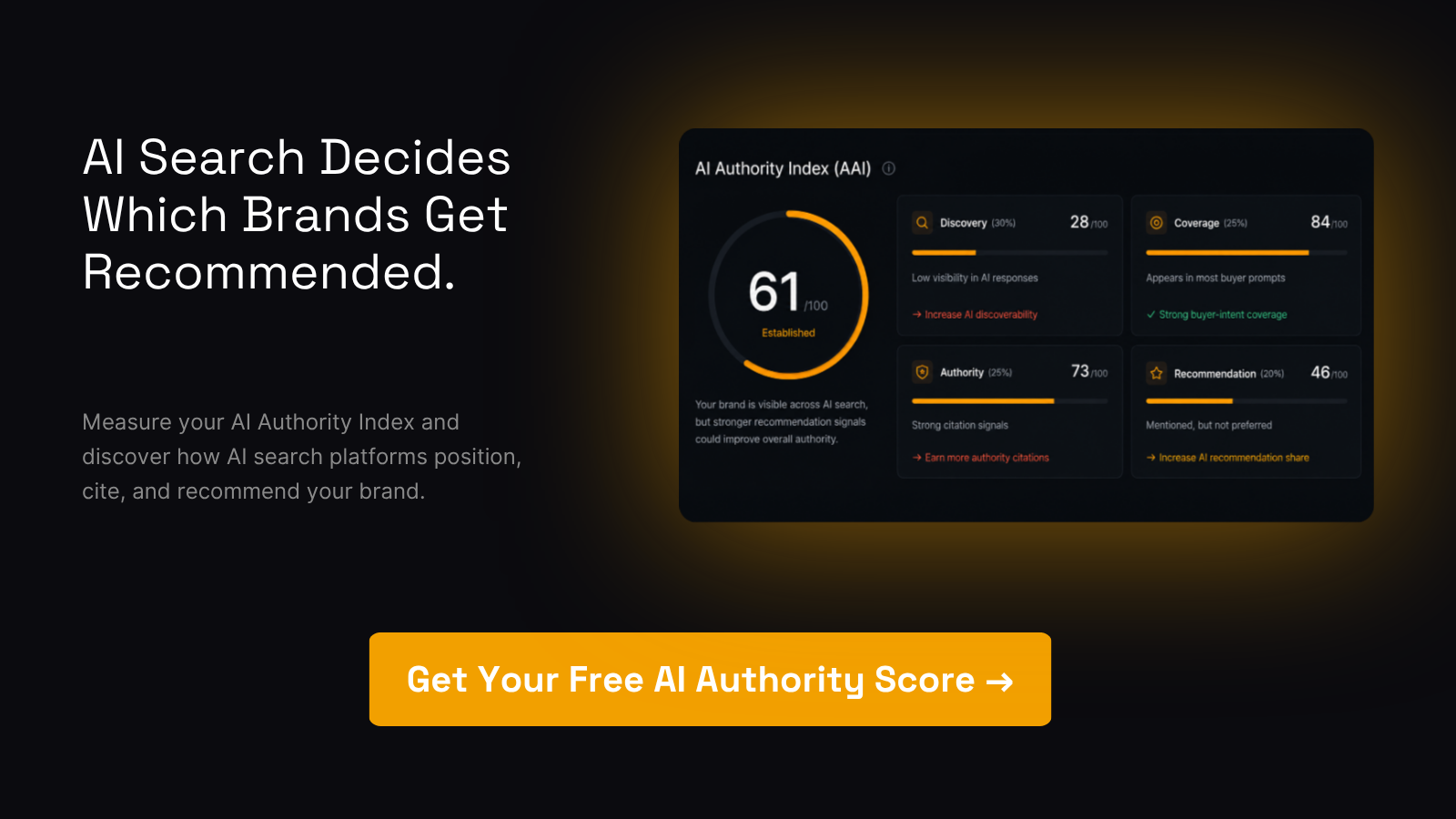
We measure your AI recommendation share against named competitors, flag where assistants are describing you incorrectly or not at all, and turn those gaps into prioritized, specific recommendations rather than a generic audit.
- Start with a Free AI Visibility Scan to see your current baseline at no cost.
- Move to the Monthly AI Visibility Report at $59 per month for ongoing tracking without a full platform commitment.
- Scale into the Starter plan at $99 per month, Growth at $349 per month, or Enterprise at $795 per month for multi-brand benchmarking and prioritized action plans.
Run the free scan this week and see exactly where your brand stands before you write another page of content aimed at assistants that may not even know you exist yet.
FAQ
What does "LLM optimization" mean for a marketing team?
LLM optimization is the work of improving how AI assistants discover, describe, and recommend your brand during buyer research, rather than tuning the underlying AI models themselves. For marketers, it means tracking and improving metrics like AI recommendation share across tools such as ChatGPT, Claude, Gemini, and Perplexity.
Which AI assistants should we monitor first?
Start with the assistants your buyers are most likely to use for research, typically ChatGPT, Claude, Gemini, and Perplexity. Running the same prompt set across all four gives you a more reliable picture than checking just one.
How often should we re-check our AI recommendation share?
A monthly cadence works for most teams, with weekly spot checks during active content or structured-data interventions. The AAI methodology outlines a measurement cadence built around this rhythm.
What is the AI Authority Index (AAI)?
The AAI is AuthorityLayer's benchmarking index for AI visibility, combining signals like recommendation share, prominence, and attribution into one score. It gives marketing teams a single number to track over time instead of separate, disconnected metrics.
How fast can we expect to see movement in AI citations?
Early movement often shows up within weeks of publishing answer-ready content or adding structured data, though full competitive shifts typically take a full quarter to confirm. A 90-day cycle of baseline, intervention, and remeasurement is a realistic window for the first visible gains.