LLM Brand Visibility: How to Measure and Improve It
Discover how to effectively measure and enhance your LLM brand visibility to attract more customers and outperform competitors.
· 14 min read

LLM brand visibility is how often, where, and how favorably AI assistants like ChatGPT, Gemini, Claude, and Perplexity name and cite your brand when someone asks a buying question. The single best first action: build a fixed set of prompts and run it across multiple engines at once, instead of typing one question into one chatbot and calling it research. That single query is a snapshot; a pooled, multi-engine run reveals a pattern you can actually defend to a CMO.
Six metrics tell the whole story:
- Mention rate — how often your brand appears at all
- Share of voice — your mentions versus competitors' across the same prompts
- First-mention rate — how often you're named first, not fourth
- Citation rate — how often the answer links to a page that's actually yours
- Sentiment — whether the framing is positive, neutral, or damaging
- Competitive gap — the delta between your scores and the category leader's
Why this matters now: 51% of B2B software buyers already start their research with an AI chatbot more often than with a traditional search engine. If you're not measuring what those chatbots say about you, half your funnel is a black box.
Key Takeaways
LLM brand visibility requires tracking mention rate, share of voice, first-mention rate, citation rate, sentiment, and competitive gap through pooled multi-engine runs, not single ad-hoc prompts.
| Point | Details |
|---|---|
| Define visibility precisely | Mention plus prominence plus citation plus framing, measured across AI assistants, not just search rank. |
| Track six core metrics | Mention rate, share of voice, first-mention rate, citation rate, sentiment, and competitive gap together tell the full story. |
| Fix presence before citation | Solve discovery gaps first, then positioning, then earn placements on trusted third-party pages. |
| Pool runs, don't trust one prompt | Multi-engine, multi-run sampling smooths out noise a single personalized chat session can't reveal. |
| Use Authoritylayer for continuous tracking | Authoritylayer automates the fixed-prompt, multi-engine pipeline and exports raw answers and sources for audit. |
Where to Read More on LLM Visibility and GEO
- How to measure LLM brand visibility covers the pooled-run scorecard method this guide builds on.
- Generative engine optimization explains the GEO discipline and tool evaluation checklist.
- Visual marketing display best practices offer useful context on how off-site visual signals feed discoverability.
Table of Contents
- What Is LLM Brand Visibility and Why Does It Differ From SEO?
- What Metrics Should You Track for LLM Brand Visibility?
- Which AI Engines Should You Track for Brand Mentions?
- How Do You Build a Repeatable LLM Visibility Measurement Process?
- What Should You Do to Improve LLM Brand Visibility?
- How Should You Interpret LLM Visibility Metrics and Set Benchmarks?
- What Are the Biggest Pitfalls in Measuring LLM Brand Visibility?
- What Does a Successful LLM Visibility Improvement Look Like?
- Get a Baseline AI Visibility Score Without Building the Pipeline Yourself
- Sources
- FAQ
What Is LLM Brand Visibility and Why Does It Differ From SEO?
LLM brand visibility is the combination of four things: whether you get mentioned, how prominently, whether you get cited as a source, and how you get framed. A brand that shows up in fortieth place on a comparison page has SEO visibility. A brand an AI assistant recommends by name, unprompted, in the second sentence of an answer has something SEO metrics were never built to capture.
The mechanics explain why. LLMs don't rank pages, they synthesize answers from a blend of reviews, forums, vendor pages, and comparison sites, then decide which of those sources to cite. Hootsuite's research on LLM visibility frames this as tracking presence, positioning, sentiment, and narrative gaps rather than clicks and rankings. Two brands can have identical Google rankings and wildly different AI visibility, because the AI is reading different signals: how you're described on G2, what a Reddit thread says about your onboarding, whether a comparison page calls you "the enterprise option" or "the cheap alternative."
That's the practical gap marketing leaders need to close. Ranking metrics tell you about your own pages. Visibility metrics tell you about the story AI assistants are telling about you, using pages you may not control.
- Traditional SEO: rank, clicks, impressions, backlinks
- LLM visibility: mention rate, framing, citation source, sentiment across engines
What Metrics Should You Track for LLM Brand Visibility?
Each of the six metrics answers a different question, and together they separate "does the AI know we exist" from "does the AI recommend us."
- Mention rate: the percentage of prompts where your brand name appears anywhere in the answer. This is your floor. If it's low, you have a discovery problem before you have a positioning problem.
- Share of voice: your mention count divided by total brand mentions (yours plus competitors) across the same prompt set. This tells you whether you're winning the category conversation or losing it.
- First-mention rate: how often you're the first brand named. Order matters. Users skim; the first name mentioned gets disproportionate trust.
- Citation rate: how often the answer includes a link or explicit source reference back to a page connected to your brand.
- Sentiment: whether the AI's framing skews positive, neutral, or negative, scored consistently across runs.
- Competitive gap: the numeric distance between your share of voice and the top competitor's, tracked over time.
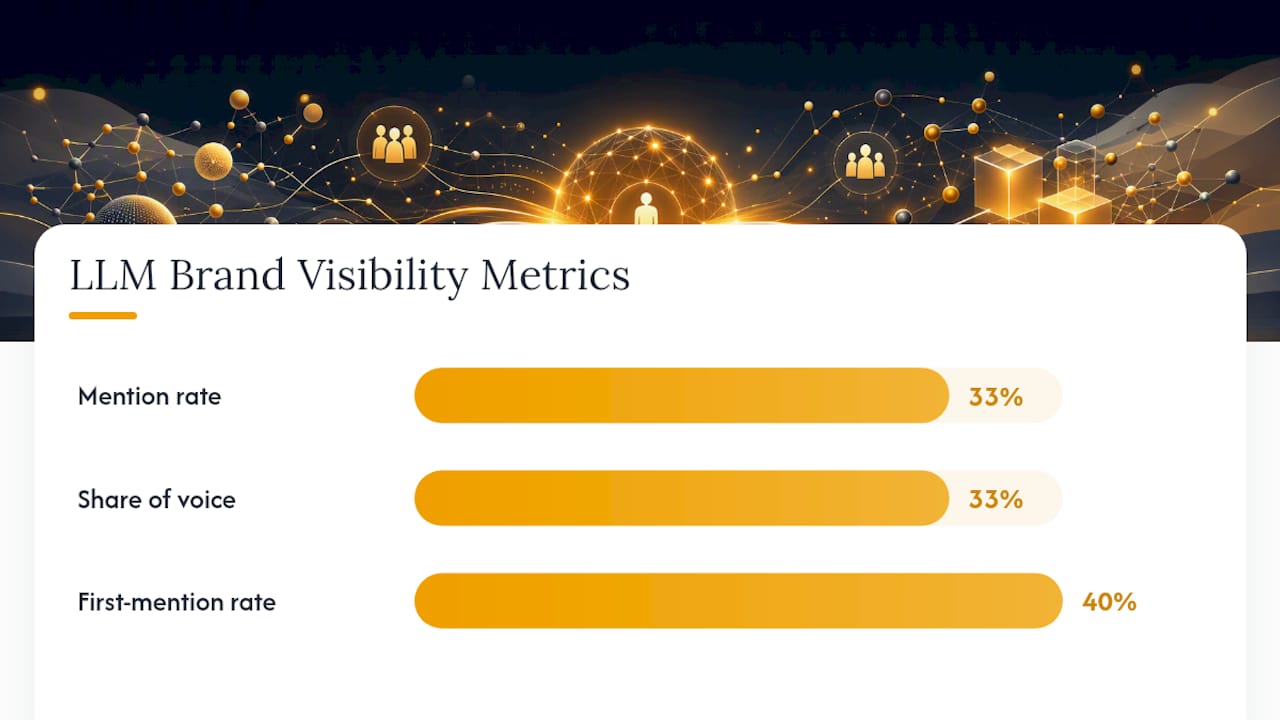
Here's a simplified worked example using three prompts run across five engines (15 total responses):
| Metric | Raw count | Calculation | Result |
|---|---|---|---|
| Mention rate | Brand appears in 5 of 15 | 5 / 15 | 33% |
| Share of voice | 5 of 15 total brand mentions | 5 / 15 | 33% |
| First-mention rate | First-named in 2 of 5 mentions | 2 / 5 | 40% |
Apify's methodology for measuring LLM brand visibility uses this same pooled-run structure, and it's worth adopting wholesale rather than reinventing it. One caveat: single runs carry sampling noise, since the same prompt can return different phrasing or even different brands mentioned across runs. Pooling five or more runs per prompt smooths that out and gives you a number you can trust in a board deck.
Which AI Engines Should You Track for Brand Mentions?
Track the engines your buyers actually use, plus one you're testing. For most B2B and B2C brands, that means:
- ChatGPT — largest user base, strong web-browsing citation behavior
- Perplexity — citation-heavy by design, useful for tracking source patterns
- Gemini — pulls heavily from Google's index and Search-linked signals
- Microsoft Copilot — often surfaces Bing-indexed and enterprise-adjacent content
- Google AI Overviews/AI Mode — sits directly in search results, highest volume exposure
- Anthropic Claude — more conservative citation style, useful as a sanity check
Engines differ in which sources they trust and how they cite them, which is why Hootsuite's guidance treats each surface as a distinct discovery channel, not a single "AI search" bucket. A brand can rank first on Perplexity and vanish on Copilot, because the two engines weight source types differently. Track four to six engines your buyers actually rely on, and keep one experimental engine in rotation as adoption shifts.
How Do You Build a Repeatable LLM Visibility Measurement Process?
Ad-hoc checks feel productive and mean almost nothing. Someone on your team opens ChatGPT, types "best project management software," sees their company mentioned, and reports "we're visible in AI." That's one personalized answer, shaped by that person's account history, location, and the model's mood that day. It is not a metric.
Here's the process that produces one:
- Define 15 to 30 priority prompts that mirror real buyer questions ("best CRM for mid-market SaaS," "alternatives to [category leader]").
- Build an alias list covering your brand name, common misspellings, and product names, so mention detection doesn't miss variants.
- Schedule multi-engine runs across your chosen surfaces, at minimum five runs per prompt per engine to average out variance.
- Capture full raw answers and cited source URLs, not just a pass/fail mention flag.
- Normalize and pool results into the six core metrics, run over run and engine over engine.
Apify's approach to LLM visibility measurement documents exactly this pipeline with a working scorecard, and it's the closest thing to an industry-standard method available right now. Your minimal scorecard should export: prompt text, engine, run number, brand mentioned (yes/no), mention position, sentiment score, and cited source URLs. That last column is what turns your report into something auditable rather than a black box.
Pro Tip: Always store the raw answer text alongside your scores, not just the computed metric. When leadership asks "why did our sentiment score drop," you need the actual sentence the AI wrote, not just a number.
What Should You Do to Improve LLM Brand Visibility?
Fix things in order: presence first, then prominence, then citation. Chasing citations before you've solved basic mention rate wastes effort on the wrong layer.
- If mention rate is low, your discovery signals are thin. Expand coverage on review platforms, industry directories, and comparison pages where AI models pull source material.
- If mention rate is fine but first-mention rate is low, you're present but not positioned. Publish category-defining content that stakes a claim to the terms buyers actually search.
- If citation rate lags both, you're being talked about without being linked to. This is the hardest layer, and it requires earning placements on the specific third-party pages the engines already trust.
Target channels for citation work:
- Review sites (G2, Capterra) — structured comparison data engines cite directly
- Comparison and "vs." pages — often the single most-cited page type for competitive prompts
- Forums and community threads (Reddit, niche Slack communities) — informal but heavily sourced by Perplexity and ChatGPT
Optimizing third-party source material tends to move citation rate faster than polishing your own website, since the AI is choosing between many external pages, not your homepage alone. Use your scorecard to find the single prompt with the biggest competitive gap, fix the source feeding that prompt, then re-run the full pooled measurement in two to four weeks. Iterate from there rather than trying to fix everything simultaneously.
How Should You Interpret LLM Visibility Metrics and Set Benchmarks?
Don't benchmark against an absolute number pulled from a blog post. Benchmark against your own category, your own prompt set, and your own trend line. A 25% mention rate might be strong in a fragmented market with fifteen viable competitors, and weak in a category with three.
Start by establishing a baseline in month one, before you change anything. That baseline is the only number that matters for the first quarter. Everything after that is measured as movement, not absolute position.
A few interpretation rules worth setting as team policy:
Weight citation rate above mention rate for maturity. Any brand can get named once by an AI model that's being generous. Consistent citation across multiple prompts and engines signals the AI's underlying sources genuinely trust you, which is a slower, harder-won signal.
Expect volatility in month one, stability by month three. Individual runs swing based on model updates and prompt phrasing. Pooled monthly averages settle down noticeably by the third reporting cycle, which is also when trend lines become worth presenting to leadership.
Set goals as relative deltas, not fixed targets. "Close the competitive gap with the category leader by 15 percentage points in two quarters" is a defensible goal.
Treat sentiment separately from volume. A brand can have high mention rate and mediocre sentiment. That combination usually means you're present in comparisons but consistently framed as the budget option or the option with caveats, which is a positioning problem, not a visibility problem.
What Are the Biggest Pitfalls in Measuring LLM Brand Visibility?
The most common mistake is mistaking a personalized chat session for a market signal. Your ChatGPT account has history. It knows what you've searched before, possibly what plan you're on, and its answers to you are not the same answers a first-time prospect sees. Screenshotting your own chatbot session and calling it "proof of visibility" is a real trap marketing teams fall into repeatedly.
A second pitfall: sampling too small a prompt set and overreacting to noise. Hootsuite and Apify both note that ad-hoc spot checks don't scale into anything you can trend, precisely because they don't control for this variance.
A third pitfall is tracking mentions but ignoring citation sources entirely. Knowing you were mentioned in 40% of runs tells you almost nothing about why. Without capturing the source URLs the AI actually pulled from, you can't tell whether the fix is a new blog post, a G2 review campaign, or a Reddit thread that needs correcting.
A fourth pitfall: measuring once and declaring victory or defeat. LLM outputs shift as models update, as competitors publish new content, and as your own pages get indexed or de-indexed from training and retrieval sources. A single measurement is a photograph. What you need is a video, captured at a fixed cadence, so a bad quarter doesn't get overread and a good month doesn't get taken as permanent.
The fix for all four pitfalls is the same: standardize the prompt set, pool the runs, capture the sources, and measure on a schedule instead of when someone remembers to check.
What Does a Successful LLM Visibility Improvement Look Like?
The pattern that shows up across brands that move their numbers is consistent: they don't chase every prompt at once, they find the highest-leverage gap and fix the source feeding it.
A common starting point looks like this. Digging into the raw citation data shows the AI is pulling almost entirely from one comparison page and two G2 review threads, neither of which mention the brand meaningfully. The fix isn't a new landing page. It's getting listed and reviewed on that specific comparison page and actively soliciting reviews on G2 that speak to enterprise use cases. Re-measured eight weeks later, mention rate on that exact prompt climbs into the 30s, not because the brand's website changed, but because the third-party source material the AI trusts changed.

The lesson generalizes: LLM visibility gains rarely come from rewriting your own homepage copy. They come from identifying which specific external pages are feeding a specific weak prompt, then fixing those pages, one gap at a time, and re-measuring with the same fixed prompt set to confirm the movement is real rather than run-to-run noise.
The Mistake Marketing Leaders Keep Making With AI Checks
The recurring error I see is treating one good answer from one chatbot as proof of visibility. It's not proof, it's a data point. Real confidence comes from watching the same prompts, run across models, hold their pattern over months. Treat this like paid search or SEO: a channel that needs ongoing governance, not a box you check once.
Get a Baseline AI Visibility Score Without Building the Pipeline Yourself
Everything in this guide, the fixed prompt sets, the multi-engine pooling, the citation source tracking, is a real workload to build and maintain manually. Authoritylayer is built to run that exact pipeline for you: it samples ChatGPT, Gemini, Claude, and Perplexity on a schedule, pools the runs into the same six metrics covered above, and exports the raw answers and cited sources so nothing is a black box.
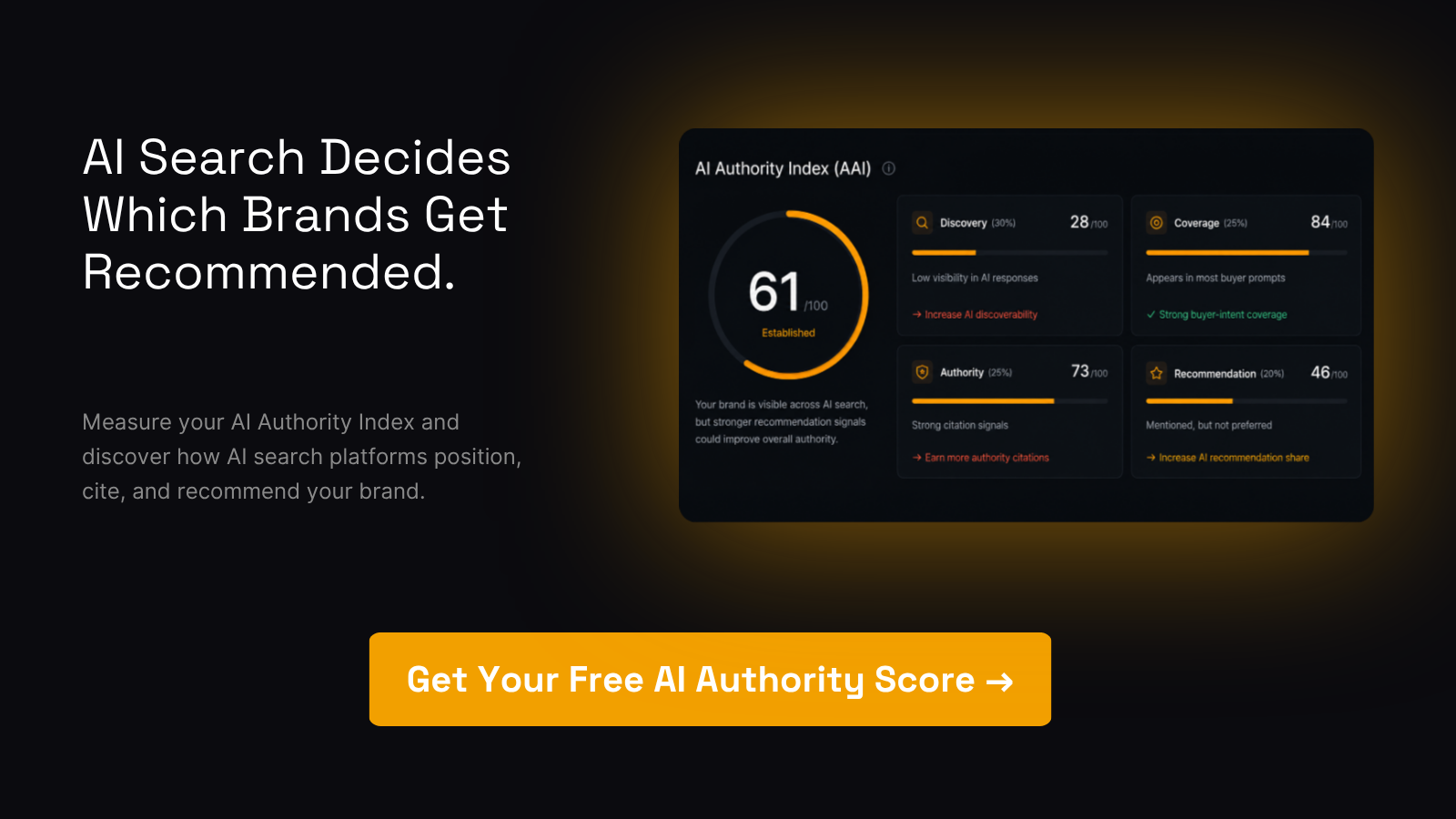
Where a manual spot check gives you one account's personalized answer on one day, Authoritylayer gives you a benchmark measured the same way, every time, across every engine that matters to your buyers, so you can actually trend a competitive gap instead of guessing at it. The platform also maps directly to the presence, prominence, and citation methodology described earlier, so the numbers your team reports connect directly to the fixes your content team runs.
If you want to see where your brand actually stands before committing to a full measurement build, run a free AI visibility scan and get a baseline score across the major engines in minutes.
Sources
- LLM visibility: What it is and how to track it in 2026
FAQ
What Is LLM Brand Visibility?
It's how often, where, and how favorably AI assistants like ChatGPT, Gemini, and Claude mention, cite, and frame your brand when responding to buying-related questions.
What Does "Brand Visibility" Mean in an AI Search Context?
Traditionally it meant search rank and impressions; in AI search it means presence, prominence, citation, and sentiment across chatbot answers, since 51% of B2B buyers now start research with an AI chatbot.
How Do You Drive LLM Visibility Higher?
Fix discovery gaps first with review-site and comparison-page presence, then work on category-positioned content, then target the specific third-party pages AI models cite most for your key prompts.
How Do You Build Brand Visibility Across AI and Search Together?
Run the same fixed prompt set across search rankings and AI engines, then compare where narratives diverge, since a page that ranks well doesn't guarantee the framing an AI assistant gives it is accurate or favorable.
Can You Track LLM Brand Visibility Without a Dedicated Platform?
You can manually sample a few prompts, but personalized single-account checks vary by phrasing and history, which is why platforms like Authoritylayer that pool multi-engine runs produce more defensible, repeatable numbers.