Four Signals That Move Brand Authority Score for Marketers
Get a copyable protocol to measure and raise your brand authority score in AI assistants. Use the four signal model, a 250 prompt sample, and a 12 week...
· 10 min read

A brand authority score measures how reliably ChatGPT, Gemini, Claude, and Perplexity discover, cite, link to, and recommend your brand when someone researches a purchase. It has nothing to do with domain authority or backlink counts. The single most useful move for a CMO right now is to stop looking at one blended number and start tracking citation and recommendation rates separately, per engine.
TL;DR:
- Brands at the lowest visibility tier (Tier 3) appear in only about 11% of AI responses, making it realistic to aim for mid-tier growth within a few months.
- Different AI engines prioritize sources differently: Bing and Wikipedia boost brands with encyclopedic coverage, while Google favors structured data and recent content.
- The four signals—mention rate, citation rate, linked source rate, and recommendation rate—each reflect a different aspect of brand authority and require separate tracking.
- Improving citation, schema markup, and review velocity can generate measurable progress within 60 to 90 days, but sustained efforts are needed for recommendation rate growth.
- Cross-functional measurement and ongoing dashboards are crucial, as AI visibility impacts PR, SEO, and product teams simultaneously, not just SEO.
Table of Contents
- What Counts as a Brand Authority Score: the Four-Signal Model
- Why Do AI Engines Score Brand Authority Differently?
- How Do You Measure Brand Authority Score Across AI Engines?
- How AuthorityLayer Measures Your AI Authority Index
- Building the Roadmap: What Actually Moves Your Score
- Why AI Visibility Has to Become a Cross-Functional KPI
- Get Enterprise-Grade AI Visibility Tracking
- Sources
- FAQ
What Counts as a Brand Authority Score: the Four-Signal Model
Treat brand presence in AI answers as four separate measurements, not one score. Each one moves independently, and each one points to a different fix.
- Mention rate: the percentage of sampled prompts where an AI assistant names your brand at all, even in passing. This is your awareness baseline.
- Citation rate: how often the assistant treats your brand as evidence, quoting a stat, a claim, or a feature you own.
- Linked source rate: how often the answer includes an actual clickable link back to your domain rather than just naming you.
- Recommendation rate: how often you show up inside a "you should consider" or "best option for X" answer, which is the signal closest to commercial intent.
Mentions tell you if you exist in the model's world. Citations and linked sources tell you if the model treats you as verifiable. Recommendations tell you if it treats you as a buying decision. This four-column structure is the same multi-signal approach SerpApi recommends for exactly this reason: a single composite score averages away the difference between "AI knows who you are" and "AI would send a customer to you." Those are not the same problem and they don't share a fix.
Why Do AI Engines Score Brand Authority Differently?
Your brand authority score is not one number. It is at least four numbers, because ChatGPT, Gemini, Claude, and Perplexity pull from different indexes and reward different kinds of evidence. Treating them as one score is the single biggest measurement mistake marketing teams make right now.
Start with the baseline reality of brand stature. A large-scale analysis of AI prompt responses found a three-tier ladder in unbranded, category-level queries: Tier 1 brands surface roughly 73% of the time, Tier 2 brands around 44%, and Tier 3 brands about 11%. That's roughly a 30 percentage-point drop at each tier. If you're a Tier 3 brand today, closing that gap to Tier 2 is a realistic near-term goal. Jumping straight to Tier 1 visibility in a quarter is not.
Statistic Callout: Brand visibility on unbranded prompts follows a steep three-tier curve, roughly 73% for established leaders, 44% for mid-tier challengers, and 11% for emerging brands, according to analysis of over 100,000 AI prompt responses.
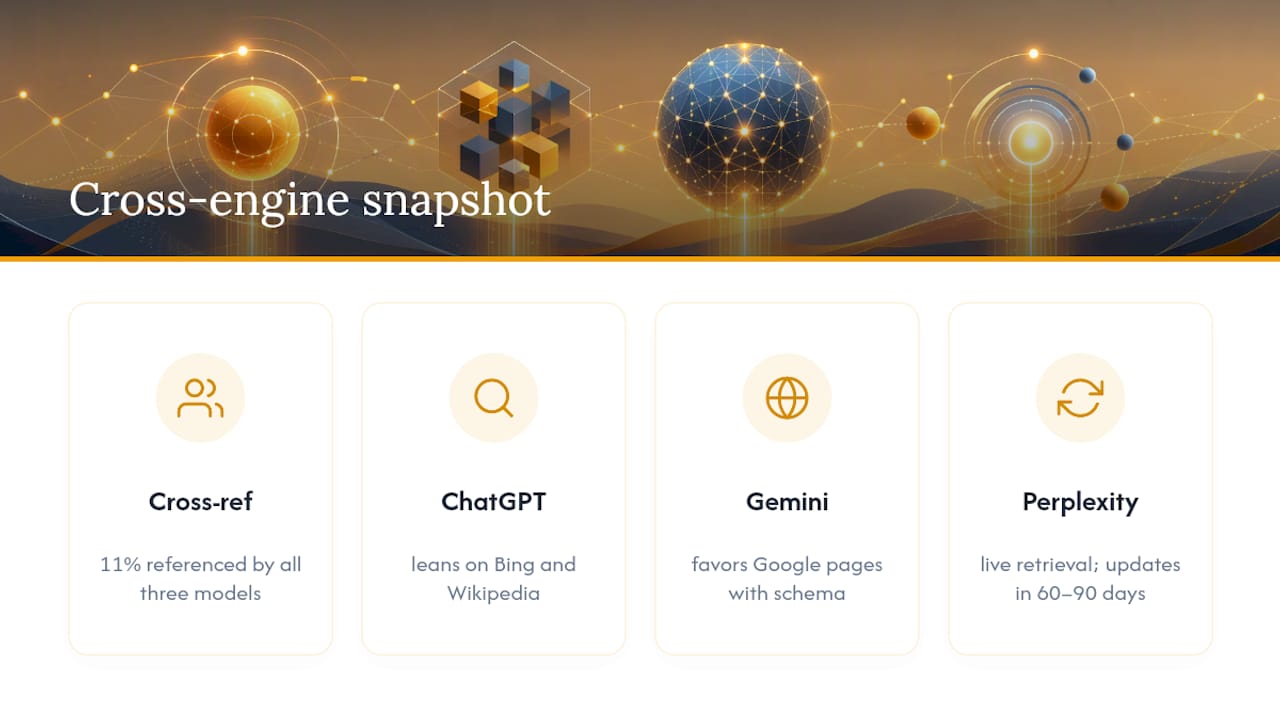
The tier a brand sits in also interacts with which engine is asking. ChatGPT leans on Bing's index and Wikipedia, so brands with strong encyclopedic coverage and Bing-crawled press tend to over-index there. Gemini favors Google-indexed pages with clean schema markup, rewarding structured data more than raw editorial volume. Claude draws heavily on Brave Search and shows a preference for high-authority, well-sourced long-form content over marketing copy. Perplexity runs live retrieval, which means review velocity and freshly published data can move its citation rate in as little as 60 to 90 days, while the other three engines shift more slowly.
That's also why only about 11% of brands get referenced by all three major models in independent sampling. Most brands that show up anywhere show up in exactly one engine. If your team only checks ChatGPT because it's the most familiar interface, you're likely missing where the actual gap is. Segment every prompt set by engine and by buyer intent category (comparison queries, "best for X" queries, pricing queries) before you draw any conclusion about where your authority is weak.
How Do You Measure Brand Authority Score Across AI Engines?
Run this as a repeatable protocol, not a one-time audit. Here's the version we recommend to marketing teams building their first dashboard:
- Build a 250-prompt sample. Cover five surfaces, ChatGPT, Gemini, Claude, Perplexity, and one vertical AI tool relevant to your category, at 50 queries each. Fewer than that and per-engine numbers get noisy fast.
- Split prompts by intent. Roughly a third unbranded category questions, a third comparison queries ("X vs Y"), and a third direct brand or pricing questions. This is what makes the data diagnostic instead of just descriptive.
- Extract all four signals per response. Mention, citation, linked source, recommendation. Where an engine's output doesn't structurally expose one of these (some Gemini responses skip visible links, for instance), mark it null rather than zero. A null is a measurement gap; a zero is a real absence.
- Sample weekly, report on a 12-week trailing rate. Daily and even weekly snapshots swing wildly on model updates and prompt phrasing. Practitioners smooth this with a rolling 12-week window so a single bad week doesn't distort the trend line.
- Compute both a blended score and per-engine scores, and keep both. The blended number is useful for a board slide. The per-engine breakdown is what your team actually acts on.
Pro Tip: Run your first baseline scan before you touch anything on your site. Otherwise you'll never know whether a citation-rate jump six weeks from now came from your new schema markup or from a model update that had nothing to do with you.
Quarterly, step back from the weekly noise and ask whether the strategic priorities still hold, whether a new competitor jumped a tier, or whether one engine's retrieval behavior shifted enough to change your roadmap.
How AuthorityLayer Measures Your AI Authority Index
A dashboard that hides per-engine differences behind one blended number isn't useful to a marketing team trying to fix anything.
Continuous per-engine monitoring across ChatGPT, Gemini, Claude, and Perplexity extracts the same four signals, mention, citation, linked source, and recommendation, on every sampled prompt.
- Prompt tracking segmented by buyer intent to see whether gaps occur in unbranded discovery or in head-to-head comparison answers.
- An AI Authority Index scoring system that reports blended and per-engine numbers side by side, smoothed on a rolling basis instead of single-run snapshots.
- Prioritized opportunity recommendations tied to underperforming signals, so the fix maps to the diagnosis instead of a generic "publish more content" suggestion.
If you want to see how the scoring logic works before committing to anything, the AuthorityLayer methodology page walks through the data collection cadence in detail, and the AI visibility audit framework gives you a checklist to run manually first.
Building the Roadmap: What Actually Moves Your Score
Not every fix has the same timeline, and pretending otherwise sets marketing teams up to abandon tactics that were working before they had time to register in the data.
Start with an audit against the signals that actually predict AI visibility: editorial coverage, knowledge graph presence (Wikipedia and Wikidata entries), review volume and velocity, structured data on product and brand pages, and the diversity of third-party sources mentioning you. A brand with strong reviews but no schema markup has a different problem than a brand with clean schema and zero earned press. Diagnose before you spend.
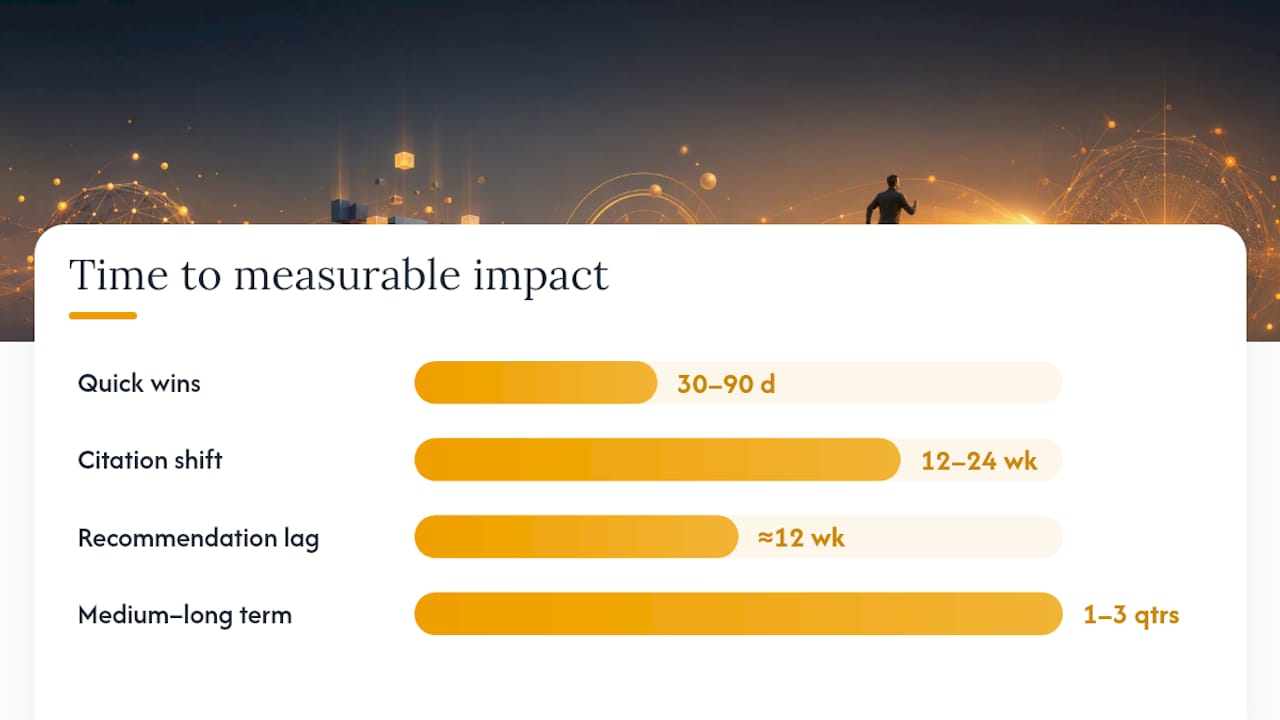
Quick wins, 30 to 90 days:
- Add or clean up Schema.org markup (Organization, Product, Review) on your core pages; this is a direct lever on Gemini's citation behavior.
- Launch a review-velocity push on the platforms Perplexity actually crawls; measurable movement there has shown up in as little as 60 to 90 days.
- Update or claim your Wikidata entry if you don't have one; this feeds multiple engines' knowledge graphs at once.
- Pitch for inclusion in category listicles. One study found listicles account for roughly 21% of non-corporate AI citations, making them one of the highest-leverage earned-media formats for this specific goal.
Medium to long-term work (one to three quarters):
- Build a standing editorial outreach program instead of one-off pitches; AI citation rewards recurring third-party mentions to improve AI visibility, not a single press hit.
- Set up structured data governance so new product pages ship with correct markup by default, not as an afterthought months later.
- Align PR, SEO, and product marketing on a shared entity strategy, consistent naming, consistent claims, consistent category positioning across every surface a model might crawl.
Pro Tip: Citation rate tends to move faster than recommendation rate. Expect citations to shift within one or two 12-week windows after a schema or PR push, and expect recommendation rate to lag another quarter behind that, since it depends on the model trusting you as evidence first.
Why AI Visibility Has to Become a Cross-Functional KPI
Most organizations still park AI visibility inside SEO, reporting it like a vanity metric nobody else is accountable for. That's backwards. The teams seeing real movement treat it as a shared product KPI across PR, SEO, product, and analytics, because the fixes span all four.
Set executive OKRs with actual per-engine citation and recommendation targets, not a vague "improve AI presence" line. Pair that with a measurement SLA, someone owns the weekly sample, someone owns the monthly triage, someone owns the quarterly strategy reset. Integrated programs report lead increases at more than double the rate of siloed teams doing the same work in isolation. That gap is the cost of treating this as one department's side project.
— Geraldine
Get Enterprise-Grade AI Visibility Tracking
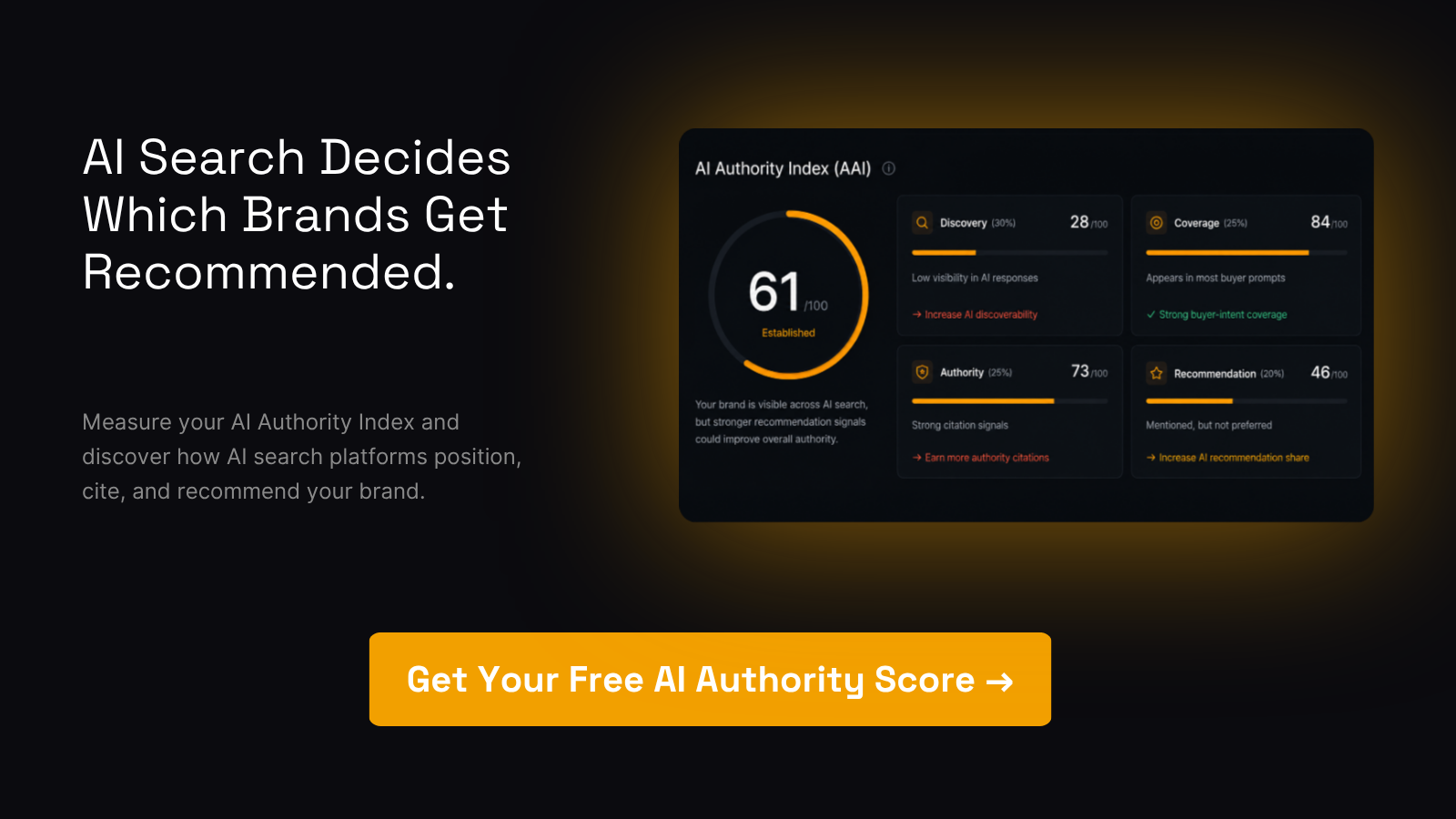
If your team is managing this across multiple brands, product lines, or regional markets, spreadsheet tracking breaks down fast, and that's exactly the gap the AuthorityLayer Enterprise Plan is built to close. It gives you per-engine dashboards across ChatGPT, Gemini, Claude, and Perplexity, full AI Authority Index scoring with the 12-week trailing smoothing built in, and prioritized remediation recommendations mapped to whichever signal, mention, citation, linked source, or recommendation, is actually holding your score back.
Enterprise onboarding may include team training so PR, SEO, and product marketing functions can coordinate analysis instead of working from separate spreadsheets. If you want to see where your brand currently sits before committing to anything, start with a free AI visibility scan to get a baseline, then talk to the team about what the Enterprise Plan adds for multi-brand tracking at your scale.
Sources
- Generative Engine Optimization at Scale: Measuring Brand Visibility Across AI Search Engines
- The AI visibility index: Which brands are vanishing from AI search?
- Measuring brand presence across AI answer engines
- Semrush releases expanded 2026 AI Visibility Index
FAQ
What Is a Brand Authority Score for AI Assistants?
It's a measurement of how reliably AI assistants mention, cite, link to, and recommend your brand in buyer-research answers, tracked separately per engine rather than as one blended number.
How Is This Different From Traditional SEO Authority?
Traditional SEO authority scores estimate a domain's link and traffic strength; a brand authority score for AI assistants measures actual presence inside generated answers across ChatGPT, Gemini, Claude, and Perplexity.
How Often Should We Measure AI Brand Authority?
Sample weekly and report on a rolling 12-week trailing rate to smooth model-update noise, then revisit strategy quarterly.
Which Signal Matters Most for Revenue Impact?
Recommendation rate correlates most directly with buying intent, but citation rate is the leading indicator that usually moves first and predicts recommendation gains a quarter or two later.
Can One Tool Track All Four Engines at Once?
Platforms built specifically for this, including AuthorityLayer's Enterprise Plan, monitor ChatGPT, Gemini, Claude, and Perplexity together and report both blended and per-engine scores.