Decide Build vs Buy AI Analytics in 60–90 Days for CMOs
CMOs and SEO heads: use a decision matrix plus a 60–90 day pilot to prove whether to build or buy AI analytics. Includes checklist, metrics, and a kill...
· 9 min read

Buy a specialized AI visibility intelligence platform unless your organization has a large engineering team, strict proprietary data residency requirements, or a need for extreme customization that no vendor roadmap covers. Measuring how ChatGPT, Claude, Gemini, and Perplexity discover and recommend brands requires multi-model monitoring and benchmarked evidence that most internal teams cannot build quickly. The decision matrix below gives you the specifics.
Key Takeaways
Purchasing a specialized AI visibility platform is the most practical option for brands seeking consistent, multi-model monitoring and benchmarking, unless they have extensive engineering resources.
| Point | Details |
|---|---|
| Scale limitations | Internal tracking is feasible for few brands or queries but becomes unmanageable at larger scales. |
| Data residency needs | Strict regulatory or legal requirements may necessitate building or customizing deployment to keep data on controlled infrastructure. |
| Engineering capacity | Ongoing AI monitoring requires dedicated engineers to adapt to rapid assistant updates, making build projects resource-intensive. |
| Model standardization | Most marketing teams need comparable scores across models, which are difficult to develop in-house and better suited for vendor solutions. |
| AuthorityLayer's approach | AuthorityLayer offers benchmarked, cross-model visibility with prioritized insights, addressing multi-assistant challenges effectively. |
Table of Contents
- Decision matrix: when to build in-house and when to buy
- Core capabilities to require from an AI visibility analytics solution
- Cost, timeline, and resourcing tradeoffs
- How to pilot AI visibility intelligence: a 60 to 90 day checklist
- Metrics and benchmarks to track
- Why a dedicated AI visibility platform closes the gaps this guide describes
- Try a low-risk pilot before committing either way
- FAQ
Decision matrix: when to build in-house and when to buy
The right call depends on a handful of concrete factors, not a general preference for in-house control.
- Scale: Tracking one brand across a handful of queries is manageable internally; tracking dozens of competitors across hundreds of prompts and four or more models is not.
- Data residency: If your legal or compliance team requires query data to stay on infrastructure you control, building (or heavily customizing a vendor's deployment) becomes a real requirement, not a preference.
- Engineering capacity: Sustained monitoring means maintaining scrapers or API integrations against assistants that change behavior often; this needs dedicated engineering time, not a side project.
- Need for custom models: Most marketing teams need standardized, comparable scoring across brands, not a bespoke model architecture.
- Speed to value: A build typically takes months before producing a usable baseline; a vendor platform can produce one within days.
The hidden costs cut both ways. Building in-house means absorbing the cost of constant adaptation as AI assistants change how they retrieve and cite sources, while buying means trusting a vendor's methodology and accepting some loss of control over raw data. A hybrid path works for some organizations: build lightweight internal telemetry for your own domain's crawl and citation logs, and buy the competitive intelligence and benchmarking layer that would otherwise take a dedicated team to replicate.
Pro Tip: Run a two-week internal audit of your current tracking capability before deciding anything. If you cannot answer "which model cites us most" today, you are not ready to build.

Core capabilities to require from an AI visibility analytics solution
Whether you build or buy, the functional bar is the same. Evaluate any option, internal or vendor, against these minimums.
- Multi-model coverage with cross-model agreement reporting. A single-model view hides real risk: one empirical study found only about 41.6% agreement among three large language models on which brand they recommended first for a given category, so platform-specific blind spots are common.
- Citation and exposure diagnostics. The tool should show whether your own domain is being cited directly and how often branded fan-out queries (follow-up questions that name your brand) surface your content.
- Benchmarking indices. Look for a Category Ownership Index or recommendation-share metric that lets you compare your standing against named competitors over time, not just a raw mention count.
- Prioritized, evidence-based recommendations. Diagnostics are only useful when tied to specific next actions, ranked by expected impact.
- Integration and export capabilities. Data needs to flow into your existing reporting stack, whether that is a BI dashboard or a board deck, without manual reassembly.
Generative engines increasingly behave like recommendation engines rather than link-based search, so positioning and brand fit matter as much as raw discoverability. A capability checklist built around that reality, rather than around vanity mention counts, is what separates a useful tool from a dashboard that looks busy.
Cost, timeline, and resourcing tradeoffs
A simple total cost of ownership model clarifies the comparison fast. Three cost lines matter most: engineering and setup, ongoing data and query costs, and the labor required to interpret output into action.
- Build: engineering time to construct and maintain API integrations across multiple assistants, recurring API query costs that scale with the number of prompts tracked, and the analyst time needed to turn raw outputs into a coherent narrative.
- Buy: subscription cost, onboarding time measured in days rather than months, and a smaller internal team needed to act on findings rather than produce them.
- Hidden cost on both sides: AI assistants change retrieval behavior frequently, so whatever you build needs ongoing engineering attention, and whatever you buy needs a vendor committed to keeping pace.
Time-to-value is the sharpest differentiator. A credible internal build typically needs two to four months before producing a trustworthy baseline across multiple models, largely because of the engineering lift described above. A vendor platform can produce a first benchmark within the first billing cycle. If your team cannot commit sustained engineering hours past the pilot phase, that gap alone should settle the decision. For a cautionary look at how enterprise AI builds commonly stall, see this analysis of failed enterprise AI investments.
How to pilot AI visibility intelligence: a 60 to 90 day checklist
A short, structured pilot settles the build-or-buy question with evidence instead of opinion.
- Select 5 to 10 priority queries that reflect real buyer research moments in your category, and record baseline visibility for each.
- Run parallel probes for 30 days: a lightweight internal check (manual prompts across two or three models) against a vendor trial or free scan.
- Measure own-domain exposure and branded fan-outs at the 30-day mark, since own-domain citation is associated with dramatically higher brand mention rates in one large study of AI search behavior.
- Check multi-model agreement at day 60: if your brand's standing varies widely by model, a single-model internal tool will mislead you.
- Apply decision gates at 30, 60, and 90 days: continue only if the chosen path (build or buy) has produced an actionable, repeatable baseline by day 60 and at least one measurable improvement by day 90.
Pro Tip: Treat the 30-day mark as a kill switch. If your internal build has not produced a usable cross-model reading by then, buying is the faster path to an answer.
Metrics and benchmarks to track
Success in AI visibility needs numbers you can defend in a board meeting, not impressions.
- Category Ownership Index or recommendation share: how often your brand is the one actually recommended within your category, not just mentioned.
- Own-domain citation rate: the share of relevant AI answers that cite your domain directly, a figure researchers tie closely to mention volume.
- Branded fan-out frequency: how often follow-up, brand-specific queries surface your content.
- Operational metrics: detection time (how fast you spot a visibility gap), remediation time (how fast you close it), and opportunity conversion (how many flagged gaps turn into measurable gains).
One study found brand mentions jumped from a very low baseline to between about half and nearly 60%, depending on the assistant, when own-domain citations were present, underscoring how much leverage owned-source visibility carries in a fitted stage model of AI search behavior. A separate industry analysis of 6.8 million AI citations found that about 86% originated from brand-managed sources such as websites, listings, and reviews, which makes owned-source hygiene one of the few levers marketers fully control. For a deeper breakdown of these metrics, see our practitioner's guide to AI visibility metrics.
Why a dedicated AI visibility platform closes the gaps this guide describes
Everything above points to the same structural problem: visibility inside AI assistants is multi-model, fast-changing, and dependent on owned-source signals that are easy to miss without dedicated tooling. We built AuthorityLayer to address exactly that gap. Our platform benchmarks brands against named competitors with a single scoring index, tracks exposure and citations across multiple assistants at once, and ties every finding to a prioritized, evidence-based recommendation rather than a raw mention count. A monthly AI visibility report gives marketing leaders a recurring benchmark to bring into planning cycles, and our methodology documents how each score is calculated so nothing in the output is a black box. For readers who want the technical detail behind how exposure and citation data are collected, our AI visibility measurement guide walks through the components step by step.
Try a low-risk pilot before committing either way
The fastest way to settle build versus buy is to see your own numbers first. We recommend starting with a Free AI Visibility Scan to get a baseline snapshot of how your brand currently appears across AI assistants, with no commitment required.
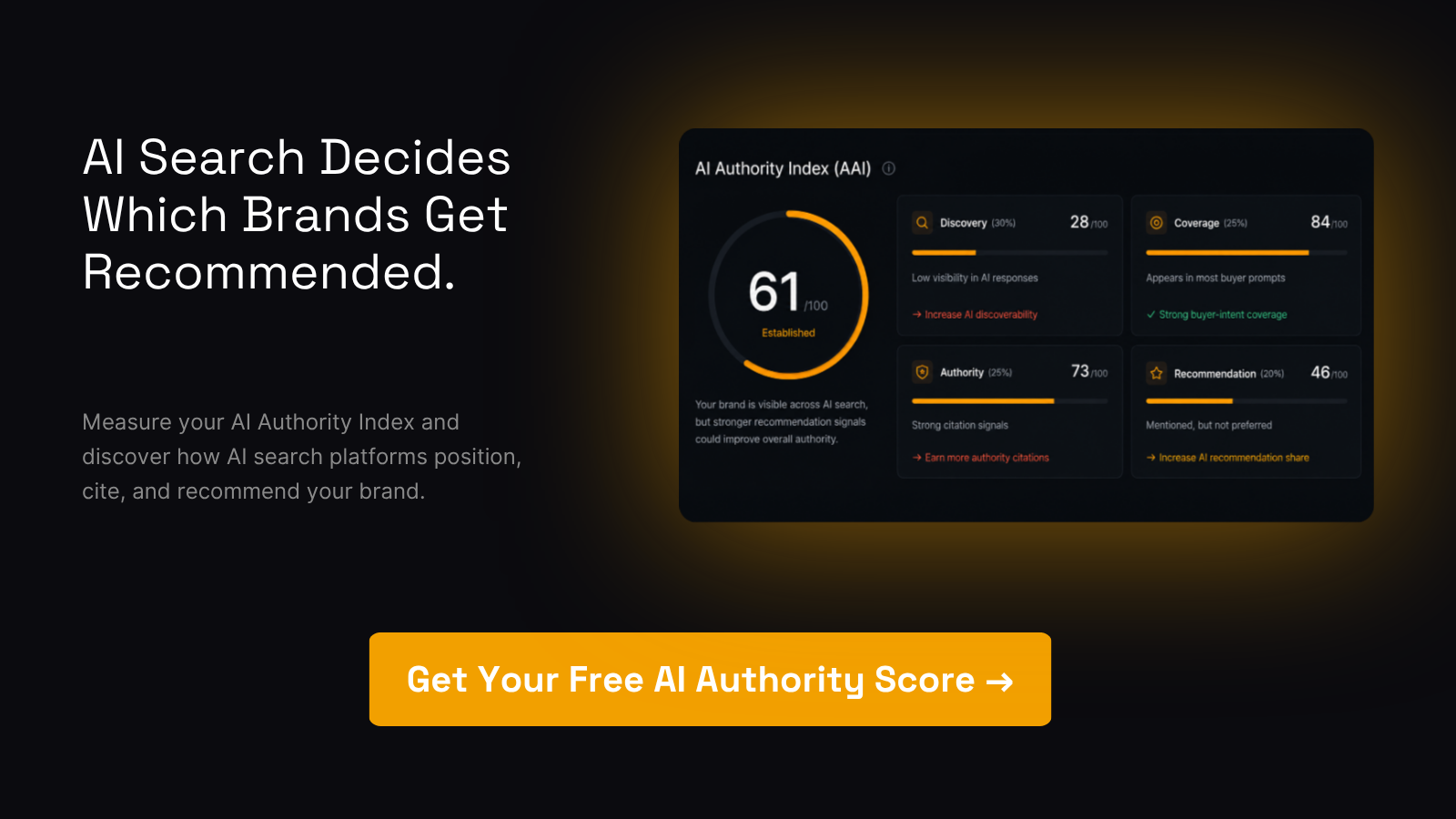
Within the first 30 to 60 days, you should expect a baseline visibility snapshot, a view of where competitors are outranking you in AI-generated answers, and a short list of prioritized actions ranked by expected impact. If that baseline shows gaps worth closing on an ongoing basis, the Starter plan at an entry-level subscription price starting under $100 per month extends that scan into continuous monitoring, with Growth and Enterprise tiers available as your tracking needs expand across more brands, markets, or competitors. If the scan instead confirms your current visibility is solid, you have your answer at a fraction of the cost of a multi-month internal build.
FAQ
Is it cheaper to build AI visibility tracking in-house?
Rarely, once engineering time and ongoing maintenance are counted. Internal builds require sustained engineering hours to keep pace with how assistants change retrieval behavior, while a subscription platform spreads that cost across many customers and ships a usable baseline in the first billing cycle.
Why does cross-model monitoring matter so much?
Different AI assistants frequently disagree on which brand to recommend first in the same category. One multi-model study found only about 41.6% full agreement among three models, so tracking a single assistant leaves significant blind spots.
What role do owned sources play in AI citations?
A major role: one analysis of 6.8 million AI citations found roughly 86% came from brand-managed sources like websites, listings, and reviews. Improving the accuracy and structure of your own-domain content is one of the most direct levers available to marketers.
How long should a build vs buy pilot take?
A focused pilot fits in 60 to 90 days: baseline a small set of priority queries in the first 30 days, compare in-house tracking against a vendor trial through day 60, then apply a decision gate at day 90 based on which path produced an actionable, repeatable benchmark.
What does AuthorityLayer cost to start?
A Free AI Visibility Scan is available with no published price for an initial baseline, and the Starter plan begins continuous monitoring at an entry-level subscription price starting under $100 per month.