AI Model Differences: Test 3 Prompts, Then Check AI Picks
Compare AI models using your three hardest real prompts. Weigh capability, cost, and speed, then check how assistants recommend your chosen tools.
· 14 min read

Pick by the task: reasoning and multimodal work favor high-capability models, while cost-sensitive or high-volume tasks favor efficiency-optimized models tuned through techniques like RLHF. No single model wins across capability, cost, latency, context length, and alignment at once. We treat these five axes, paired with a visibility check like the one AuthorityLayer runs on AI recommendations, as the starting point for any model decision.
Key Takeaways
Choosing the right AI model involves evaluating capability, cost, speed, context window, and alignment, as no single model excels at all factors for every workload.
| Point | Details |
|---|---|
| Model capabilities vary by task | Match the model to specific tasks, not just reputation, as strength at one area does not ensure performance across all. |
| Test with real prompts | Use three of your hardest prompts to compare models directly, rather than relying on generic test questions. |
| Monitor and validate updates | Pin specific model versions in production and run diffing tests to detect behavioral changes after updates. |
| Assess transparency and bias | Choose models with explainability features and review bias benchmarks, especially for high-stakes decisions. |
| AuthorityLayer for visibility | We provide measurement of how often AI assistants recommend your models or tools, ensuring your brand is visible in buyer research. |
Table of Contents
- What to compare: the concrete evaluation dimensions
- Types of models and learning approaches
- Model versioning and diffing: why updates can change outputs
- How to test and choose a model for your task: step-by-step checklist
- Where to find authoritative specs and benchmarks
- AuthorityLayer perspective: AI visibility and why it matters for model choice
- Differences in model architectures and their impact
- Comparison of training data types and volumes across models
- Variations in model interpretability and explainability features
- Ethical considerations and bias differences among models
- Deployment environments and integration capabilities of different models
- Privacy and data security implications related to different AI models
- Quick note: see how assistants recommend the models and tools you choose
- FAQ
What to compare: the concrete evaluation dimensions
Choosing a model means weighing trade-offs, not finding a universal winner. A few dimensions decide whether a model fits your actual workload.
- Capability and task fit: a model strong at code generation may lag on long-form summarization or multimodal image reasoning, so match the model to the task, not a general reputation.
- Factuality and hallucination risk: rather than trusting one benchmark number, test against a small gold-standard dataset for your domain and track both incorrect claims and silent omissions, a method grounded in how researchers measure factuality in applied settings.
- Cost: inference pricing is usually quoted per token, so your monthly bill depends on prompt length, output length, and request volume, not a flat per-use fee.
- Speed: latency and throughput often trade against capability. Smaller models answer faster and cost less per call, while larger models may be worth the wait for harder reasoning tasks.
- Context window: how much text a model can hold in one pass determines whether it can process a full contract or needs the document chunked.
- Tooling, alignment, and policy: integration support, safety filters, and usage policies vary by provider and shape what you can actually deploy in production.
Pro Tip: Run your three hardest real prompts, not generic test questions, before comparing any two models on paper.
Types of models and learning approaches
A model is the trained neural network itself. A tool is the product built around it, with an interface, memory, and workflow layered on top, a distinction that matters because teams sometimes chase a "smarter model" when the real gap is a clunky interface. Buying a tool is a procurement decision; integrating a model is an engineering one.
Training approach shapes behavior as much as scale does:
- Supervised learning teaches a model from labeled examples, useful for narrow, well-defined tasks.
- Unsupervised learning finds patterns in unlabeled data, which is how most large language models build their initial language understanding.
- Reinforcement learning from human feedback (RLHF) fine-tunes a pretrained model using human preference signals, and this stage often does more to shape a model's tone, refusal behavior, and verbosity than the base architecture does, since modern systems commonly combine supervised pretraining with RLHF to align outputs with intent.
Size and architecture add another layer: dense models activate every parameter per request, while mixture-of-experts designs activate only a subset, and multimodal variants add image, audio, or video handling on top of text.
Model versioning and diffing: why updates can change outputs
A model that worked perfectly last month can behave differently after an update, even when the provider calls it a minor release. Providers publish versioning and upgrade policies that distinguish major version changes, which often shift capability meaningfully, from minor patches, which may adjust safety behavior or response style without warning.
One audit technique worth knowing: researchers at Anthropic built a model diffing tool that compares a base model against its fine-tuned version, or compares across architectures entirely, to surface behavioral changes that a simple prompt test might miss.
A practical monitoring routine looks like this:
- Pin the exact model version in production rather than auto-upgrading silently.
- Run a fixed suite of test prompts against both the old and new version before switching.
- Use a diffing pass to flag behavioral changes worth a closer human review.
- Set a monitoring window after any upgrade to catch regressions in live traffic.
How to test and choose a model for your task: step-by-step checklist
Treat model selection like any other engineering decision: define what "better" means before you compare anything.
- Define success metrics first. Decide what matters most for your use case: accuracy on domain questions, a safety threshold, a latency ceiling, or a hard monthly cost cap.
- Build a representative test set. Pull 20 to 50 real prompts from your actual workload, plus a small holdout set you never show the model during tuning.
- Run side-by-side trials. Send identical prompts to each candidate model and log both the output and a short qualitative note on quality.
- Measure the metrics that matter. Track hallucination rate against your gold-standard answers, latency per request, cost per request, and how each model handles edge cases like ambiguous or adversarial prompts.
- Record the exact model version used in testing, since a future auto-upgrade can invalidate your results without notice.
- Score candidates with weights. Assign weights to each axis (capability, cost, speed, safety) based on what your project actually needs, then total the scores rather than picking by gut feel.
- Pilot the top choice on a limited slice of real traffic before full rollout.
- Monitor live performance and run a version-diff check before migrating to any new release.
Pro Tip: Keep your test prompt set fixed across every model you evaluate. Changing the questions between trials makes the comparison worthless.
Teams that skip instrumentation and rely on manual spot-checks tend to miss slow drift in quality, a gap that ad-hoc testing struggles to catch compared to a repeatable process.
Where to find authoritative specs and benchmarks
Model cards and official documentation remain the most reliable source for hard specs: context window size, active versus total parameter counts for mixture-of-experts designs, and documented limitations. Public leaderboards offer a useful starting signal, but a benchmark score measures performance on a fixed test set, not your workload, so a top-ranked model can still underperform on your specific task.
- Check the provider's model card for context window limits and any stated weaknesses before testing.
- Read deployment and versioning pages, since official docs often hold the only canonical record of upgrade and retirement schedules.
- Treat leaderboard rankings as a shortlist filter, not a final answer, and confirm with your own test prompts.
AuthorityLayer perspective: AI visibility and why it matters for model choice
Buyers increasingly ask AI assistants directly which tools or models fit a given job, and those assistants answer from patterns in training data, documentation, and public mentions, not a neutral ranking. We built AuthorityLayer to measure that gap: how often assistants like ChatGPT, Claude, Gemini, and Perplexity actually surface and recommend a given brand or product during buyer research.
- We benchmark competitors and track recommendation share across major AI assistants.
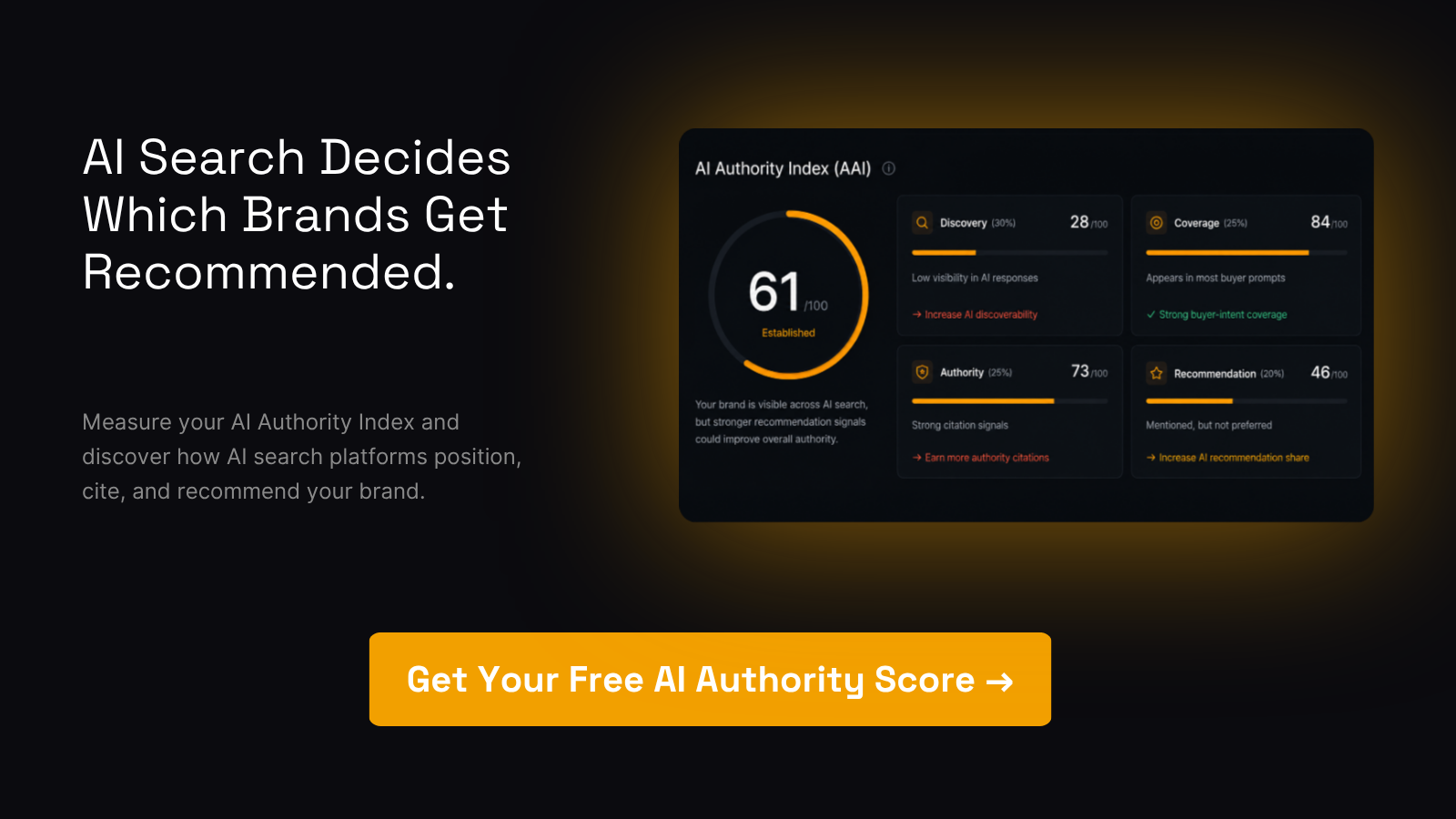
- Our AI Authority Index scores visibility with an auditable methodology rather than a black-box number.
- We surface prioritized fixes so a team's own model, tool, or platform choice is also the one AI assistants actually recommend.
Differences in model architectures and their impact
Most current large language models use a transformer architecture, which processes an entire input sequence at once using an attention mechanism that weighs how every word relates to every other word. That design is what allows modern models to handle long documents and maintain coherence across a long response.
Older recurrent neural network (RNN) architectures process text sequentially, one token after another, carrying forward a compressed memory of everything seen so far. That sequential design makes RNNs slower to train on long sequences and prone to losing track of information from early in a long input, which is a core reason the field moved toward transformers for most language tasks.
The practical impact shows up in a few places. Transformer-based models handle long-range dependencies better, which is why they support larger context windows and more reliable multi-step reasoning. They also parallelize well during training, which is part of why newer models can be trained on larger datasets within a reasonable timeframe. Mixture-of-experts variants build on the transformer design but activate only a subset of total parameters per request, which changes the cost and latency profile without necessarily matching a dense model's behavior prompt for prompt. If you migrate between a dense and an MoE model, expect to re-test your prompts since the same wording can produce different quality.

Comparison of training data types and volumes across models
Models differ sharply in what they were trained on, and that difference shows up directly in what they are good at. A model trained heavily on code repositories tends to perform better at programming tasks, while one trained on a broader mix of web text, books, and licensed data tends to generalize better across general knowledge questions.
Training data also varies by modality. Text-only models never saw an image during training, so asking one to reason about a picture simply will not work. Multimodal models are trained on paired text, image, and sometimes audio or video data, which lets them answer questions about a diagram or a photo but typically requires more compute and a different training pipeline than a text-only model.
Volume matters alongside composition. Providers generally do not publish exact token counts for proprietary training runs, so the practical move is to test behavior directly rather than estimate quality from vague claims about data scale. A model's documented cutoff date, listed in its model card, tells you how current its world knowledge is, which matters more for some tasks (current events, recent APIs) than others (grammar correction, creative writing).
Variations in model interpretability and explainability features
Some models expose a visible reasoning trace, often called a "chain of thought," that shows intermediate steps before the final answer. Others return only the final output with no visibility into how the model arrived there. That difference matters for any task where you need to audit a decision, such as a compliance workflow or a medical information summary, because a visible reasoning trace gives you something to check against your own logic.
Explainability also varies by how much a provider documents about training choices, known failure modes, and evaluation results in its model card. A thorough model card that lists known weaknesses is more useful for interpretability purposes than a sparse one, even if the underlying model performs similarly.
None of this amounts to full transparency into why a model produced a specific output, since the internal weights of a large neural network remain difficult to interpret even for the teams that built it. Treat any exposed reasoning trace as a useful diagnostic signal, not a guaranteed accurate account of the model's internal process, and verify high-stakes outputs independently rather than trusting the stated reasoning alone.
Ethical considerations and bias differences among models
Every model inherits patterns from its training data, including skewed representation across demographics, languages, and viewpoints. Models differ in how aggressively they filter for bias during training and fine-tuning, and in how their RLHF process was designed, since human feedback itself can introduce its own preferences into what the model learns to favor.
Alignment choices also create real behavioral differences. One model might refuse a borderline request outright, while another answers with a caveat, and a third answers without flagging any concern. These differences stem from provider-specific safety policies and training choices, not from a single universal standard, which means two models can give meaningfully different answers to the same sensitive prompt.
For any application touching hiring, lending, health, or other high-stakes decisions, test the specific model against known bias benchmarks for your use case before deployment, and document that testing as part of your own compliance process rather than relying on a provider's general safety claims.
Deployment environments and integration capabilities of different models
Where and how a model runs shapes what you can actually build with it. Cloud-hosted API access is the most common deployment path, letting you send requests over the internet without managing infrastructure, but it also means your data leaves your environment and you depend on the provider's uptime.
Some providers also offer on-premises or private cloud deployment for teams with strict data residency or compliance requirements, though this option typically costs more and narrows your choice of models. Edge deployment, running a smaller model directly on a device, trades capability for speed and offline availability, which matters for applications that cannot tolerate network latency.
Integration capability also varies by SDK maturity, available client libraries, and how well a model's provider documents authentication, rate limits, and error handling. A model that scores well on benchmarks but ships with thin SDK support can cost you more engineering time than a slightly less capable model with mature tooling. Teams weighing a prebuilt tool against building directly on a model's API should also look at platforms that pair multiple model providers behind one interface, which can reduce integration overhead when building a tool rather than wiring a model up from scratch.

Privacy and data security implications related to different AI models
Data handling policies differ meaningfully across providers, and the details matter more than most buyers initially assume. Some providers retain input data for a fixed period to improve future models unless you opt out, while others offer enterprise tiers with contractual guarantees against training on your data at all.
Where your data is processed also matters for regulatory compliance. A provider with data centers only in one region may not meet residency requirements for a regulated industry in another, so check the provider's documentation for processing locations before committing to a workflow involving sensitive data.
Access controls and audit logging also vary. Enterprise-tier deployments typically offer more granular permission settings and request logging than consumer-facing interfaces, which matters if you need to demonstrate compliance to an internal security team or an external auditor. Before sending any regulated or sensitive data to a model, confirm the specific provider's data retention and processing terms directly, since these policies change over time and vary by plan tier even within the same provider.
Quick note: see how assistants recommend the models and tools you choose
Picking the right model is half the job. We help you confirm that AI assistants actually mention your brand or product when buyers ask for recommendations in your category. Start with our Free AI Visibility Scan for a baseline, or move straight to Starter at $99 per month for ongoing monitoring and prioritized fixes.
FAQ
What are the different types of AI learning models?
The three core training approaches are supervised learning (trained on labeled examples), unsupervised learning (finding patterns in unlabeled data), and reinforcement learning, including RLHF, which fine-tunes a model using human feedback to align its behavior with human intent. Most modern large language models combine more than one of these approaches at different training stages.
What are 5 examples of AI?
Common categories of AI in active use include large language models for text generation, image generation models, speech recognition systems, recommendation engines, and computer vision models for image classification. Each category uses different architectures and training data suited to its specific task.
What is the key difference between an AI model and an AI tool?
An AI model is the trained neural network itself, essentially the engine that processes inputs and generates outputs. An AI tool is a consumer-facing product built around one or more models, adding an interface, memory, and workflow features on top.
What are the top 3 most used AI?
Usage rankings shift often and vary by region and use case, so there is no single authoritative answer to which three AI systems see the most use worldwide. Rather than chasing popularity rankings, test candidate models directly against your own tasks using a fixed set of prompts and compare the results on capability, cost, and speed.
How often do AI model updates change behavior?
Providers publish versioning policies distinguishing major and minor releases, and even a minor update can shift tone, safety responses, or output style without changing the model's name. Running a fixed regression test suite before and after any update, paired with a diffing pass like the one described in Anthropic's model diffing research, helps catch unexpected changes before they reach production.