AI Authority Index: Marketers Can Score Four Pillars With a Free Scan
Benchmark the four pillars of AI authority, compare how assistants recommend your brand, and use AuthorityLayer’s free scan to find your next step.
· 8 min read

An AI Authority Index measures how often, how favorably, and how accurately AI assistants like ChatGPT, Gemini, Claude, and Perplexity surface a brand during buyer research, turning scattered mentions into a single benchmark score. For marketing teams, that score tells you whether AI-driven discovery is working for or against you, and where to focus to close the gap. Frameworks like an AI Authority Index make that measurement operational rather than theoretical.
Key Takeaways
An AI Authority Index evaluates how effectively a brand is discovered, recommended, and accurately described across AI platforms, impacting discovery and conversions.
| Point | Details |
|---|---|
| Discovery | It measures if a brand appears when relevant prompts are used across multiple AI engines. |
| Recommendation | It assesses whether AI assistants actively suggest the brand as a solution to users. |
| Coverage and positioning | It examines how the brand is framed relative to competitors in AI responses. |
| Trust and citation depth | It evaluates the quality and authority of sources that AI platforms cite for the brand. |
| AuthorityLayer's approach | We build the index using observable evidence from AI answers for precise benchmarking. |
Table of Contents
- What an AI Authority Index measures versus SEO metrics
- The four pillars and sampling approach behind an AI Authority Index
- Why AI authority changes discovery and conversion for brands
- A step-by-step checklist to benchmark your brand's AI authority
- How index snapshots and category rankings vary by industry
- How AuthorityLayer builds and applies the AI Authority Index
- Get your AI Authority Index score and a clear next step
- FAQ
What an AI Authority Index measures versus SEO metrics
An AI Authority Index condenses brand performance across answer engines into one comparable benchmark, typically scored on a 0 to 100 scale, the way a credit score compresses financial history into a single number. It differs from traditional SEO tracking because it is not just about appearing somewhere. It accounts for whether a brand gets discovered, recommended, described accurately, and cited from trustworthy sources across multiple AI platforms.
Counting brand mentions alone misses the point: a brand mentioned once but recommended confidently carries more weight than one mentioned often but described vaguely. A useful index typically pulls from major answer engines rather than a single chatbot, since each platform draws on different sources and training data. Classic SEO KPIs like rankings and organic traffic still matter for web discovery, but they cannot tell you whether an AI assistant is actually recommending you over competitors when someone asks for a recommendation.

The four pillars and sampling approach behind an AI Authority Index
A defensible AI Authority Index rests on four measurable pillars that, together, explain why a brand shows up in AI answers and how convincingly.
- Discovery: whether a brand appears at all when a relevant prompt is asked.
- Recommendation: whether the AI assistant actively suggests the brand as a solution.
- Coverage and positioning: how the brand is framed relative to competitors in the answer.
- Trust and citation depth: the quality and authority of the sources the AI draws from.
Scoring these pillars requires sampling across prompt clusters that mix branded and unbranded queries with objective and subjective intents, plus geographic and contextual variation, since an AI assistant may answer differently depending on where a query originates. Platform citation overlap matters too: research on AI citation patterns shows overlap between models can be as low as around one-third, meaning a single-engine snapshot can badly misrepresent actual visibility. Pillar scores are normalized and weighted into one composite index so marketing teams get a single, trackable number instead of four disconnected metrics.
One stat worth remembering: a Yext analysis of millions of AI citations found that the majority came from brand-managed sources like websites, listings, and reviews, meaning owned assets carry disproportionate weight in AI answers.
Why AI authority changes discovery and conversion for brands
AI-driven discovery is no longer a side channel. Google reports that AI Overviews reaches over a billion monthly users, and that AI Mode tends to prompt longer, more detailed queries, which expands the range of questions a brand needs to be ready to answer. Longer queries mean more room for an AI assistant to compare options, explain tradeoffs, and recommend a specific brand by name.
That shift also changes the economics of discovery. In Google's own marketing data, advertisers using AI Max for Search saw a notable increase in conversions at similar cost per acquisition and return on ad spend, a sign that AI-assisted discovery tends to deliver higher-intent traffic rather than just more of it. Since most AI citations trace back to brand-managed sources, brands that keep their own websites, listings, and structured data accurate and current have a real advantage over those relying on secondhand mentions.

A step-by-step checklist to benchmark your brand's AI authority
Building your own AI Authority Index baseline does not require guesswork. It follows a repeatable process:
- Build a representative prompt set spanning branded, unbranded, objective, and subjective intents across your core use cases.
- Run each prompt across multiple AI engines, not just one, since citation patterns vary significantly by platform.
- Record citations and answer positions for every response, noting which sources the AI drew from.
- Score each pillar (discovery, recommendation, coverage, trust) and normalize the results into a single index value.
- Track mention-source overlap, the share of identical cited sources appearing across different models, to spot where your sample depends too heavily on one platform.
- Set a reporting cadence, reviewing discovery and recommendation metrics more frequently than slower-moving trust and citation signals.
Pro Tip: Run your prompt set monthly for volatile pillars like discovery, but review citation depth on a quarterly cycle since authoritative sources change more slowly.
Platform-specific citation rates deserve particular attention.
How index snapshots and category rankings vary by industry
Benchmark reports typically publish index snapshots alongside category rankings, letting you see both your absolute score and your standing against sector peers. Reading these correctly means understanding that different industries produce different baseline patterns.
- Software and technology brands tend to score well on discovery and coverage, since AI training data is rich with product comparisons and reviews.
- Finance brands often score strongly on trust and citation depth due to regulatory documentation and established publisher coverage, but weaker on recommendation for niche products.
- Retail brands typically see high discovery scores but more volatile recommendation scores tied to seasonal and pricing shifts.
- Healthcare brands usually show cautious recommendation language from AI assistants, reflecting the sensitivity of medical topics.
Strong sector performance generally shows up as consistent citation from owned and third-party sources together, stable positioning across repeated prompts, and recommendation language that names the brand directly rather than describing it generically.
How AuthorityLayer builds and applies the AI Authority Index
We built our AI Authority Index as the core of an AI Visibility Intelligence platform, applying the same four-pillar framework, discovery, recommendation, coverage and positioning, and trust and citation depth, to every brand we benchmark. Every score we generate traces back to observable evidence from real AI answers, so marketing teams can see exactly why a number moved rather than treating it as a black box.
Platform capabilities extend past the index itself to include competitive benchmarking, prompt tracking across multiple AI engines, recommendation share analysis, and prioritized recommendations grounded in competitive intelligence rather than generic advice.
For teams wanting to learn the mechanics firsthand, our Academy resource on how AI visibility is measured walks through the methodology, and our AI Authority Index methodology page covers the scoring approach in more technical detail.
Get your AI Authority Index score and a clear next step
If you want to know where your brand actually stands in AI-generated answers rather than guessing, running a scan is the fastest way to find out. A Free AI Visibility Scan can provide an initial read on discovery, recommendation, and citation patterns without any commitment.
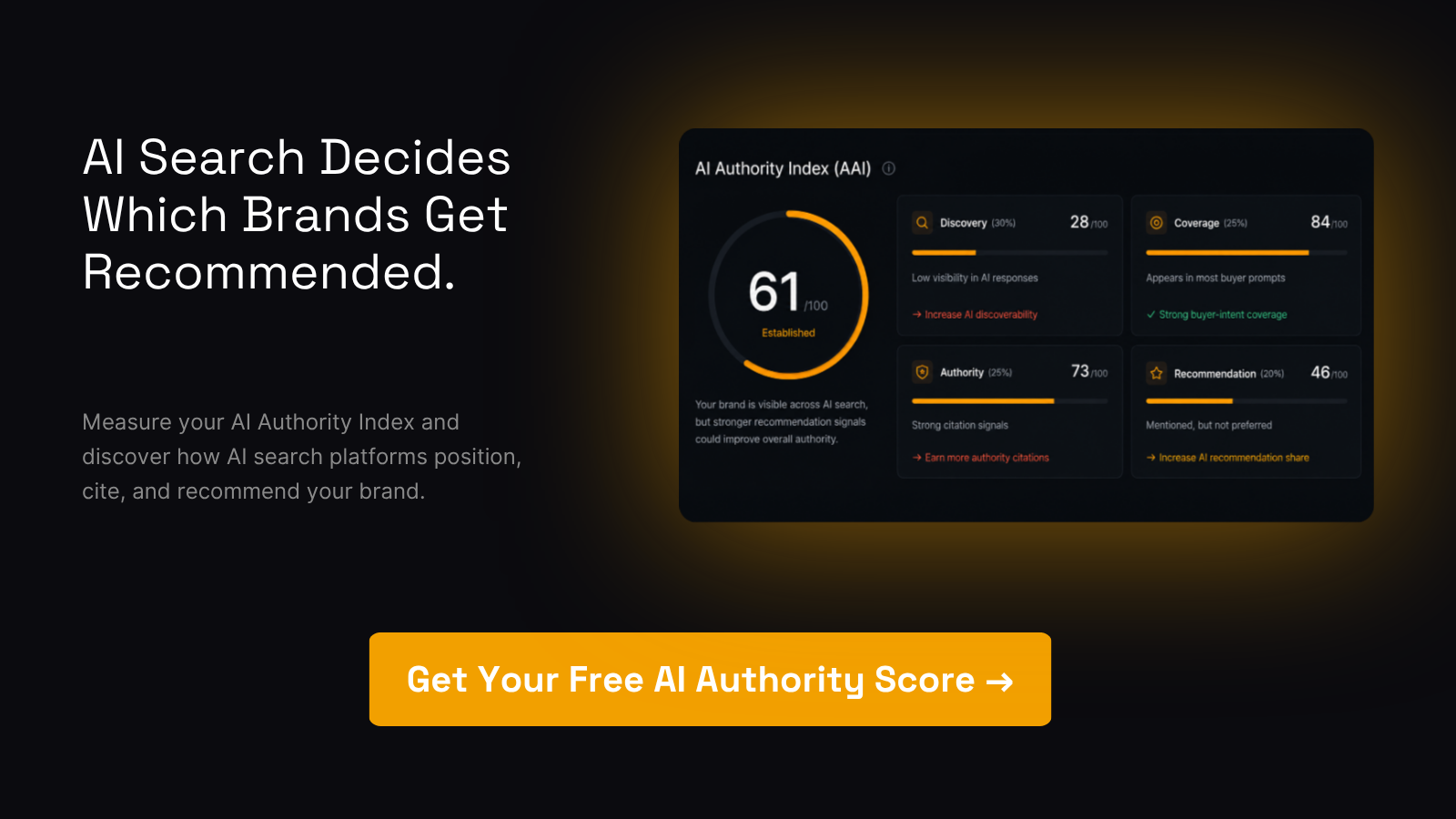
From there, the right next step depends on how deep you want to go:
- The Free AI Visibility Scan surfaces immediate gaps in how AI assistants describe and recommend your brand.
- The Starter plan fits teams beginning to track AI visibility on an ongoing basis.
- The Monthly AI Visibility Report delivers recurring, prioritized recommendations without a full platform commitment.
For teams building out a longer-term measurement practice, pairing a baseline scan with tactical guidance such as crafting extractable answers for AI features or running an independent AI visibility audit can round out your approach alongside ongoing index tracking.
FAQ
What counts as a good AI Authority Index score?
There is no universal passing score since baselines vary by industry and competitive density, but consistent citation from owned and third-party sources, stable positioning, and direct recommendation language are signs of strong performance. Comparing your score against category peers matters more than chasing an absolute number.
How is an AI Authority Index different from a brand's SEO ranking?
SEO rankings measure position in traditional search results, while an AI Authority Index measures whether AI assistants discover, recommend, and accurately describe a brand across multiple engines. A brand can rank well in search yet score poorly on an AI Authority Index if assistants rarely cite or recommend it directly.
Why isn't counting AI mentions enough to measure visibility?
Mention counts ignore context, so a brand mentioned briefly but recommended confidently outperforms one mentioned often but described vaguely.
How often should I benchmark my brand's AI authority?
Fast-moving pillars like discovery and recommendation benefit from monthly checks, while slower-moving trust and citation signals hold up well on a quarterly review. Our Monthly AI Visibility Report is built around that kind of recurring cadence.
Where can I get my brand's AI Authority Index measured?
Our Free AI Visibility Scan provides an initial score across the four pillars, and our Academy methodology guide explains how the underlying measurement works in more detail.